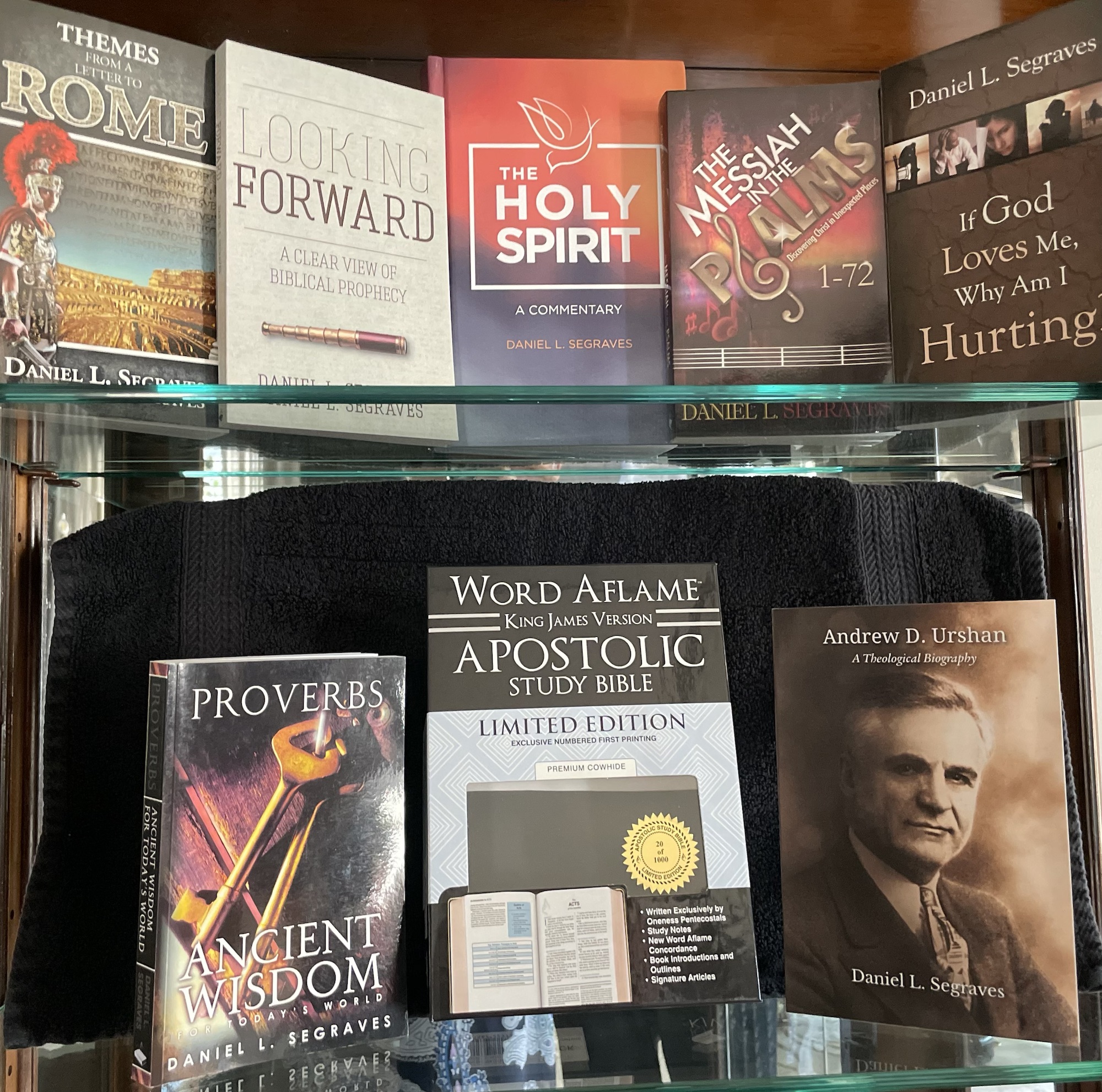
The Holy Spirit: An Apostolic Perspective on Pneumatology, Lesson 3
Lesson 3: The Deity of the Holy Spirit
December 16, 2018 | The Sanctuary UPC
Daniel L. Segraves
The Holy Spirit is God
[1] At several places in Scripture the Holy Spirit is spoken of in such a way as to identify the Spirit with God. For instance, the dramatic event of the death of Ananias because of his lie about the price of the land he sold reveals that Peter viewed the Holy Spirit as God.
But Peter said, “Ananias, why has Satan filled your heart to lie to the Holy Spirit and keep back part of the price of the land for yourself? While it remained was it not your own? And after it was sold, was it not in your own control? Why have you conceived this thing in your heart? You have not lied to men but to God (Acts 5:3-4).
When Ananias lied to the Holy Spirit, he lied to God. This indicates not only that the Holy Spirit is God, but also that the Spirit is not a mere force or power. The Spirit is a conscious, thinking being with whom one can communicate.
[2] Paul also understand the Holy Spirit to be God. He wrote,
Do you not know that you are the temple of God and that the Spirit of God dwells in you? (I Corinthians 3:16).
Or do you not know that your body is the temple of the Holy Spirit who is in you, whom you have from God, and you are not your own? (I Corinthians 6:19).
For believers to be the temple of God is to be the temple of the Holy Spirit. To say one thing is to say the other.
[3] There are many claims in Scripture that it is inspired by the Spirit. Some of these claims are made by Jesus, David, Paul, and Peter. For example:
Now these are the last words of David. Thus says David the son of Jesse; thus says the man raised up on high, the anointed of the God of Jacob, and the sweet psalmist of Israel: “The Spirit of the Lord spoke by me, and His word was on my tongue” (II Samuel 23:1-2).
Then Jesus answered and said, while He taught in the temple, “How is it that the scribes say that the Christ is the Son of David? For David himself said by the Holy Spirit: ‘The Lord said to my Lord, sit at My right hand, till I make Your enemies Your footstool’ ” (Mark 12:35-36).
And in those days Peter stood up in the midst of the disciples (altogether the number of names was about a hundred and twenty), and said, “Men and brethren, this Scripture had to be fulfilled, which the Holy Spirit spoke before by the mouth of David concerning Judas, who became a guide to those who arrested Jesus” (Acts 1:15-16).
All Scripture is given by inspiration of God, and is profitable for doctrine, for reproof, for correction, for instruction in righteousness (II Timothy 3:16).
For prophecy never came by the will of man, but holy men of God spoke as they were moved by the Holy Spirit (II Peter 1:21).
The topic is the same in all cases: the origin of Scripture. The terms used include “the Spirit of the Lord” and “the Holy Spirit,” but these words refer to God Himself.
[4] It is quite interesting to note that Peter, who twice credited the giving of Scripture to the Holy Spirit, also saw “the Spirit of Christ” as its source.
Of this salvation the prophets have inquired and searched diligently, who prophesied of the grace that would come to you, searching what, or what manner of time, the Spirit of Christ who was in them was indicating when He testified beforehand the sufferings of Christ and the glories that would follow. To them it was revealed that, not to themselves, but to us they were ministering the things which now have been reported to you through those who have preached the gospel to you by the Holy Spirit sent from heaven – things which angels desire to look into (I Peter 1:10-12).
How could the Spirit of Christ have been in the prophets when Christ, the Messiah, had not yet come? One possible answer is to note that the term “Spirit of Christ” is a genitive of description, referring perhaps not to the Spirit possessed by Christ but the proclamation of the Holy Spirit about Christ.[1] Another suggestion is that this is a reference to Christ following His resurrection and thus first century prophets, but that does not seem likely in view of the context provided by the three verses.[2]
[5] In the interest of developing a biblical pneumatology, we should note that the only other time the term “Spirit of Christ” appears in Scripture is in Romans 8:9: “But you are not in the flesh but in the Spirit, if indeed the Spirit of God dwells in you. Now if anyone does not have the Spirit of Christ, he is not His.” It seems certain here that Paul used the terms “Spirit of God” and “Spirit of Christ” as synonyms. This would mean these terms were understood to be equivalents in the first century. In that case, the deity of the Spirit and of Christ is further underscored, and clarity is brought to Galatians 4:6: “And because you are sons, God has sent forth the Spirit of His Son into your hearts, crying out, “Abba, Father!”
[6] After the incarnation it was possible to refer to the Holy Spirit as the Spirit of Christ and the Spirit of His Son because the same Spirit, the same God, who gave the Scriptures by inspiration was now manifest in Christ, the Son of God. A statement of the essential oneness of God, the oneness of the church, and the oneness of saving faith is found in Ephesians 4:4-6: “There is one body and one Spirit, just as you were called in one hope of your calling; one Lord, one faith, one baptism; one God and Father of all, who is above all, and through all, and in you all.”
[7] In this text informed by Paul’s interest in the Shema – “Hear, O Israel: The Lord our God, the Lord is one!”[3] – we see that there is but one church, one salvation experience, one Spirit, one Lord and God, the Father. We cannot separate the Lord from God. To do so would be to fly in the face of the Shema. God is the Lord, and the Lord is God. At the same time, there is one Spirit, identified elsewhere in Scripture as the Spirit of God and the Spirit of the Lord. It is because the Lord God is a Spirit being that He can be “above all, through all, and in you all.”
[8] The oneness of the Spirit is also seen in Paul’s discussion of spiritual gifts: “For by one Spirit we were all baptized into one body – whether Jews or Greeks, whether slaves or free – and have all been made to drink into one Spirit” (I Corinthians 12:13). As in Ephesians 4:4, there is one body and one Spirit.
Therefore I make known to you that no one speaking by the Spirit of God calls Jesus accursed, and no one can say that Jesus is Lord except by the Holy Spirit. There are diversities of gifts, but the same Spirit. There are differences of ministries, but the same Lord. And there are diversities of activities, but it is the same God who works all in all. But the manifestation of the Spirit is given to each one for the profit of all (I Corinthians 12:3-7).
We notice first in this text that the Holy Spirit testifies to the deity of Jesus: He is Lord. Then, it is the same Spirit that grants diverse gifts. These gifts are the manifestation of the Spirit.
[9] But why the references to the same Spirit, the same Lord, and the same God? Some read this as evidence of three “persons” in the Godhead.[4] But to do so is to forget Paul’s commitment to the Shema. Earlier in this same letter, Paul appropriated the Shema to remind his readers of the nothingness of idols and of the existence of only one God.[5] Then, in language obviously informed by the Shema, he wrote: “[Y]et for us there is one God, the Father, of whom are all things, and we for Him; and one Lord Jesus Christ, through whom are all things, and through whom we live” (I Corinthians 8:6). Perhaps this could be described as a revision or reshaping of the Shema, but it would be more appropriate to see it as an explanation of the Shema in view of the Incarnation. In the words of Richard Bauckham, “Paul offers a Christian formulation of the Shema.”[6]
[10] In view of the radical monotheism of the Hebrew Scriptures, this is a dramatic, inspired move on Paul’s part. If the Lord (Yahweh) our God (Elohim) is one Lord (Yahweh), how can God be the Father and Jesus the Lord? New Testament faith is deeply rooted in the Hebrew Scriptures. First century Jewish believers saw their faith as having been anticipated by and as having fulfilled the Old Testament. This is seen by the fact that the New Testament quotes from, paraphrases, and alludes to the Old Testament in at least 800 places, although some scholars estimate a much greater frequency of those references.
[11] Because of these deep Old Testament roots, and because Jesus identified the Shema as the first of all the commandments,[7] it is not surprising to see so many references to the Shema in the New Testament. These references need not specifically quote the Shema word for word. The essence of this first commandment was so engrained in Jewish believers that it would not be too much to say that all New Testament affirmations of one God or one Lord or Lord God hearken back to the Shema. There are twenty of these.[8] But when we recognize that even the words “Lord Jesus” reflect the influence of the Shema, the number increases significantly. There are at least 225 such references.
[12] We can appreciate Bauckham’s analysis of I Corinthians 8:6 which demonstrates Paul’s commitment to the Shema. Our difference with Bauckham’s perspective is that the Shema identifies the Lord (Yahweh) our God (Elohim) as one Lord (Yahweh).[9] Bauckham’s conclusion seems to leave open the possibility that God, the Father, is not the Lord but that the Lord is exclusively the Messiah, the Son of the Father. The Shema declares that Yahweh, who is one, is both Lord and God. Bauckham’s “Christian formulation” of the Shema certainly includes the Messiah, but Paul’s use of the Shema points in the direction of the Incarnation.
[13] In a careful examination of the uses of the words “Lord, Lord” as applied by Jesus to Himself in Matthew and Luke, Jason A. Staples demonstrates that “the distinctive double form of ku,rie . . . serves to represent the name YHWH in Greek texts.”[10] Steven J. Beardsley has explored the significance of the word kurios as it is used to refer to Jesus.[11]
[14] What has all of this to do with the Holy Spirit? The reason for this exploration of the use of kurios[12] as it relates to Jesus in the New Testament is to obtain a grasp of the significance of New Testament references to the Shema. What do these references tell us about God? What do they say about Jesus? To what extent, if any, do they inform us about the Holy Spirit? If they do influence our understanding of the Holy Spirit, our belief in the inspiration of both testaments by the Spirit demands that there be no discrepancy of the Spirit’s identity between the two.
[15] The Shema appears first in the Pentateuch (Deuteronomy 6:4). In the interest of establishing context, we should note that “the Pentateuch was originally composed as a single book.”[13] The only apparent reference to the Spirit of the Lord in Deuteronomy is near the end of the book: “Now Joshua the son of Nun was full of the spirit of wisdom, for Moses had laid his hands on him; so the children of Israel heeded him, and did as the Lord had commanded Moses” (Deuteronomy 34:9). The event this refers to reaches back to Numbers 27:18: “And the Lord said to Moses: ‘Take Joshua the son of Nun with you, a man in whom is the Spirit, and lay your hand on him.”
[16] The Spirit with which Joshua was full was not merely the human spirit. The “Spirit of wisdom” describes “the Spirit of the Lord” (Isaiah 11:2). It is significant for biblical pneumatology that this reference to Joshua’s fullness of the Spirit appears at the conclusion of the Pentateuch while the first mention of the Spirit of God is found in the Pentateuch’s second verse. The same Spirit that hovered over the face of the waters at creation filled Joshua to equip him for his mission of leading the people of Israel into the Promised Land.
[17] If John Sailhamer is right that the first chapter of Genesis, beginning with verse 2, is about the preparation of the land later promised to Abraham and his descendants, the references to the Spirit at the opening and closing of the Pentateuch are even more significant.[14] The Spirit is involved at the beginning of the preparation of the Promised Land and on the cusp of entry into that land under Joshua’s leadership. This literary device, referred to by scholars as an inclusio, heightens the profile of the Spirit throughout the Pentateuch.
[18] The Shema declares, “Hear, O Israel: The Lord our God, the Lord is one!” (Deuteronomy 6:4). The New Testament proclaims by its references to the Shema that Jesus is Lord. Finally, as Paul wrote, “No one can say that Jesus is Lord except by the Holy Spirit” (I Corinthians 12:3).[15] The word “Spirit” may be absent from the Shema, but the Spirit is certainly present in the Shema, for only the Spirit of the Lord can identify the Lord.
[1] Daniel L. Segraves, First Peter: Standing Fast in the Grace of God (Hazelwood, MO: Word Aflame Press, 1999), 55-56.
[2] See Peter H. Davids, The First Epistle of Peter (Grand Rapids, MI: Eerdmans, 1990), 62, n. 26.
[3] Deuteronomy 6:4.
[4] Surely this text does not mean that the Spirit is responsible for gifts, the Lord for ministries, and God for activities! Notions like this fragment God into some kind of divine committee. When we see references to “Lord” and “God,” we must keep in mind that the faith of the writers of the New Testament was deeply influenced by the Hebrew Scriptures’ first commandment (according to Jesus [Mark 12:29-30]), the Shema.
[5] I Corinthians 8:4.
[6] Richard Bauckham, Jesus and the God of Israel (Grand Rapids, MI: Eerdman’s, 2008), 97. Bauckham points out the careful structure of I Corinthians 8:6: “but for us [there is] one God, the Father / from whom [are] all things and we for him / and one Lord, Jesus Christ / through whom [are] all things and we through him. ¶In stating that there is one God and one Lord, Paul is unmistakably echoing the monotheistic statement of the Shema` (‘YHWH our God, YHWH is one’), whose Greek version in the Septuagint reads: ‘The Lord our God, the Lord, is one’ (kurios ho theos hēmōn kurios heis estin). Paul has taken over all of the words of this Greek version of the Shema, but rearranged them in such a way as to produce an affirmation of both one God, the Father, and one Lord, Jesus Christ. ¶If Paul were understood as adding the one Lord to the one God of whom the Shema` speaks, then, from the perspective of Jewish monotheism, he would certainly be producing, not christological monotheism, but outright ditheism. . . . [T]he Shema` demands exclusive allegiance to the unique God alone. . . . [T]he addition of a unique Lord to the unique God of the Shema` would flatly contradict the uniqueness of the latter. Paul would not be reasserting Jewish monotheism in a Christian way nor modifying or expanding the Shema`, but repudiating Judaism and radically subverting the Shema`. The only possible way to understand Paul as maintaining monotheism is to understand him to be including Jesus in the unique identity of the one God affirmed in the Shema`. But this is, in any case, clear from the fact that the term ‘Lord’, applied here to Jesus as the ‘one Lord’, is taken from the Shema` itself. Paul is not adding to the one God of the Shema` a ‘Lord’ the Shema` does not mention. He is identifying Jesus as the ‘Lord’ whom the Shema` affirms to be one. In this unprecedented reformulation of the Shema`, the unique identity of the one God consists of the one God, the Father, and the one Lord, his Messiah . . . .” (Bauckham, Jesus and the God of Israel, 101).
[7] Mark 12:29.
[8] One God: Mark 12:32; Romans 3:30; Ephesians 4:6; I Timothy 2:5; James 2:19; One Lord: Mark 12:29; I Corinthians 8:6; Ephesians 4:5; Lord God: Luke 1:32, 68; I Peter 3:15; Revelation 4:8; 11:17; 15:3; 16:7; 18:8; 19:6; 21:22; 22:5, 6.
[9] יְהוָ֥ה אֱלֹהֵ֖ינוּ יְהוָ֥ה׀ אֶחָֽד
[10] Jason A. Staples, “ ‘Lord, Lord’: Jesus as YHWH in Matthew and Luke,” New Testament Studies (2018), 64, p. 19. Referring to Matthew 7:21-22; 25:11; and Luke 6:46, Staples says, “[T]hese verses thereby place a self-referential use of the divine name on Jesus’ lips, an echo any first-century reader familiar with the Greek Bible would be unlikely to miss. Such applications of the name to the exalted Jesus amount to calling him God . . . . In this respect, the presentation of Jesus in these passages appears comparable to that of Philippians 2 and the creedal statement of 1 Cor 8:6, in which Paul expands upon the Shema to talk of ‘One God, the father . . . and one ku,rioj, Jesus Christ’.” Further, it is Staples’ view that the use of the “double ku,rioj” in Matthew and Luke “seems to confirm that the frequent application of the single ku,rioj to Jesus elsewhere should be understood as echoing the divine name.” In some manuscripts, another “double ku,rioj” is found in Luke 13:25.
[11] “Luke reached back into the common religious cultural context of the early Christians where he obtained his understanding of ku,rioj as Yahweh from the Greek Jewish Scriptures . . . . When Luke and his Jewish audience heard ku,rioj, they first understood it to mean Yahweh. . . . For Luke, the identity of Jesus was profoundly clear. Jesus was Yahweh, the Lord God of Israel, born a human being and as such he explicitly replaced Caesar as Lord of all” (Steven J. Beardsley, “Luke’s Narrative Agenda: The Use of ku,rioj within Luke-Acts to Proclaim the Identity of Jesus” [Ph.D. diss., Temple University, 2012], iii).
[12] Some translations, like the KJV, translate kurios as “Lord,” even when the New Testament reference is to an Old Testament text using the Hebrew Yahweh. More recent English translations tend to translate kurios as Lord when the Old Testament text uses Yahweh. This is helpful for English readers because it immediately indicates the deity of Jesus. See, for example, Hebrews 1:10 (NKJV). In nearly every case where Yahweh appears in the Old Testament, the KJV renders it as Lord. The Greek Septuagint, commonly referred to as LXX, renders Yahweh as kurios. Most of the quotations from the Old Testament, as well as paraphrases of and allusions to the Old Testament in the New Testament, are from the Septuagint. Since the Septuagint translates Yahweh into Greek as kurios, so does the New Testament.
[13] Sailhamer, The Pentateuch as Narrative, xix.
[14] Sailhamer maintains “that the narratives of Genesis 1 and 2 are to be understood as both literal and historical. They recount two great acts of God. In the first act, God created the universe we see around us today, consisting of the earth, the sun, the moon, the stars, and all the plants and animals that now inhabit (or formerly inhabited) the earth. The biblical record of that act of creation is recounted in Genesis 1:1 . . . . ¶The second act of God recounted in Genesis 1 and 2 deals with a much more limited scope and period of time. Beginning with Genesis 1:2, the biblical narrative recounts God’s preparation of a land for the man and woman He was to create. That ‘land’ was the same land later promised to Abraham and his descendants. It was the land which God gave to Israel after their exodus from Egypt. It was that land to which Joshua led the Israelites after their time of wandering in the wilderness. According to Genesis 1, God prepared that land within a period of a six-day work week. On the sixth day of that week, God created human beings. God then rested on the seventh day” (John H. Sailhamer, Genesis Unbound: A Provocative New Look at the Creation Account [Colorado Springs, CO: Dawson Media, 2011], iBook edition, “Introduction.”
[15] In I Corinthians 12:3 there is no specific quotation from the Old Testament, but the association of the word kurios (Lord) with Jesus throughout the New Testament provides strong contextual evidence that any use of “Lord” with “Jesus” recalls the Shema’s assertion that there is one Lord who is God.
Copyright © 2018 by Daniel L. Segraves
Daniel Segraves plays “I’ll Be Home for Christmas.”
Daniel Segraves Plays “Silent Night.”
[archive]
Daniel Segraves at the Piano
Let’s get one thing straight. I don’t consider myself to be a great pianist. I have had the privilege over the years of playing the Hammond B-3 organ (with the Leslie speaker, of course!) in church services. First, when I was on staff at the First Pentecostal Church in Maplewood, Missouri in the early 1970s, then at Christian Life Center in Stockton, California, and now at The Sanctuary in Hazelwood, Missouri.
I enjoy playing and appreciate the opportunity to do so. Since our marriage, Susan has posted various short videos on FaceBook of me playing the piano at home. People are very kind, and they say nice things. Susan says they are always asking for more videos. Now I have a bit of technology that enables me to record and post them more quickly, so I will do that from time to time.
A couple of Christmas songs will follow this post, and you will find other songs posted occasionally.[archive]
The Holy Spirit, Lesson 2 Video
The Holy Spirit: An Apostolic Perspective on Pneumatology, Lesson 2
The Deity of the Holy Spirit
December 9, 2018 | The Sanctuary UPC
Daniel L. Segraves
[1] In a chapter titled “The Holy Spirit and the Oneness of God,” Frank Stagg offered a perspective on the Holy Spirit that focuses on the deity of the Spirit rather than any notion of distinctions between persons in the Godhead.[1]
[2] The accuracy of this perspective becomes apparent as we examine the various biblical references to the Spirit. As we have seen, the Spirit is God at work in creation. For this reason, we will not refer to the Holy Spirit as “it.” We have also seen that the Spirit is God at work in the granting of skills for the construction of the tabernacle and in the impartation of wisdom needed for leadership.
[3] In short, we cannot fragment God by separating Him from His Spirit. When the Holy Spirit is present, God is present. David acknowledged this in his prayer of repentance: “Do not cast me away from Your presence, and do not take Your Holy Spirit from me” (Psalm 51:11). In another prayer, David asked, “Where can I go from Your Spirit? Or where can I flee from Your presence?” (Psalm 139:7). As Jesus said, “God is Spirit” (John 4:24).
[4] It is difficult to think of God as a “person” in view of our self-identity as persons. If we think of God as a person like ourselves, we have made Him in our image. We are, instead, made in His image.[2] Whatever that may have meant at the time of creation, that image is now marred by our participation in sinful rebellion against God. Jesus is, of course, God manifest in human existence, but spared sin’s mar by the miracle of His conception by the Holy Spirit in the womb of a virgin.[3]
[5] In the King James Version, the word “person” appears only once in reference to God. This is in Hebrews 1:3, where the Son of God is declared to be the express image of God’s “person.” The word “person” is translated from the Greek hypostasis, which refers to the substratum, or that which underlies something. Here, it is a reference to the essence or essential nature of God. Thus, Jesus is the exact representation of God’s essence. As Paul put it, “He is the image of the invisible God, the firstborn[4] over all creation” (Colossians 1:15). God is invisible because He is Spirit. Jesus is visible because He is God incarnate, God in flesh. In this miraculous event, God added complete and authentic human existence to His divine essence. This included not only a human body, but everything essential to human existence, materially and immaterially.
[6] The invisibility of God apart from the incarnation is also seen in John 1:18: “No one has seen God at any time. The only begotten Son, who is in the bosom of the Father, He has declared Him.” There are those who think this means the Son is not God. This is not the case. In the Greek text, there is no definite article preceding the word “God” (theon). This means the reference is to God’s essence, to what He essentially is. God is essentially Spirit,[5] and a spirit is invisible.[6] The word translated “declared” (éxēgéomai) means Christ revealed God, making Him fully known.[7]
[7] Confusion arises when we think we define what it means to be human. But the incarnation did not require participation in the sin “nature,” for sin is not inherent in what it means to be human. Neither Adam nor Eve were created fallen, but both were fully human. As Paul wrote, “ ‘The first man Adam became a living being.’ The last Adam became a life-giving spirit” (I Corinthians 15:45). Due to our fallenness, we could say that Jesus was more human than we are. He was perfectly human, as people were created to be.
[8] But the English word “person” does not really capture the idea of hypostasis. For that reason, most translations of Hebrews 1:3 do not use the word “person” at this point. Instead, the words used include “being,” “nature,” “essence,” “character,” and “subsistence.”[8]
[9] In an effort to avoid the fragmentation that so often occurs when the words “person” and “persons” are used to describe God as a trinity, Alister E. McGrath explains the contrast in meaning between the third century use of the word “person” and the meaning of “person” today.[9]
[10] It is of historical interest that “person,” when first used by Tertullian, referred to the role played by an actor in a face mask who could also fill other roles by means of different masks, but it remains that the use of the words “person” or “persons” complicates and obscures the biblical witness to the oneness of God as proclaimed in the Shema: “Hear, O Israel: The Lord our God, the Lord is one!” (Deuteronomy 6:4). To speak of God as one person in the modern sense of the word seeks to preserve His oneness, but the problem remains that this is not precisely the sense with which Scripture speaks of God. To use the word “person” in the ancient sense of the word does not avoid sequential Sabellianism or modalism, because no actor could wear three masks at once.
[11] Millard J. Erickson observes that there is nothing in the term “Spirit of God” that indicates the Spirit is a separate person from God.[10] After a discussion of the Spirit of Jehovah in the books of Judges and I Samuel, J. H. Raven asserted that the Old Testament includes no “distinction of persons in the Godhead.”[11]
[12] Ideally, we should use biblical language when speaking of God. As it relates to Hebrews 1:3, the word is hypostasis. This word must, of course, be defined in our language. Lexicons agree that the essential meaning of the word is essence, nature, real being, substance.[12] The word “person,” in the ancient or modern sense, does not capture this meaning. God is a being, a spirit being, a spirit being who added sinless human existence to his unmitigated deity.
[13] Perhaps a better way to think of God in connection with various biblical terms is this: God is spoken of as God, and sometimes as God the Father.[13] When we see these terms, we can think of God as transcendent, prior to, above and beyond the created realm. The Son, Jesus, is spoken of as God.[14] When we see this, we can think of God made known to us in sinless human existence, God incarnate. The Spirit is identified as the Spirit of God.[15] When we see references to the Spirit, we can think of God immanent, among us, with us, in us.
[14] Regardless of the words used in reference to God in Scripture, it is the same God. The Shema undergirds all that can be said of God. Whether He is before us, beyond us, above us, among us, in us, or incarnate, He is the same God.
The Holy Spirit is God
[15] At several places in Scripture the Holy Spirit is spoken of in such a way as to identify the Spirit with God. For instance, the dramatic event of the death of Ananias because of his lie about the price of the land he sold reveals that Peter viewed the Holy Spirit as God.
But Peter said, “Ananias, why has Satan filled your heart to lie to the Holy Spirit and keep back part of the price of the land for yourself? While it remained was it not your own? And after it was sold, was it not in your own control? Why have you conceived this thing in your heart? You have not lied to men but to God (Acts 5:3-4).
When Ananias lied to the Holy Spirit, he lied to God. This indicates not only that the Holy Spirit is God, but also that the Spirit is not a mere force or power. The Spirit is a conscious, thinking being with whom one can communicate.
[16] Paul also understand the Holy Spirit to be God. He wrote,
Do you not know that you are the temple of God and that the Spirit of God dwells in you? (I Corinthians 3:16).
Or do you not know that your body is the temple of the Holy Spirit who is in you, whom you have from God, and you are not your own? (I Corinthians 6:19).
For believers to be the temple of God is to be the temple of the Holy Spirit. To say one thing is to say the other.
[17] There are many claims in Scripture that it is inspired by the Spirit. Some of these claims are made by Jesus, David, Paul, and Peter. For example:
Now these are the last words of David. Thus says David the son of Jesse; thus says the man raised up on high, the anointed of the God of Jacob, and the sweet psalmist of Israel: “The Spirit of the Lord spoke by me, and His word was on my tongue” (II Samuel 23:1-2).
Then Jesus answered and said, while He taught in the temple, “How is it that the scribes say that the Christ is the Son of David? For David himself said by the Holy Spirit: ‘The Lord said to my Lord, sit at My right hand, till I make Your enemies Your footstool’ ” (Mark 12:35-36).
And in those days Peter stood up in the midst of the disciples (altogether the number of names was about a hundred and twenty), and said, “Men and brethren, this Scripture had to be fulfilled, which the Holy Spirit spoke before by the mouth of David concerning Judas, who became a guide to those who arrested Jesus” (Acts 1:15-16).
All Scripture is given by inspiration of God, and is profitable for doctrine, for reproof, for correction, for instruction in righteousness (II Timothy 3:16).
For prophecy never came by the will of man, but holy men of God spoke as they were moved by the Holy Spirit (II Peter 1:21).
The topic is the same in all cases: the origin of Scripture. The terms used include “the Spirit of the Lord” and “the Holy Spirit,” but these words refer to God Himself.
[18 It is quite interesting to note that Peter, who twice credited the giving of Scripture to the Holy Spirit, also saw “the Spirit of Christ” as its source.
Of this salvation the prophets have inquired and searched diligently, who prophesied of the grace that would come to you, searching what, or what manner of time, the Spirit of Christ who was in them was indicating when He testified beforehand the sufferings of Christ and the glories that would follow. To them it was revealed that, not to themselves, but to us they were ministering the things which now have been reported to you through those who have preached the gospel to you by the Holy Spirit sent from heaven – things which angels desire to look into (I Peter 1:10-12).
How could the Spirit of Christ have been in the prophets when Christ, the Messiah, had not yet come? One possible answer is to note that the term “Spirit of Christ” is a genitive of description, referring perhaps not to the Spirit possessed by Christ but the proclamation of the Holy Spirit about Christ.[16] Another suggestion is that this is a reference to Christ following His resurrection and thus first century prophets, but that does not seem likely in view of the context provided by the three verses.[17]
[19] In the interest of developing a biblical pneumatology, we should note that the only other time the term “Spirit of Christ” appears in Scripture is in Romans 8:9: “But you are not in the flesh but in the Spirit, if indeed the Spirit of God dwells in you. Now if anyone does not have the Spirit of Christ, he is not His.” It seems certain here that Paul used the terms “Spirit of God” and “Spirit of Christ” as synonyms. This would mean these terms were understood to be equivalents in the first century. In that case, the deity of the Spirit and of Christ is further underscored, and clarity is brought to Galatians 4:6: “And because you are sons, God has sent forth the Spirit of His Son into your hearts, crying out, “Abba, Father!”
[20] After the incarnation it was possible to refer to the Holy Spirit as the Spirit of Christ and the Spirit of His Son because the same Spirit, the same God, who gave the Scriptures by inspiration was now manifest in Christ, the Son of God. A statement of the essential oneness of God, the oneness of the church, and the oneness of saving faith is found in Ephesians 4:4-6: “There is one body and one Spirit, just as you were called in one hope of your calling; one Lord, one faith, one baptism; one God and Father of all, who is above all, and through all, and in you all.”
[21] In this text informed by Paul’s interest in the Shema – “Hear, O Israel: The Lord our God, the Lord is one!”[18] – we see that there is but one church, one salvation experience, one Spirit, one Lord and God, the Father. We cannot separate the Lord from God. To do so would be to fly in the face of the Shema. God is the Lord, and the Lord is God. At the same time, there is one Spirit, identified elsewhere in Scripture as the Spirit of God and the Spirit of the Lord. It is because the Lord God is a Spirit being that He can be “above all, through all, and in you all.”
[22] The oneness of the Spirit is also seen in Paul’s discussion of spiritual gifts: “For by one Spirit we were all baptized into one body – whether Jews or Greeks, whether slaves or free – and have all been made to drink into one Spirit” (I Corinthians 12:13). As in Ephesians 4:4, there is one body and one Spirit.
Therefore I make known to you that no one speaking by the Spirit of God calls Jesus accursed, and no one can say that Jesus is Lord except by the Holy Spirit. There are diversities of gifts, but the same Spirit. There are differences of ministries, but the same Lord. And there are diversities of activities, but it is the same God who works all in all. But the manifestation of the Spirit is given to each one for the profit of all (I Corinthians 12:3-7).
We notice first in this text that the Holy Spirit testifies to the deity of Jesus: He is Lord. Then, it is the same Spirit that grants diverse gifts. These gifts are the manifestation of the Spirit.
[23] But why the references to the same Spirit, the same Lord, and the same God? Some read this as evidence of three “persons” in the Godhead.[19] But to do so is to forget Paul’s commitment to the Shema. Earlier in this same letter, Paul appropriated the Shema to remind his readers of the nothingness of idols and of the existence of only one God.[20] Then, in language obviously informed by the Shema, he wrote: “[Y]et for us there is one God, the Father, of whom are all things, and we for Him; and one Lord Jesus Christ, through whom are all things, and through whom we live” (I Corinthians 8:6). Perhaps this could be described as a revision or reshaping of the Shema, but it would be more appropriate to see it as an explanation of the Shema in view of the Incarnation. In the words of Richard Bauckham, “Paul offers a Christian formulation of the Shema.”[21]
[24] In view of the radical monotheism of the Hebrew Scriptures, this is a dramatic, inspired move on Paul’s part. If the Lord (Yahweh) our God (Elohim) is one Lord (Yahweh), how can God be the Father and Jesus the Lord? New Testament faith is deeply rooted in the Hebrew Scriptures. First century Jewish believers saw their faith as having been anticipated by and as having fulfilled the Old Testament. This is seen by the fact that the New Testament quotes from, paraphrases, and alludes to the Old Testament in at least 800 places, although some scholars estimate a much greater frequency of those references.
[25] Because of these deep Old Testament roots, and because Jesus identified the Shema as the first of all the commandments,[22] it is not surprising to see so many references to the Shema in the New Testament. These references need not specifically quote the Shema word for word. The essence of this first commandment was so engrained in Jewish believers that it would not be too much to say that all New Testament affirmations of one God or one Lord or Lord God hearken back to the Shema. There are twenty of these.[23] But when we recognize that even the words “Lord Jesus” reflect the influence of the Shema, the number increases significantly. There are at least 225 such references.
[26] We can appreciate Bauckham’s analysis of I Corinthians 8:6 which demonstrates Paul’s commitment to the Shema. Our difference with Bauckham’s perspective is that the Shema identifies the Lord (Yahweh) our God (Elohim) as one Lord (Yahweh).[24] Bauckham’s conclusion seems to leave open the possibility that God, the Father, is not the Lord but that the Lord is exclusively the Messiah, the Son of the Father. The Shema declares that Yahweh, who is one, is both Lord and God. Bauckham’s “Christian formulation” of the Shema certainly includes the Messiah, but Paul’s use of the Shema points in the direction of the Incarnation.
[27] In a careful examination of the uses of the words “Lord, Lord” as applied by Jesus to Himself in Matthew and Luke, Jason A. Staples demonstrates that “the distinctive double form of ku,rie . . . serves to represent the name YHWH in Greek texts.”[25] Steven J. Beardsley has explored the significance of the word kurios as it is used to refer to Jesus.[26]
[28] What has all of this to do with the Holy Spirit? The reason for this exploration of the use of kurios[27] as it relates to Jesus in the New Testament is to obtain a grasp of the significance of New Testament references to the Shema. What do these references tell us about God? What do they say about Jesus? To what extent, if any, do they inform us about the Holy Spirit? If they do influence our understanding of the Holy Spirit, our belief in the inspiration of both testaments by the Spirit demands that there be no discrepancy of the Spirit’s identity between the two.
[29] The Shema appears first in the Pentateuch (Deuteronomy 6:4). In the interest of establishing context, we should note that “the Pentateuch was originally composed as a single book.”[28] The only apparent reference to the Spirit of the Lord in Deuteronomy is near the end of the book: “Now Joshua the son of Nun was full of the spirit of wisdom, for Moses had laid his hands on him; so the children of Israel heeded him, and did as the Lord had commanded Moses” (Deuteronomy 34:9). The event this refers to reaches back to Numbers 27:18: “And the Lord said to Moses: ‘Take Joshua the son of Nun with you, a man in whom is the Spirit, and lay your hand on him.”
[30] The Spirit with which Joshua was full was not merely the human spirit. The “Spirit of wisdom” describes “the Spirit of the Lord” (Isaiah 11:2). It is significant for biblical pneumatology that this reference to Joshua’s fullness of the Spirit appears at the conclusion of the Pentateuch while the first mention of the Spirit of God is found in the Pentateuch’s second verse. The same Spirit that hovered over the face of the waters at creation filled Joshua to equip him for his mission of leading the people of Israel into the Promised Land.
[31] If John Sailhamer is right that the first chapter of Genesis, beginning with verse 2, is about the preparation of the land later promised to Abraham and his descendants, the references to the Spirit at the opening and closing of the Pentateuch are even more significant.[29] The Spirit is involved at the beginning of the preparation of the Promised Land and on the cusp of entry into that land under Joshua’s leadership. This literary device, referred to by scholars as an inclusio, heightens the profile of the Spirit throughout the Pentateuch.
[32] The Shema declares, “Hear, O Israel: The Lord our God, the Lord is one!” (Deuteronomy 6:4). The New Testament proclaims by its references to the Shema that Jesus is Lord. Finally, as Paul wrote, “No one can say that Jesus is Lord except by the Holy Spirit” (I Corinthians 12:3).[30] The word “Spirit” may be absent from the Shema, but the Spirit is certainly present in the Shema, for only the Spirit of the Lord can identify the Lord.
[1] “The Holy Spirit is the Spirit of God, not the Spirit of the third person of the trinity. The Holy Spirit is God in nearness and power, anywhere and anytime, the very divine presence incarnated in Jesus Christ now present in people. The Holy Spirit is not a third God nor one-third of God. The Spirit is God relating to us in creation, judgment, guidance, strength, redemption, or otherwise” Frank Stagg, The Holy Spirit Today (Macon, GA: Smyth & Helwys, 1995), 11. Stagg, who was a professor at The Southern Baptist Theological Seminary, commented further, “ ‘Spirit’ when applied to God implied God’s immanence in the world, near and accessible. . . . ¶In the Old Testament, ‘the Spirit of Yahweh’ or ‘the Spirit of Elohim’ does not imply division within God or a person separate from God. This is simply another way of referring to God. . . . ¶The terms ‘God’ and ‘Spirit’ are there in the Old Testament, but they do not imply two Gods or one God as two persons, a divine ‘Binity.’ The absence of a ‘binitarian’ doctrine in the Old Testament should caution us against any ‘trinitarian’ doctrine implying division within God as three Persons. . . . ¶The Old Testament portrayal of ‘the Spirit of God as active in his world creating, inspiring, and empowering’ anticipates the incarnational representation of ‘the Holy Spirit’ and spirituality in the New Testament. . . . ¶the Old Testament and the Gospels also know of God’s presence as the Spirit. . . . ¶The Holy Spirit, then, is not a third god nor one-third of God. The Holy Spirit is God in nearness and power, anytime and anywhere, the same divine presence as we know in the word made flesh, Immanuel. . . . ¶Someone will say, ‘But this is modalism.’ Labels come easy, and this label as widely employed is to be rejected, even though it is to be preferred to tritheism. If by ‘modalism’ one means that God came serially, now as Father, now as Son, and now as Holy Spirit, this is to be rejected as not doing justice to New Testament faith. . . . That God may be known, and is actually known, as Father, Son, and Holy Spirit, is true to New Testament faith. But ‘modalism’ as God divided or God coming in installments is not true to New Testament faith. ¶Theology’s problem is that it has no terms or models which do justice to the reality of God in the richness of God’s self-disclosure to us and presence with us. Our point is that when we encounter God as Father, it is God (not a fraction) whom we meet. When we encounter God as Son, it is God who is with us. When we encounter God as Holy Spirit, it is God whom we encounter” (12-13).
[2] Genesis 1:26-27.
[3] Luke 1:26-38.
[4] The word translated “firstborn” (prōtotokos) can mean “existing prior to something else,” but it need not. It can also have the sense of “superior in status.” See Johannes P. Louw and Eugene A. Nida, Louw-Nida Greek-English Lexicon of the New Testament, BibleWorks – Version 10.0.8.667, 10.43; 13.79; 87.47. When a range of meaning is possible, meaning is influenced by context. The immediate context of Colossians 1:15 concludes “that in all things He may have the preeminence” (Colossians 1:18).
[5] Exodus 33:20; Matthew 16:17; Luke 24:39; I Timothy 1:17; 6:15-16; Hebrews 11:27; 12:9; I John 4:12.
[6] Merrill C. Tenney wrote, “The noun God (theon) has no article in the Greek text, which indicates that the author is presenting God in his nature of being rather than as a person. ‘Deity’ might be a more accurate rendering. The meaning is that no human has ever seen the essence of deity. God is invisible, not because he is unreal, but because physical eyes are incapable of detecting him” (The Expositor’s Bible Commentary [Grand Rapids: Zondervan, 1981], 34). Edwin A. Blum commented, “God in His essence is invisible (I Tim. 1:17). He is One ‘whom no one has ever seen or can see’ (I Tim. 6:16). But John 1:18 means, ‘no one has ever seen God’s essential nature.’ God may be seen in a theophany or anthropomorphism but His inner essence or nature is disclosed only in Jesus’ (The Bible Knowledge Commentary [Wheaton, IL: Victor Books, 1983], 273). According to Marvin R. Vincent, “The seeing intended here is seeing of the divine essence rather than of the divine person, which is also indicated by the absence of the article from θεον, God” (Word Studies in the New Testament, vol. 2 (Peabody, MA: Hendrickson, n.d.), 59.
[7] Friberg, Analytical Greek Lexicon.
[8] The phrase translated “the express image of His person” in the KJV is rendered as follows: “the very imprint of his being” (NAB); “the exact representation of His nature” (NAS); “the representation of His essence” (NET); “the exact representation of his being” (NIB); “the impress of God’s own being” (NJB); “the very character of God” (NLT); “the impress of His subsistence” (YLT).
[9] “How can God be three persons and one person at the same time? . . . The word ‘person’ has changed its meaning since the third century when it began to be used in connection with the ‘threefoldness of God’. When we talk about God as a person, we naturally think of God a being one person. But theologians such as Tertullian, writing in the third century, used the word ‘person’ with a different meaning. The word ‘person’ originally derives from the Latin word persona, meaning an actor’s face-mask – and, by extension, the role which he takes in a play.” ¶By stating that there were three persons but only one God, Tertullian was asserting that all three major roles in the great drama of human redemption are played by the one and the same God. The three great roles in this drama are all played by the same actor: God. Each of these roles may reveal God in a somewhat different way, but it is the same God in every case. So when we talk about God as one person, we mean one person in the modern sense of the word, and when we talk about God as three persons, we mean three persons in the ancient sense of the word. . . . Confusing these two senses of the word ‘person’ inevitably leads to the idea that God is actually a committee . . . ” Alister E. McGrath, Understanding the Trinity (Grand Rapids, MI: Academie Books, Zondervan,1988), 130-131. McGrath also wrote, “[T]he New Testament tends to think of the Holy Spirit as the Spirit of Christ as much as of God. The Spirit is understood to stand in the closest of possible relationships to Christ, so that his presence among the people of Christ is equivalent to the presence of Christ himself, just as the presence of Christ is treated as being that of God himself. In other words, to encounter the Son is really to encounter the Father and not some demigod or surrogate. To encounter the Spirit is really to encounter the Son and hence the Father. The enormous importance of this is obvious: the believer of today can encounter the living God at first-hand, not through semi-divine or created intermediaries. To affirm the divinity of Father, Son and Spirit is not to suggest that there are three gods, but simply that the one God can be encountered in these different ways, all of which are equally valid. It means that God makes himself available, here and now, directly and personally” (129-130).
[10] “It is not apparent from this construction [of the two nouns, Spirit and God] that a separate person is involved. The expression ‘Spirit of God’ could well be understood as being simply a reference to the will, mind, or activity of God. . . . [T]he Old Testament ‘Spirit of God’ is synonymous with the Holy Spirit” (Millard J. Erickson, Christian Theology [Grand Rapids: MI: Baker, 1985], 866).
[11] “Although these expressions resemble what it [sic] said about the Holy Spirit in the New Testament, there is here no distinction of persons in the Godhead. The Spirit of God in the Old Testament is God himself exercising active influence and imparting divine life” (John H. Raven, The History of the Religion of Israel: An Old Testament Theology [Grand Rapids, MI: Baker, 1979], 164).
[12] See Louw-Nida Greek-English Lexicon, Liddell-Scott Greek Lexicon, Friberg Lexicon, and Walter Bauer, A Greek-English Lexicon of the New Testament and Other Early Christian Literature, trans. William F. Arndt and F. Wilbur Gingrich (Chicago: University of Chicago Press, 1979), 847.
[13] John 6:27; I Corinthians 8:6; Galatians 1:1, 3; Ephesians 6:23; Philippians 2:11; I Thessalonians 1:1; II Timothy 1:2; Titus 1:4; I Peter 1:2; II Peter 1:17; II John 1:3; Jude 1:1.
[14] II Peter 1:1; Romans 9:5; Isaiah 9:6; I Timothy 3:16; Matthew 1:23; Titus 2:13; Hebrews 1:8, 10.
[15] See endnote 3.
[16] Daniel L. Segraves, First Peter: Standing Fast in the Grace of God (Hazelwood, MO: Word Aflame Press, 1999), 55-56.
[17] See Peter H. Davids, The First Epistle of Peter (Grand Rapids, MI: Eerdmans, 1990), 62, n. 26.
[18] Deuteronomy 6:4.
[19] Surely this text does not mean that the Spirit is responsible for gifts, the Lord for ministries, and God for activities! Notions like this fragment God into some kind of divine committee. When we see references to “Lord” and “God,” we must keep in mind that the faith of the writers of the New Testament was deeply influenced by the Hebrew Scriptures’ first commandment (according to Jesus [Mark 12:29-30]), the Shema.
[20] I Corinthians 8:4.
[21] Richard Bauckham, Jesus and the God of Israel (Grand Rapids, MI: Eerdman’s, 2008), 97. Bauckham points out the careful structure of I Corinthians 8:6: “but for us [there is] one God, the Father / from whom [are] all things and we for him / and one Lord, Jesus Christ / through whom [are] all things and we through him. ¶In stating that there is one God and one Lord, Paul is unmistakably echoing the monotheistic statement of the Shema` (‘YHWH our God, YHWH is one’), whose Greek version in the Septuagint reads: ‘The Lord our God, the Lord, is one’ (kurios ho theos hēmōn kurios heis estin). Paul has taken over all of the words of this Greek version of the Shema, but rearranged them in such a way as to produce an affirmation of both one God, the Father, and one Lord, Jesus Christ. ¶If Paul were understood as adding the one Lord to the one God of whom the Shema` speaks, then, from the perspective of Jewish monotheism, he would certainly be producing, not christological monotheism, but outright ditheism. . . . [T]he Shema` demands exclusive allegiance to the unique God alone. . . . [T]he addition of a unique Lord to the unique God of the Shema` would flatly contradict the uniqueness of the latter. Paul would not be reasserting Jewish monotheism in a Christian way nor modifying or expanding the Shema`, but repudiating Judaism and radically subverting the Shema`. The only possible way to understand Paul as maintaining monotheism is to understand him to be including Jesus in the unique identity of the one God affirmed in the Shema`. But this is, in any case, clear from the fact that the term ‘Lord’, applied here to Jesus as the ‘one Lord’, is taken from the Shema` itself. Paul is not adding to the one God of the Shema` a ‘Lord’ the Shema` does not mention. He is identifying Jesus as the ‘Lord’ whom the Shema` affirms to be one. In this unprecedented reformulation of the Shema`, the unique identity of the one God consists of the one God, the Father, and the one Lord, his Messiah . . . .” (Bauckham, Jesus and the God of Israel, 101).
[22] Mark 12:29.
[23] One God: Mark 12:32; Romans 3:30; Ephesians 4:6; I Timothy 2:5; James 2:19; One Lord: Mark 12:29; I Corinthians 8:6; Ephesians 4:5; Lord God: Luke 1:32, 68; I Peter 3:15; Revelation 4:8; 11:17; 15:3; 16:7; 18:8; 19:6; 21:22; 22:5, 6.
[24] יְהוָ֥ה אֱלֹהֵ֖ינוּ יְהוָ֥ה׀ אֶחָֽד
[25] Jason A. Staples, “ ‘Lord, Lord’: Jesus as YHWH in Matthew and Luke,” New Testament Studies (2018), 64, p. 19. Referring to Matthew 7:21-22; 25:11; and Luke 6:46, Staples says, “[T]hese verses thereby place a self-referential use of the divine name on Jesus’ lips, an echo any first-century reader familiar with the Greek Bible would be unlikely to miss. Such applications of the name to the exalted Jesus amount to calling him God . . . . In this respect, the presentation of Jesus in these passages appears comparable to that of Philippians 2 and the creedal statement of 1 Cor 8:6, in which Paul expands upon the Shema to talk of ‘One God, the father . . . and one ku,rioj, Jesus Christ’.” Further, it is Staples’ view that the use of the “double ku,rioj” in Matthew and Luke “seems to confirm that the frequent application of the single ku,rioj to Jesus elsewhere should be understood as echoing the divine name.” In some manuscripts, another “double ku,rioj” is found in Luke 13:25.
[26] “Luke reached back into the common religious cultural context of the early Christians where he obtained his understanding of ku,rioj as Yahweh from the Greek Jewish Scriptures . . . . When Luke and his Jewish audience heard ku,rioj, they first understood it to mean Yahweh. . . . For Luke, the identity of Jesus was profoundly clear. Jesus was Yahweh, the Lord God of Israel, born a human being and as such he explicitly replaced Caesar as Lord of all” (Steven J. Beardsley, “Luke’s Narrative Agenda: The Use of ku,rioj within Luke-Acts to Proclaim the Identity of Jesus” [Ph.D. diss., Temple University, 2012], iii).
[27] Some translations, like the KJV, translate kurios as “Lord,” even when the New Testament reference is to an Old Testament text using the Hebrew Yahweh. More recent English translations tend to translate kurios as Lord when the Old Testament text uses Yahweh. This is helpful for English readers because it immediately indicates the deity of Jesus. See, for example, Hebrews 1:10 (NKJV). In nearly every case where Yahweh appears in the Old Testament, the KJV renders it as Lord. The Greek Septuagint, commonly referred to as LXX, renders Yahweh as kurios. Most of the quotations from the Old Testament, as well as paraphrases of and allusions to the Old Testament in the New Testament, are from the Septuagint. Since the Septuagint translates Yahweh into Greek as kurios, so does the New Testament.
[28] Sailhamer, The Pentateuch as Narrative, xix.
[29] Sailhamer maintains “that the narratives of Genesis 1 and 2 are to be understood as both literal and historical. They recount two great acts of God. In the first act, God created the universe we see around us today, consisting of the earth, the sun, the moon, the stars, and all the plants and animals that now inhabit (or formerly inhabited) the earth. The biblical record of that act of creation is recounted in Genesis 1:1 . . . . ¶The second act of God recounted in Genesis 1 and 2 deals with a much more limited scope and period of time. Beginning with Genesis 1:2, the biblical narrative recounts God’s preparation of a land for the man and woman He was to create. That ‘land’ was the same land later promised to Abraham and his descendants. It was the land which God gave to Israel after their exodus from Egypt. It was that land to which Joshua led the Israelites after their time of wandering in the wilderness. According to Genesis 1, God prepared that land within a period of a six-day work week. On the sixth day of that week, God created human beings. God then rested on the seventh day” (John H. Sailhamer, Genesis Unbound: A Provocative New Look at the Creation Account [Colorado Springs, CO: Dawson Media, 2011], iBook edition, “Introduction.”
[30] In I Corinthians 12:3 there is no specific quotation from the Old Testament, but the association of the word kurios (Lord) with Jesus throughout the New Testament provides strong contextual evidence that any use of “Lord” with “Jesus” recalls the Shema’s assertion that there is one Lord who is God.
Copyright (c) 2018 by Daniel L. Segraves[archive]
The Holy Spirit, Lesson 1 Video
The Holy Spirit: An Apostolic Perspective on Pneumatology, Lesson 1
This Sunday, December 2, 2018, I will begin teaching a series of thirteen weekly lessons at The Sanctuary UPC in Hazelwood, Missouri. The lessons will be drawn from a book I am writing on the Holy Spirit, which I hope will fill the need for a book on pneumatology to be published by Word Aflame Press.
From week to week, I plan to post the lesson handout here, followed early the next week by the video of the class session. Here is the handout for the first week.
Introduction
The development of a truly biblical understanding of the Holy Spirit requires more than a mere listing of all the verses that mention the Spirit.[1] It requires more than a systematic categorization of these verses into topical headings. We must allow our understanding to arise from the text itself as we weave together the various contexts of the biblical witness to the Holy Spirit. This contextual interweaving occurs not only within individual books of Scripture, but also among them. It also includes the way in which the two testaments embrace one another in their doctrine of the Holy Spirit (i.e., pneumatology).
When it comes to the development of biblical pneumatology, it is helpful to avoid the limitations of systematic theology. This is not to say there is no value to systematic theology; it is, however, but one approach. Scripture was not written as a systematic theology.[2] The text presents itself to us as a book, in such a way that a natural reading of it results in a biblical theology.
As it relates to pneumatology, for example, it is interesting that the Spirit appears extremely early and very late in the text. The second verse of Scripture informs us that “the Spirit of God was hovering over the face of the waters” (Genesis 1:2). The third from the last verse reads, “And the Spirit and the bride say, ‘Come!’ ” (Revelation 22:17). Regardless of the implications of the immediate contexts in which these verses are found, and regardless of how many other verses may be found describing the Spirit as “hovering” or as participating in an invitation, the location of these two verses indicates that the Holy Spirit has an extremely high profile in Scripture. We could say all of Scripture is bracketed by the Holy Spirit.
Pentecostal pneumatology has by default always been a more biblical pneumatology in that the Pentecostal experience heightens our interest in the full scope of Scripture’s testimony to the Holy Spirit. Oneness, or apostolic, Pentecostals emphasize as normative the experience of baptism with the Holy Spirit with the initial sign of speaking with tongues. As a result, virtually all of those identified with Oneness Pentecostalism speak with tongues. This does not mean, however, that all have developed a view of the Holy Spirit that could be described as a biblical pneumatology. A single-minded focus only on speaking with tongues sometimes comes at the expense of minimizing other experiences with the Holy Spirit such as the full range of spiritual gifts, empowerment, and fruit.
We must not be satisfied with approaches to the text that do anything less than reading it as it was meant to be read, in a holistic literary fashion, allowing the text to speak for itself and refusing to reshape it into our own image.
The Holy Spirit
The Hebrew word translated “spirit” is ruach. It appears 377 times in the Old Testament with the usual range of meaning also including wind or breath. In about eighty cases, ruach refers to the Holy Spirit, but this precise term is used only three times. (See Psalm 51:11; Isaiah 63:10-11.) Other references to the Holy Spirit in the Old Testament use phrases like “the Spirit of the Lord,” “the Spirit of God,” “my Spirit,” “your Spirit,” “His Spirit,” and “the Spirit.” In some cases, the word “spirit” may not be used, but the context makes it clear the Spirit is in view.
In the New Testament, the Greek word pneuma is translated “spirit.” It is a virtual synonym for ruach and includes the ideas of wind or breath. In nearly 250 cases, a form of pneuma refers to the Holy Spirit, but other phrases include “the Spirit of the Lord,” “the Spirit of God,” “my Spirit,” “His Spirit,” and “the Spirit.” One phrase refers even to “the Spirit of His Son” (Galatians 4:6) and another to “the Spirit of Christ” (I Peter 1:11).
Altogether, then, there are more than 330 references to the Holy Spirit in Scripture. Since there are 1,189 chapters in the Bible, this means the Spirit is mentioned on average about once every 3.6 chapters. In the Old Testament, the Spirit is referred to about once every 11.6 chapters. In the New Testament, with 260 chapters, the Spirit is referred to almost once per chapter.
The first reference to the Spirit of God appears in the second verse of the Bible: “The earth was without form, and void; and darkness was on the face of the deep. And the Spirit of God was hovering over the face of the waters” (Genesis 1:2). The word translated “God” is the Hebrew noun Elohim, which appears thirty-three times in Genesis 1. Although Elohim is plural in form, the referent is singular. This is because in the Hebrew language, the verb governs the number of the noun. When there is a singular verb with a plural noun, the noun does not refer to more than one of something; the plural form is used for other reasons.[3] Elohim must be accompanied by plural modifiers and plural verb forms to function as a plural noun. If accompanied by singular modifiers and singular verb forms, it functions as a singular noun.[4]
In the phrase “Spirit of God,” the word “Spirit” is in the construct state, which means it is grammatically bound to the word “God.”[5] It is the Spirit possessed by God.[6] There is no suggestion here that the Spirit is a person distinct from God. Instead, the context created by the relationship between the first two verses of Genesis is that the phrase “Spirit of God” in this case refers to God in activity. In Genesis 1:1, the word translated “created” (bara’) is in the perfect form, indicating action that is completed. In English, the perfect is usually translated as the “simple past or present perfect.”[7] The point is that Genesis 1:1 describes a completed action.
In Genesis 1:2, the word translated “was hovering” (rachaph) is a participle, suggesting “continuous occurrence of an activity or a mode of being.”[8] As the Pentateuch draws to a close, a form of the word translated “was hovering” appears again for the first time since Genesis 1:2. Here, in the Song of Moses, the Lord[9] is described as an eagle that stirs up its nest and hovers over its young (Deuteronomy 32:11). It is significant that this image of God appears both at the beginning and ending of the Torah.[10] As with the entirety of Scripture, we could say that the Torah is bracketed by the Holy Spirit. This is especially true since the fourth verse from the end of the Pentateuch tells us that Joshua “was full of the spirit of wisdom, for Moses had laid his hands on him” (Deuteronomy 34:9).
It should also be noted that just as the Spirit of God was involved in His creative work, so the Spirit was involved in the work of the building of the tabernacle. Indeed, the thing that enabled Bezalel to accomplish his work was that he was filled with the Spirit of God (Exodus 31:3; 35:30-31).[11]
Endnotes
[1] From the perspective of systematic theology, the doctrine of the Holy Spirit is referred to as pneumatology. In this series of lessons, we will avoid excessive use of theological terms in favor of biblical language.
[2] Although the biblical text can be approached and interpreted in a variety of ways (e.g., historical theology, philosophical theology, practical theology, exegetical theology, systematic theology, or in various ideologically driven ways), none of these captures fully the way the text presents itself to us.
[3] Concerning Elohim, C. L. Seow points out that “[t]he form of the noun is plural, but the referent is singular. This is sometimes called ‘plural of majesty’ ”(A Grammar for Biblical Hebrew, [Abingdon Press, 1987], 19n. He further notes that “[n]ouns that occur in the plural of majesty . . . take the singular verb” (Ibid., 96).
[4] Page H. Kelly, Biblical Hebrew: An Introductory Grammar (Grand Rapids, MI: William B. Eerdmans Publishing Company 1992, 32.
[5] Seow, A Grammar of Biblical Hebrew, 70.
[6] See Logos Exegetical Guide.
[7] Seow, A Grammar for Biblical Hebrew, 92-93.
[8] Seow A Grammar for Biblical Hebrew, 47.
[9] In this series of lessons we will follow the common practice of presenting the Hebrew Yahweh as Lord.
[10] See the discussion by John H. Sailhamer, The Expositor’s Bible Commentary, vol. 2 (Grand Rapids, MI: Zondervan, 1990), 25.
[11] As Sailhamer points out, “The parallels between God’s work in Creation and Israel’s work on the tabernacle are part of the Pentateuch’s larger emphasis on the importance of the work of God’s Spirit among his people. This is the same emphasis found in later biblical books where the new covenant notion of faith and of internal change of heart are put at the center of the human relationship with God. Genuine obedience to the will of God comes only after the renewal of the human heart by the Spirit of God (cf. Eze 36:26-27). It is of interest here to note that the two key characters in the Pentateuch who provide a clear picture of genuine obedience to God’s will, Joseph and Joshua, are specifically portrayed in the narrative as those who are filled with the Spirit of God (Ge 41:38; Dt 34:9).” See John H. Sailhamer, The Pentateuch as Narrative (Grand Rapids, MI: Zondervan, 1992), 309.
Copyright (c) 2018 by Daniel L. Segraves
- He was led as a lamb to the slaughter (Isaiah 53:7).
- Back to school ….
- Introducing my second volume on Psalms to an adult Sunday school class.
- My mother, Agnes Segraves, would have been 100 years old today.
- Second volume of The Messiah in the Psalms is now available in Kindle format.
- Do you know the meaning of your name?
- What does a Calvinist say after falling down the stairs?
- A Wonderful Gift for Babies.
- Let Us Make Man [Revisited]
- My 115 year old Christmas gift.
- Update on Book Signing this Wednesday, December 3, 2025 at 10 a.m.
- Have Thine Own Way
- Book signing event coming up December 3, 2025
- Thanks for visiting my book signing event!
- Will I see you at 9:15 tonight?
- UPCI GENERAL CONFERENCE 2025
- New book available in both paperback and eBook formats.
- New book now available at pentecostalpublishing.com
- At last, Psalms volume 2 has arrived!
- All that Thrills My Soul
- Closer by the moment!
- Back to my roots.
- Nearing the finish line.
- The Hermeneutical Circle and Canonical-Compositional Hermeneutics
- It has taken me only about 2,555 days ….
- Your greatest power.
- The Role of Tongues in Praying in the Spirit
- How videos are produced at the UPCI headquarters.
- Is speaking in tongues the evidence or the sign of baptism with the Holy Spirit?
- Sixty years of ministry.
- How consumerism redefines our values.
- Jesus taught hermeneutics.
- Pneumatology at Urshan Graduate School of Theology
- Purpose Institute and Bible Project
- Israel and Paul’s great sorrow and continual grief.
- Goodbye World, Goodbye!
- The first purchase for our new home.
- Good News!
- With gratitude ….
- All done!
- Almost there ….
- A New Year and a New Era for Logos Bible Software
- Marching on …
- Psalm 92 and Old Age
- Here’s what has happened in recent weeks.
- Somewhere …
- A glance toward the future from a very old psalm: Psalm 90
- Does Psalm 89 include an internal contradiction?
- Psalm 88 … Is There Any Hope?
- Is Psalm 87 a Pentecostal psalm?
- Now, on to Psalm 87
- Celebrating our first date!
- At last, Psalm 85 is finished.
- Videos on YouTube
- The Christology of John: In the Beginning [video]
- The Christology of John: In the Beginning
- Interesting and little known information about the New King James Version.
- Checking out the $130,000 Shigeru Kaiwai.
- Daniel and Susan Segraves on the Nancy Grandquist Podcast
- A Surprising Discovery of a Blog Written by David K. Bernard and Something I Didn’t Know About Myself.
- Messiah in the Psalms, Lesson Three, Discovering Christ in Unexpected Places
- Messiah in the Psalms, Lesson Two, Discovering Christ in Unexpected Places
- Messiah in the Psalms: Discovering Christ in Unexpected Places, Lesson One
- Pentecost Sunday at The Sanctury UPC
- Tomorrow…Pentecost Sunday
- Urshan University
- Living a Holy Life
- Here’s a sign for you …
- Good news from Urshan Graduate School of Theology!
- Presentation at the Urshan Graduate School of Theology Symposium
- Morning Has Broken
- An Unusual Post
- Urshan Symposium of Apostolic Pentecostal Scholars
- Learning Biblical Aramaic
- Substantial Savings Until December 31, 2023
- Getting Up to Date on the Psalms Project
- Praying for the Peace of Jerusalem
- Hamas [חמס]
- Curriculum Vitae
- Letting Our Hair Down: Another Look at I Corinthians 11:2-16 [A]
- Another Look at I Corinthians 11:10: A Plea for Caution
- Upcoming Urshan Symposium of Apostolic Pentecostal Scholars
- First-Century Jewish Christology
- First-Century Jewish Christology
- First Century Jewish Christology
- First Century Jewish Christianity
- First Century Jewish Christology
- 15% discount on my books until July 14, 2023
- “The sick … shall recover” (Mark 16:18).
- The Arkansas District Camp Meeting is scheduled for July 11-14, 2023.
- Oneness Pentecostalism: Race, Gender, and Culture
- Bits and Pieces ….
- The Messiah in the Psalms
- Psalm 83 and the future of volumes 2 and 3 of The Messiah in the Psalms
- Psalm 82 and its 2389 words.
- Psalm 81 … it took a while, but now it’s finished!
- Finding the time to do the important thing.
- I will utter dark sayings of old (Psalm 78:2).
- Back to school ….
- No Respecter of Persons
- Writing well.
- Is Thy Heart Right With God?
- A visit to the seminary classroom via the Book of Proverbs
- The Ten Commandments
- We arrive in Orlando!
- Celebrating Our Ninth Anniversary!
- God Chose a Day of Rest
- “The New Birth,” Second Session, Purpose Institute
- Finally, the thesis.
- The Encyclopedia Britannica and Baptism in the Name of Jesus Christ
- The Pneumatology of the Minor Prophets
- “The New Birth” offered by Purpose Institute
- The Addiction of Sin: Lesson 13
- My Journey from Theory to Thesis
- The Addiction of Sin: Lesson 12
- Standing on Holy Ground …
- The joy of meeting old friends by surprise!
- The Addiction of Sin: Lesson 11
- The Addiction of Sin: Lesson 10
- Charity Gayle
- The Addiction of Sin: Lesson 9
- The Addiction of Sin: Lesson 8
- The Most Important Question: What Shall We Do?
- The Addiction of Sin: Lesson 7
- The Addiction of Sin: Lesson 6
- The Addiction of Sin: Lesson 5
- The Addiction of Sin: Lesson 4
- Sin as an Addiction: Lesson 3
- Sin as an Addiction: Lesson 2
- The Addiction of Sin
- Thoughts about the Use of the King James Version
- To Know the Son is to Know the Father
- The Use of the Hebrew Scriptures in the New Testament: An Introduction to Canonical-Compositional Hermeneutics
- What I’ve been doing in the writing ministry since 2017
- “I Bowed on My Knees and Cried Holy”
- Draw Me Nearer: A good theme for 2022
- The day I wore suspenders to school
- How has God directed your steps in the early days of 2022?
- Who will direct your steps in 2022?
- A Pentecostal Church in Chin State Burned Down by the Burmese Army | Persecution
- Education in Transition: From Judaism to Christianity
- My Seventy-Sixth Birthday: October 29, 2022
- Daily Wisdom 353: Proverbs 15:21
- Daily Wisdom 352: Proverbs 15:20
- Daily Wisdom 351: Proverbs 15:19
- Daily Wisdom 350: Proverbs 15:18
- Thanks for stopping by to check out my twenty-first book!
- Book Signing Today at the UPCI 2021 General Conference
- Daily Wisdom 349: Proverbs 15:17
- Daily Wisdom 348: Proverbs 15:16
- Book signing at 2021 UPCI general conference
- Daily Wisdom 347: Proverbs 15:15
- Daily Wisdom 346: Proverbs 15:14
- Daily Wisdom 345: Proverbs 15:13
- Our eighth anniversary!
- Daily Wisdom 344: Proverbs 15:12
- Daily Wisdom 343: Proverbs 15:11
- Daily Wisdom 342: Proverbs 15:10
- Daily Wisdom 341: Proverbs 15:8-9
- Daily Wisdom 340: Proverbs 15:7
- Daily Wisdom 339: Proverbs 15:6
- Daily Wisdom 338: Proverbs 15:5
- Daily Wisdom 337: Proverbs 15:4
- Daily Wisdom 336: Proverbs 15:3
- Daily Wisdom 335: Proverbs 15:2
- Daily Wisdom 334: Proverbs 15:1
- Invitation to participate in the Pentecostal Publishing House Blog
- Daily Wisdom 333: Proverbs 14:35
- Daily Wisdom 332: Proverbs 14:34
- Daily Wisdom 331: Proverbs 14:33
- Daily Wisdom 330: Proverbs 14:32
- Daily Wisdom 329: Proverbs 14:31
- Daily Wisdom 328: Proverbs 14:30
- Daily Wisdom 327: Proverbs 14:29
- Daily Wisdom 326: Proverbs 14:28
- Daily Wisdom 325: Proverbs 14:26-27
- Daily Wisdom 324: Proverbs 14:25
- Daily Wisdom 323: Proverbs 14:24
- Daily Wisdom 322: Proverbs 14:23
- Daily Wisdom 321: Proverbs 14:22
- A bit of insight on Acts 22:16
- Daily Wisdom 320: Proverbs 14:20-21
- Daily Wisdom 319: Proverbs 14:19
- Daily Wisdom 318: Proverbs 14:18
- Daily Wisdom 317: Proverbs 14:17
- Daily Wisdom 316: Proverbs 14:16
- Daily Wisdom 315: Proverbs 14:15
- Daily Wisdom 314: Proverbs 14:14
- Daily Wisdom 313: Proverbs 14:13
- Daily Wisdom 312: Proverbs 14:12
- Daily Wisdom 311: Proverbs 14:11
- Daily Wisdom 310: Proverbs 14:10
- Daily Wisdom 309: Proverbs 14:9
- Daily Wisdom 308: Proverbs 14:8
- Daily Wisdom 307: Proverbs 14:7
- Daily Wisdom 306: Proverbs 14:6
- Daily Wisdom 305: Proverbs 14:5
- A brief lesson on apostles, prophets, evangelists, pastors and teachers.
- Daily Wisdom 304: Proverbs 14:4
- Daily Wisdom 303: Proverbs 14:3
- Daily Wisdom 302: Proverbs 14:2
- The Roots of Apostles, Prophets, Evangelists, Pastors and Teachers in the Book of Psalms
- Follow-Up on Massachusetts-Rhode Island Summer Summit
- Session 3: Bible Lesson for Friday, July 15, 2021 Massachusetts – Rhode Island Summer Summit
- Session 2: Bible Lesson for Thursday, July 15, 2021 Massachusetts – Rhode Island Summer Summit
- Session 1: Bible Lesson for Wednesday, July 14, 2021 Massachusetts – Rhode Island Summer Summit
- An Invitation to Teach at the Upcoming Massachusetts – Rhode Island District Summer Summit
- Daily Wisdom 301: Proverbs 14:1
- The Day of Pentecost at Life Church
- Daily Wisdom 300: Proverbs 13:25
- Daily Wisdom 299: Proverbs 13:24
- Daily Wisdom 298: Proverbs 13:23
- Daily Wisdom 297: Proverbs 13:22
- Daily Wisdom 296: Proverbs 13:21
- Daily Wisdom 295: Proverbs 13:20
- Daily Wisdom 294: Proverbs 13:19
- Daily Wisdom 293: Proverbs 13:18
- Daily Wisdom 292: Proverbs 13:17
- Daily Wisdom 291: Proverbs 13:16
- Daily Wisdom 290: Proverbs 13:15
- Daily Wisdom 289: Proverbs 13:14
- Daily Wisdom 288: Proverbs 13:13
- Daily Wisdom 287: Proverbs 13:12
- Daily Wisdom 286: Proverbs 13:11
- Daily Wisdom 285: Proverbs 13:10
- Daily Wisdom 284: Proverbs 13:9
- Daily Wisdom 283: Proverbs 13:8
- Daily Wisdom 282: Proverbs 13:7
- Daily Wisdom 281: Proverbs 13:6
- Back to the classroom!
- Video: The Holy Spirit in Galatians 6
- The Holy Spirit in Galatians 6
- Daily Wisdom 280: Proverbs 13:5
- Daily Wisdom 279: Proverbs 13:4
- Daily Wisdom 278: Proverbs 13:3
- Video: The Holy Spirit in Galatians 5
- The Holy Spirit in Galatians 5-6
- Daily Wisdom 277: Proverbs 13:2
- Daily Wisdom 276: Proverbs 13:1
- Video: The Holy Spirit in Galatians 1-4
- The Holy Spirit in Galatians
- Video: The Holy Spirit in II Corinthians
- The Holy Spirit in II Corinthians
- Daily Wisdom 275: Proverbs 12:28
- Daily Wisdom 274: Proverbs 12:27
- Daily Wisdom 273: Proverbs 12:26
- Daily Wisdom 272: Proverbs 12:25
- Daily Wisdom 271: Proverbs 12:24
- Daily Wisdom 270: Proverbs 12:23
- Daily Wisdom 269: Proverbs 12:22
- Daily Wisdom 268: Proverbs 12:21
- Excellent and thought-provoking post by Dr. Robin Johnston
- Interesting comment on Acts 22:16
- Daily Wisdom 267: Proverbs 12:20
- Daily Wisdom 266: Proverbs 12:19
- Daily Wisdom 265: Proverbs 12:18
- Daily Wisdom 264: Proverbs 12:17
- Daily Wisdom 263: Proverbs 12:16
- Daily Wisdom 262: Proverbs 12:15
- A return to the classroom
- Daily Wisdom 261: Proverbs 12:14
- Daily Wisdom 260: Proverbs 12:13
- Daily Wisdom 259: Proverbs 12:12
- The Holy Spirit in I Corinthians 12-14
- The Holy Spirit in I Corinthians 12-14
- Daily Wisdom 258: Proverbs 12:11
- My students . . . my peers.
- Daily Wisdom 257: Proverbs 12:10
- A big discovery!
- Daily Wisdom 256: Proverbs 12:9
- Daily Wisdom 255: Proverbs 12:8
- The Holy Spirit in I Corinthians 2:1-5, 10-16; 3:16; 6:11, 19; 7:40; 12:1
- The Holy Spirit in I Corinthians 2:1-5, 10-16; 3:16; 6:11, 19; 7:40; 12:1
- Daily Wisdom 254: Proverbs 12:7
- Logos 9 Discount Ends February 1, 2021
- Daily Wisdom 253: Proverbs 12:6
- 777 views!
- Daily Wisdom 252: Proverbs 12:5
- The Holy Spirit in Romans 15:13, 16, 18-19, 30
- Daily Wisdom 251: Proverbs 12:4
- The Holy Spirit in the Book of Romans 15:13, 16, 18-19, 30
- Daily Wisdom 250: Proverbs 12:3
- Daily Wisdom 249: Proverbs 12:2
- Daily Wisdom 248: Proverbs 12:1
- Daily Wisdom 247: Proverbs 11:31
- The Holy Spirit in Romans 8:26-27; 9:1; 14:17
- The Holy Spirit in the Book of Romans 8:27; 9:1-3; 14:17; 15:13, 16, 18-19, 30
- Daily Wisdom 246: Proverbs 11:30
- Daily Wisdom 245: Proverbs 11:29
- Daily Wisdom 244: Proverbs 11:28
- The Holy Spirit in Romans 8:18-27
- The Holy Spirit in Romans 8:18-27
- Daily Wisdom 243: Proverbs 11:27
- Stories from my life: My call to preach the gospel
- Daily Wisdom 242: Proverbs 11:26
- Daily Wisdom 241: Proverbs 11:24-25
- Stories from my life
- Daily Wisdom 240: Proverbs 11:23
- Daily Wisdom 239: Proverbs 11:22
- Daily Wisdom 238: Proverbs 11:21
- 6041
- Special Christmas Post
- Daily Wisdom 237: Proverbs 11:20
- Daily Wisdom 236: Proverbs 11:19
- Daily Wisdom 235: Proverbs 11:18
- Daily Wisdom 234: Proverbs 11:17
- Daily Wisdom 233: Proverbs 11:16
- Daily Wisdom 232: Proverbs 11:15
- Daily Wisdom 231: Proverbs 11:14
- Daily Wisdom 230: Proverbs 11:13
- 12 Days of Logos
- Daily Wisdom 229: Proverbs 11:12
- Daily Wisdom 228: Proverbs 11:10-11
- Daily Wisdom 227: Proverbs 11:9
- Another PPH blog post about my new book,
- Daily Wisdom 226: Proverbs 11:8
- Daily Wisdom 225: Proverbs 11:7
- Daily Wisdom 224: Proverbs 11:6
- Daily Wisdom 223: Proverbs 11:5
- Daily Wisdom 222: Proverbs 11:4
- Daily Wisdom 221: Proverbs 11:3
- My take on “My Tribute (To God be the Glory)” by Andrae Crouch
- Daily Wisdom 220: Proverbs 11:2
- Apostolic Study Bible and Logos Bible Software
- PPH sale includes my new book “The Holy Spirit.”
- Daily Wisdom 219: Proverbs 11:1
- Daily Wisdom 218: Proverbs 10:32
- Daily Wisdom 217: Proverbs 10:31
- Daily Wisdom 216: Proverbs 10:30
- Daily Wisdom 215: Proverbs 10:29
- Daily Wisdom 214: Proverbs 10:28
- Thanks to the Pentecostal Publishing House!
- Daily Wisdom 213: Proverbs 10:27
- Daily Wisdom 212: Proverbs 10:26
- Daily Wisdom 211: Proverbs 10:25
- Daily Wisdom 210: Proverbs 10:24
- Daily Wisdom 209: Proverbs 10:23
- Daily Wisdom 208: Proverbs 10:22
- Daily Wisdom 207: Proverbs 10:21
- Daily Wisdom 206: Proverbs 10:20
- Daily Wisdom 205: Proverbs 10:19
- A blog dedicated to the Holy Spirit
- A Light in Darkness: Stories of Grief and Loss
- Daily Wisdom 204: Proverbs 10:18
- Daily Wisdom 203: Proverbs 10:17
- Daily Wisdom 202: Proverbs 10:16
- Daily Wisdom 201: Proverbs 10:15
- Daily Wisdom 200: Proverbs 10:14
- Logos Bible Software: The software I use for research and writing
- Stirred by God
- Daily Wisdom 199: Proverbs 10:13
- Daily Wisdom 198: Proverbs 10:12
- Daily Wisdom 197: Proverbs 10:11
- Daily Wisdom 196: Proverbs 10:10
- Daily Wisdom 195: Proverbs 10:9
- David K. Bernard reminds us of the importance of voting
- Daily Wisdom 194: Proverbs 10:8
- Daily Wisdom 193: Proverbs 10:7
- Daily Wisdom 192: Proverbs 10:6
- Daily Wisdom 191: Proverbs 10:5
- Daily Wisdom 190: Proverbs 10:4
- New Books Available from the Pentecostal Publishing House
- Daily Wisdom 189: Proverbs 10:3
- Daily Wisdom 188: Proverbs 10:2
- Daily Wisdom 187: Proverbs 10:1
- Daily Wisdom 186: Proverbs 10
- Daily Wisdom 185: Proverbs 9:18
- “Leave the Oxen and Run”
- Daily Wisdom 184: Proverbs 9:17
- Daily Wisdom 183: Proverbs 9:16
- “A Light in Darkness: Stories of Grief and Loss”
- Review of “The Holy Spirit: A Commentary” on Pentecostal Publishing Blog
- Daily Wisdom 182: Proverbs 9:15
- Daily Wisdom 181: Proverbs 9:14
- Our seventh wedding anniversary!
- Pentecostal Publishing House
- Daily Wisdom 180: Proverbs 9:13
- Daily Wisdom 179: Proverbs 9:12
- Daily Wisdom 178: Proverbs 9:11
- Daily Wisdom 177: Proverbs 9:10
- Daily Wisdom 176: Proverbs 9:9
- Amazon Best Sellers List!
- Direct link to Kindle download of “The Holy Spirit: A Commentary”
- An easier way to view my interview with Kaleb Saucer
- Video interview on “The Holy Spirit: A Commentary”
- Daily Wisdom 174: Proverbs 9:7
- Daily Wisdom 173: Proverbs 9:3-6
- Preview “The Holy Spirit: A Commentary”
- Daily Wisdom 172: Proverbs 9:2
- Daily Wisdom 171: Proverbs 9:1
- Daily Wisdom 170: Proverbs 8:36
- “The Holy Spirit: A Commentary” now available from Amazon and Apple!
- Daily Wisdom 169: Proverbs 8:35
- Daily Wisdom 168: Proverbs 8:34
- Daily Wisdom 167: Proverbs 8:33
- Terry Baughman reviews “The Holy Spirit: A Commentary”
- “The Holy Spirit: A Commentary” is now available at pentecostalpublishing.com!
- Daily Wisdom 166: Proverbs 8:32
- Daily Wisdom 165: Proverbs 8:22-31
- Daily Wisdom 164: Proverbs 8:21
- How to buy my new book “The Holy Spirit: A Commentary”
- Daily Wisdom 163: Proverbs 8:20
- David K. Bernard comments on “The Holy Spirit: A Commentary”
- Daily Wisdom 162: Proverbs 8:19
- Daily Wisdom 161: Proverbs 8:18
- The book is in!
- Daily Wisdom 160: Proverbs 8:17
- Daily Wisdom 159: Proverbs 8:15-16
- Stan Gleason reviews “The Holy Spirit: A Commentary”
- Interview with Kaleb Saucer
- Daily Wisdom 158: Proverbs 8:14
- Daily Wisdom 157: Proverbs 8:13
- Daily Wisdom 156: Proverbs 8:12
- Daily Wisdom 155: Proverbs 8:11
- Daily Wisdom 154: Proverbs 8:10
- Daily Wisdom 153: Proverbs 8:9
- Daily Wisdom 152: Proverbs 8:8
- Daily Wisdom 151: Proverbs 8:7
- Good news on the new book project!
- Daily Wisdom 150: Proverbs 8:6
- Daily Wisdom 149: Proverbs 8:5
- Daily Wisdom 148: Proverbs 8:1-4
- Daily Wisdom 147: Proverbs 7:27
- Daily Wisdom 146: Proverbs 7:26
- Daily Wisdom 145: Proverbs 7:24-25
- Daily Wisdom 144: Proverbs 7:23
- Daily Wisdom 143: Proverbs 7:22
- Daily Wisdom 142: Proverbs 7:21
- Daily Wisdom 141: Proverbs 7:19-20
- Daily Wisdom 140: Proverbs 7:16-18
- Daily Wisdom 138: Proverbs 7:15
- Daily Wisdom 138: Proverbs 7:14
- Daily Wisdom 137: Proverbs 7:13
- Daily Wisdom 136: Proverbs 7:11-12
- Daily Wisdom 135: Proverbs 7:10
- Daily Wisdom 134: Proverbs 7:9
- Daily Wisdom 133: Proverbs 7:8
- Daily Wisdom 132: Proverbs 7:6-7
- Daily Wisdom 131: Proverbs 7:5
- Daily Wisdom 130: Proverbs 7:4
- Hope Anchors the Soul
- Daily Wisdom 129: Proverbs 7:3
- Daily Wisdom 128: Proverbs 7:1-2
- Daily Wisdom 127: Proverbs 6:34-35
- Daily Wisdom 126: Proverbs 6:33
- Daily Wisdom 125: Proverbs 6:32
- Daily Wisdom 124: Proverbs 6:30-31
- Daily Wisdom 123: Proverbs 6:27-29
- Daily Wisdom 122: Proverbs 6:26
- Daily Wisdom 121: Proverbs 6:25
- Daily Wisdom 120: Proverbs 6:24
- Daily Wisdom 119: Proverbs 6:23
- Daily Wisdom 118: Proverbs 6:22
- Daily Wisdom 117: Proverbs 6:21
- Daily Wisdom 116: Proverbs 6:20
- Daily Wisdom 115: Proverbs 6:19
- Daily Wisdom 114: Proverbs 6:18
- Daily Wisdom 113: Proverbs 6:17
- Daily Wisdom 112: Proverbs 6:16-19
- Seven years ago today . . .
- Daily Wisdom 111: Proverbs 6:14-15
- Daily Wisdom 110: Proverbs 6:13
- Daily Wisdom 109: Proverbs 6:12
- Congratulations to Urshan College and Urshan Graduate School of Theology!
- Daily Wisdom 108: Proverbs 6:10-11
- Daily Wisdom 107: Proverbs 6:9
- Daily Wisdom 106: Proverbs 6:8
- Daily Wisdom 105: Proverbs 6:7
- Daily Wisdom 104: Proverbs 6:6
- Daily Wisdom 103: Proverbs 6:1-5
- Daily Wisdom 102: Proverbs 5:23
- Daily Wisdom 101: Proverbs 5:22
- Daily Wisdom 100: Proverbs 5:21
- Two statements concerning the deity of Jesus in Acts 16
- Daily Wisdom 99: Proverbs 5:20
- God put a rainbow in the sky🎶
- Daily Wisdom 98: Proverbs 5:19
- Daily Wisdom 97: Proverbs 5:18
- Daily Wisdom 96: Proverbs 5:16-17
- Daily Wisdom 95: Proverbs 5:15
- Daily Wisdom 94: Proverbs 5:12-14
- Daily Wisdom 93: Proverbs 5:9-11
- Daily Wisdom 92: Proverbs 5:6-8
- Daily Wisdom 91: Proverbs 5:5
- If God Loves Me, Why Am I Hurting? 30
- Daily Wisdom 90: Proverbs 5:4
- Daily Wisdom 89: Proverbs 5:3
- If God Loves Me, Why Am I Hurting? 29
- Daily Wisdom 88: Proverbs 5:2
- If God Loves Me, Why Am I Hurting? 28
- Daily Wisdom 87: Proverbs 5:1
- If God Loves Me, Why Am I Hurting? 27
- Daily Wisdom 86: Proverbs 4:27
- If God Loves Me, Why Am I Hurting? 26
- Daily Wisdom 85: Proverbs 4:26
- Daily Wisdom 84: Proverbs 4:25
- If God Loves Me, Why Am I Hurting? 25
- Daily Wisdom 83: Proverbs 4:24
- If God Loves Me, Why Am I Hurting? 24
- Daily Wisdom 82: Proverbs 4:23
- Daily Wisdom 81: Proverbs 4:22
- Daily Wisdom 80: Proverbs 4:21
- Daily Wisdom 79: Proverbs 4:20
- Daily Wisdom 78: Proverbs 4:19
- Daily Wisdom 77: Proverbs 4:17-18
- Daily Wisdom 76: Proverbs 4:16
- Daily Wisdom 75: Proverbs 4:15
- Daily Wisdom 74: Proverbs 4:14
- Daily Wisdom 73: Proverbs 4:13
- Daily Wisdom 72: Proverbs 4:12
- Daily Wisdom 71: Proverbs 4:11
- Daily Wisdom 70: Proverbs 4:10
- Daily Wisdom 69: Proverbs 4:9
- Daily Wisdom 68: Proverbs 4:8
- Daily Wisdom 67: Proverbs 4:7
- Spirit filled voices … Spirit inspired words!
- Spirit filled voices … Spirit inspired words
- Daily Wisdom 66: Proverbs 4:6
- Daily Wisdom 65: Proverbs 4:4-5
- Daily Wisdom 64: Proverbs 4:3
- Daily Wisdom 63: Proverbs 4:1-2
- Update on “The Holy Spirit: A Commentary”
- Daily Wisdom 62: Proverbs 3:35
- Daily Wisdom 61: Proverbs 3:34
- Daily Wisdom 60: Proverbs 3:33
- Daily Wisdom 59: Proverbs 3:32
- Daily Wisdom 58: Proverbs 3:31
- Daily Wisdom 57: Proverbs 3:30
- Daily Wisdom 56: Proverbs 3:29
- Daily Wisdom 55: Proverbs 3:28
- Daily Wisdom 54: Proverbs 3:27
- Daily Wisdom 53: Proverbs 3:21-26
- Daily Wisdom 52: Proverbs 3:20
- Daily Wisdom 51: Proverbs 3:19
- Daily Wisdom 50: Proverbs 3:18
- Daily Wisdom 49: Proverbs 3:17
- Writing Update
- Daily Wisdom 48: Proverbs 3:15-16
- Daily Wisdom 47: Proverbs 3:14
- Daily Wisdom 46: Proverbs 3:13
- Daily Wisdom 45: Proverbs 3:11-12
- Daily Wisdom 44: Proverbs 3:9-10
- Daily Wisdom 43: Proverbs 3:8
- Daily Wisdom 42: Proverbs 3:7
- Daily Wisdom 41: Proverbs 3:6
- Daily Wisdom 40: Proverbs 3:5
- Daily Wisdom 39: Proverbs 3:4
- Daily Wisdom 38: Proverbs 3:3
- Daily Wisdom 37: Proverbs 3:2
- Daily Wisdom 36: Proverbs 3:1
- Daily Wisdom 35: Proverbs 2:20-22
- Daily Wisdom 34: Proverbs 2:18-19
- Daily Wisdom 33: Proverbs 2:17
- Daily Wisdom 32: Proverbs 2:15-16
- Daily Wisdom 31: Proverbs 2:14
- Daily Wisdom 30: Proverbs 2:13
- Daily Wisdom 29: Proverbs 2:12
- Daily Wisdom 28: Proverbs 2:11
- Daily Wisdom 27: Proverbs 2:10-22
- Daily Wisdom 26: Proverbs 2:9
- Daily Wisdom 25: Proverbs 2:8
- Daily Wisdom 24: Proverbs 2:7
- Daily Wisdom 23: Proverbs 2:6
- Daily Wisdom 22: Proverbs 2:1-5
- Wisdom 21
- Wisdom 20
- Wisdom 19
- Wisdom 18
- Wisdom 17 [and a brief excerpt from my upcoming volume on the Holy Spirit].
- Daily Wisdom 15
- Wisdom 16
- Daily Wisdom 14
- Daily Wisdom 13
- Daily Wisdom 12
- A good idea for use when socially distanced.
- Helpful information.
- Daily Wisdom 11
- Daily Wisdom 10
- His Eye is on the Sparrow
- Daily Wisdom 9
- Daily Wisdom 8
- Daily Wisdom 7
- Daily Wisdom 6
- Daily Wisdom 5
- Daily Wisdom 4
- Daily Wisdom 3
- Daily Wisdom 2
- Daily Wisdom 1
- Devotion 23: If God loves me, why am I hurting?
- Devotion 22: If God loves me, why am I hurting?
- Devotion 21: If God loves me, why am I hurting?
- Devotion 20: If God loves me, why am I hurting?
- Devotion 19: If God loves me, why am I hurting?
- Devotion 18: If God loves me, why am I hurting?
- Devotion 17: If God loves me, why am I hurting?
- Good News from the Pentecostal Publishing House
- Devotion 16: If God loves me, why am I hurting?
- Devotion 15: If God loves me, why am I hurting?
- Devotion 14: If God loves me, why am I hurting?
- Devotion 13: If God loves me, why am I hurting?
- Devotion 12: If God loves me, why am I hurting?
- Devotion 11: If God loves me, why am I hurting?
- Devotion 10: If God loves me, why am I hurting?
- Devotion 9: If God loves me, why am I hurting?
- Devotion 8: If God loves me, why am I hurting?
- Devotion 7: If God loves me, why am I hurting?
- Devotion 6: If God loves me, why am I hurting?
- Devotion 5: If God loves me, why am I hurting?
- Devotion 4: If God loves me, why am I hurting?
- Devotion 3: If God loves me, why am I hurting?
- Devotion 2: If God loves me, why am I hurting?
- Devotion 1: If God loves me, why am I hurting?
- Should we write in our Bibles?
- A tree of ice.
- “As the deer pants for the water brooks …” (Psalm 42:1).
- Today we awaken to this …
- A book rediscovered.
- A “Watch Night Service” Memory
- A New Year’s Resolution
- My response to a critique of my article “Marriage without a Helpmate?”
- A bit of time in Branson…
- A small family reunion …
- The Grand Finale
- You already know some Hebrew
- Hope for the Last Days
- Catching up on writing assignments
- There’s Something About That Name
- Seventy-three years ago today …
- Answering questions from a member of the Church of Christ
- Oneness insight on Colossians 2:2-3
- I awaken to the beginning…
- From Atlantic City to Indianapolis: Two UPCI General Conference Messages
- Our trip to Jonesboro, Arkansas.
- Retired … but still working?
- Video: The Holy Spirit in Romans, Lesson 3
- The Holy Spirit in Romans, Lesson 3
- Video: The Holy Spirit in the Book of Romans, Lesson 2
- The Holy Spirit in the Book of Romans, Second Lesson
- Video: The Holy Spirit in the Book of Romans, First Lesson
- The Holy Spirit in the Book of Romans
- Video: More about the Holy Spirit in the Book of Acts
- North American Youth Congress 2019
- More about the Holy Spirit in the Book of Acts
- Our study of the Holy Spirit continues …
- Video: The Holy Spirit in the Book of Acts
- The Holy Spirit in the Book of Acts: Study Guide
- Video: Looking Ahead to Pentecost
- Looking Ahead to Pentecost: Study Guide
- Video: The Holy Spirit in the New Testament before Pentecost
- The Holy Spirit in the Lives of People before the Day of Pentecost
- Video: An Introduction to the Holy Spirit in the New Testament
- An Introduction to the Holy Spirit in the New Testament: Study Guide
- The Holy Spirit in the New Testament
- A little bit of Hammond organ and Leslie speaker
- Making it easier to find my books.
- Video: The Book of Daniel, Second Lesson
- Video: The Book of Daniel, First Lesson
- Last Things
- The Book of Daniel
- First highlight … first note.
- Sandwiched in, but safe.
- Tickets for Gaither Family Fest 2019 – 3 Day Ticket, May 24, 25, 26
- One of my greatest regrets.
- Video: An Hour on Spiritual Gifts with the Hyphens
- Video: Susan Segraves shares her story.
- Talking with the Hyphens
- A Parable about Gifts
- A video with a few words about spiritual gifts.
- The Seven Motivators
- What? No regalia?
- A first time for everything …
- Holy Spirit manuscript finished.
- No More Questions. Video.
- No More Questions. PowerPoint Easter 2019
- No More Questions.
- From the Day of Pentecost Onward
- A chapter finished, another to begin.
- An important component of writing.
- An arm lost . . . a dream fulfilled.
- Goodbye, Howdershell. Hello, Wentzville.
- Yahweh, Jehovah, and Jesus
- A tender conscience
- Redesigned website.
- Terry Gunn plays “ Great Is Thy Faithfulness.”
- More on Psalm 110:1 and baptism
- Psalm 110:1 and Acts 2:38
- The Holy Spirit, Lesson 12B Video
- The Holy Spirit, Lesson 12A Video
- Daniel Segraves’ update on The Holy Spirit: An Apostolic View on Pneumatology
- The Holy Spirit: An Apostolic Perspective on Pneumatology, Lesson 12
- The Messiah in the Psalms and Second Peter and Jude now available as ebook downloads from Amazon, iBook and PPH
- Oneness Pentecostalism and Dispensationalism
- The Holy Spirit, Lesson 11 Video
- My daily prayers …
- Bringing back memories …
- A word from Daniel Segraves
- The Holy Spirit: An Apostolic Perspective on Pneumatology, Lesson 11
- The Holy Spirit, Lesson 10 Video
- Progress on “The Holy Spirit: An Apostolic Perspective on Pneumatology”
- The Holy Spirit: An Apostolic Perspective on Pneumatology, Lesson 10
- The Holy Spirit, Lesson 9 Video
- Now available in the Spanish language …
- The Holy Spirit: An Apostolic Perspective on Pneumatology, Lesson 9
- Another word on Jephthah and his daughter
- The Holy Spirit, Lesson 8 Video
- Two new books now available as iBook downloads
- The Holy Spirit: An Apostolic Perspective on Pneumatology, Lesson 8
- The Holy Spirit, Lesson 7 Video
- The first snowman of our married lives.
- Two new books available on Amazon Kindle!
- The Holy Spirit: An Apostolic Perspective on Pneumatology, Lesson 7
- The Holy Spirit, Lesson 6 Video
- The Holy Spirit: An Apostolic Perspective on Pneumatology, Lesson 6
- The Holy Spirit, Lesson 5 Video
- The Holy Spirit: An Apostolic Perspective on Pneumatology, Lesson 5
- The Holy Spirit, Lesson 4 Video
- The Holy Spirit: An Apostolic Perspective on Pneumatology, Lesson 4
- A delightful conversation with Bishop Billy McCool
- The Holy Spirit, Lesson 3 Video
- A Spectacular Night Time View of the Eiffel Tower During Our Visit to France in August 2018.
- Daniel Segraves plays “Is Your All on the Altar?”
- The Holy Spirit: An Apostolic Perspective on Pneumatology, Lesson 3
- Daniel Segraves plays “I’ll Be Home for Christmas.”
- Daniel Segraves Plays “Silent Night.”
- Daniel Segraves at the Piano
- The Holy Spirit, Lesson 2 Video
- The Holy Spirit: An Apostolic Perspective on Pneumatology, Lesson 2
- The Holy Spirit, Lesson 1 Video
- The Holy Spirit: An Apostolic Perspective on Pneumatology, Lesson 1
- Another new lesson submitted: Hope for the Last Days: As in the days
- New Lesson Submitted: In Like Manner
- Changes in teaching videos and updates on coming lessons
- The Spirit of the Lord in the Minor Prophets Video
- The Spirit of the Lord in the Minor Prophets
- A discovery from 30 years ago
- Logos Bible Software … I like it!
- Congratulations to the Urshan System
- I thank God for sparing my life.
- A word of wisdom from one doctor to another
- No One Ever Cared for Me Like Jesus
- Logos Bible Software 8
- “My Spirit” in the Book of the Twelve: Apostolic Pneumatology
- “My Spirit” in Isaiah and Ezekiel: Apostolic Pneumatology
- The Spirit of the LORD in Isaiah, Ezekiel, and Micah: Apostolic Pneumatology
- The Spirit of the LORD in Isaiah: Apostolic Pneumatology
- The Spirit of the LORD in I and II Kings: Apostolic Pneumatology
- The Spirit comes and goes in Samuel: Apostolic Pneumatology
- The Spirit of the LORD in Judges: Apostolic Pneumatology
- A surprising discovery in Joshua: Apostolic Pneumatology
- Anticipation of Pentecost in Numbers: Apostolic Pneumatology
- Balaam, his donkey, and Apostolic pneumatology
- A decision on the Apostolic pneumatology project
- Today’s report on the Apostolic pneumatology project.
- At work on “The Holy Spirit: An Apostolic Perspective on Pneumatology.”
- The Miracle of the Bierschenk Girls
- Five years of wedded bliss!
- A general conference memory
- Also at this general conference
- New at this general conference: Andrew D. Urshan: A Theological Biography
- A new book idea . . .
- An Amazing Story of Redemption
- Another Look at “Delivering Up the Kingdom”
- Bishop Timothy Dugas
- Aboard Air France
- Our last breakfast in France
- A rainy day in Paris . . .
- Our last day in Paris
- Strolling around Paris . . .
- Our Visit to France
- Andrew David Urshan Memorial
- Andrew David Urshan Memorial
- Matthew 28:19 and Granville Sharp’s Sixth Rule
- The Living Word
- Thoughts on John 17:5
- New Birth: Purpose Institute
- Let Us Make Man
- This is That: An Examination of Peter’s Use of Joel from the Perspective of Canonical-Compositional Hermeneutics
- Apostolic Hermeneutics: Things Hard to be Understood
- A Further Response to Calvin Beisner
- A Response to Calvin Beisner’s Explanation of Acts 2:38
- Predestination?
- Binding and Loosing
- Speaking in Tongues: Evidence or Sign?
- The Bible of the New Testament Church
- My Father, the Poet
- The First Day of Retirement
- Fourth lesson in a series of four
- Third Lesson in a Series of Four
- Writing UPCI Literature
- Whatever Happened to Gifts of Language, Prophecy, and Healing? | Christianity Today
- Romans 14
- Romans 13
- Romans 12
- Romans 6:1-19
- Romans 4 and 5
- Romans 3; 4:1-8
- Romans 2
- Romans 1:16-32
- How to Locate My Books on Romans
- Romans 1:1-17
- Another exploration of the book of Romans
- Andrew D. Urshan: A Theological Biography Video
- The Messiah in the Psalms Lesson 12 Video
- The Messiah in the Psalms Lesson 12
- The Messiah in the Psalms Lesson 10 Video
- The Messiah in the Psalms Lesson 11 Video
- The Messiah in the Psalms Lesson 11
- The Messiah in the Psalms Lesson 10
- The Messiah in the Psalms Lesson 9 Video
- The Messiah in the Psalms 9 PowerPoint Handout
- The Messiah in the Psalms Lesson 9
- The Messiah in the Psalms Lesson 8 Video
- Looking Forward Video
- The Messiah in the Psalms Lesson 8
- The Messiah in the Psalms Lesson 7 Video
- The Messiah in the Psalms Lesson 7
- The Messiah in the Psalms Lesson 6 Video
- The Messiah in the Psalms Lesson 6
- The Messiah in the Psalms Lesson 5 Video
- The Messiah in the Psalms Lesson 5
- Book signing tonight! I will be at the PPH display tonight at 6 pm to sign copies of my new book, Looking Forward: A Clear View of Biblical Prophecy. See you there!
- The Messiah in the Psalms Lesson 4 Video
- The Messiah in the Psalms Lesson 4
- The Messiah in the Psalms Lesson 4 PowerPoint Slides
- The Messiah in the Psalms Lesson 3
- The Messiah in the Psalms Video 3
- The Messiah in the Psalms Video 2
- The Messiah in the Psalms 2
- Looking Forward Now Available on 3 apps: iBook, Kindle, Nook, and other news
- Looking Forward available as an iBook and on Nook as well as Kindle
- New Book: Looking Forward
- The Messiah in the Psalms Video 1
- The Messiah in the Psalms
- How to buy books I have written.
- Andrew D. Urshan: A Theological Biography
- Sabbatical Begins Today
- Reflections on More than Thirty-Five Years of Teaching
- Three Things to Know Today … and to Remember Every Day to Come!
- Down from His Glory
- Divine Flesh Video
- Proverbs 24:12[3]
- Discovering Christ in Unexpected Places Lesson 10 Video
- Discovering Christ in Unexpected Places Lesson 10
- Discovering Christ in Unexpected Places Lesson 9 Video
- Discovering Christ in Unexpected Places Lesson 9
- Discovering Christ in Unexpected Places Lesson 8 Video
- Discovering Christ in Unexpected Places Lesson 8
- Discovering Christ in Unexpected Places Lesson 7 Video
- Discovering Christ in Unexpected Places Lesson 7
- Discovering Christ in Unexpected Places Lesson 6 Video
- Discovering Christ in Unexpected Places Lesson 6 Study Guide
- Discovering Christ in Unexpected Places Lesson 5 Video
- Discovering Christ in Unexpected Places, Lesson 5
- Discovering Christ in Unexpected Places Video 4
- Discovering Christ in Unexpected Places Lesson 4
- Discovering Christ in Unexpected Places Video 3
- Discovering Christ in Unexpected Places Lesson 3
- Discovering Christ in Unexpected Places Video 2
- Discovering Christ in Unexpected Places 2
- Discovering Christ in Unexpected Places Video 1
- Discovering Christ in Unexpected Places, Lesson 1
- Proverbs Lesson 11 video
- Proverbs Lesson 10 Video
- Proverbs Lesson 11
- Proverbs Lesson 10
- Proverbs Lesson 9 Video
- Proverbs Lesson 9
- Proverbs Lesson 8
- Proverbs Lesson 8
- Proverbs Lesson 7 Video
- Proverbs Lesson 7
- Proverbs Lesson 6 video
- Proverbs Lesson 5 Video
- Proverbs Lesson 6
- Proverbs Lesson 5
- Proverbs Lesson 4
- Proverbs Lesson 3
- Proverbs Lesson 2
- Proverbs Lesson 1
- Back to Blogging!
Another new lesson submitted: Hope for the Last Days: As in the days
A few minutes ago I submitted the second lesson in a series of four on Hope for the Last Days. It will be included in the Winter 2019-20 Discipleship Series, published for the adult level curriculum by Word Aflame Publications (i.e., United Pentecostal Church International, Inc.).
The Big Idea for lesson two is As in the days of Noah, God is directing His church toward His promise of salvation. The lesson includes an interesting account of several attempts to set dates for the Second Coming.
I’m thankful for the opportunity to participate in the writing ministry. It keeps me thinking, praying, and making new discoveries!
- He was led as a lamb to the slaughter (Isaiah 53:7).
- Back to school ….
- Introducing my second volume on Psalms to an adult Sunday school class.
- My mother, Agnes Segraves, would have been 100 years old today.
- Second volume of The Messiah in the Psalms is now available in Kindle format.
- Do you know the meaning of your name?
- What does a Calvinist say after falling down the stairs?
- A Wonderful Gift for Babies.
- Let Us Make Man [Revisited]
- My 115 year old Christmas gift.
- Update on Book Signing this Wednesday, December 3, 2025 at 10 a.m.
- Have Thine Own Way
- Book signing event coming up December 3, 2025
- Thanks for visiting my book signing event!
- Will I see you at 9:15 tonight?
- UPCI GENERAL CONFERENCE 2025
- New book available in both paperback and eBook formats.
- New book now available at pentecostalpublishing.com
- At last, Psalms volume 2 has arrived!
- All that Thrills My Soul
- Closer by the moment!
- Back to my roots.
- Nearing the finish line.
- The Hermeneutical Circle and Canonical-Compositional Hermeneutics
- It has taken me only about 2,555 days ….
- Your greatest power.
- The Role of Tongues in Praying in the Spirit
- How videos are produced at the UPCI headquarters.
- Is speaking in tongues the evidence or the sign of baptism with the Holy Spirit?
- Sixty years of ministry.
- How consumerism redefines our values.
- Jesus taught hermeneutics.
- Pneumatology at Urshan Graduate School of Theology
- Purpose Institute and Bible Project
- Israel and Paul’s great sorrow and continual grief.
- Goodbye World, Goodbye!
- The first purchase for our new home.
- Good News!
- With gratitude ….
- All done!
- Almost there ….
- A New Year and a New Era for Logos Bible Software
- Marching on …
- Psalm 92 and Old Age
- Here’s what has happened in recent weeks.
- Somewhere …
- A glance toward the future from a very old psalm: Psalm 90
- Does Psalm 89 include an internal contradiction?
- Psalm 88 … Is There Any Hope?
- Is Psalm 87 a Pentecostal psalm?
- Now, on to Psalm 87
- Celebrating our first date!
- At last, Psalm 85 is finished.
- Videos on YouTube
- The Christology of John: In the Beginning [video]
- The Christology of John: In the Beginning
- Interesting and little known information about the New King James Version.
- Checking out the $130,000 Shigeru Kaiwai.
- Daniel and Susan Segraves on the Nancy Grandquist Podcast
- A Surprising Discovery of a Blog Written by David K. Bernard and Something I Didn’t Know About Myself.
- Messiah in the Psalms, Lesson Three, Discovering Christ in Unexpected Places
- Messiah in the Psalms, Lesson Two, Discovering Christ in Unexpected Places
- Messiah in the Psalms: Discovering Christ in Unexpected Places, Lesson One
- Pentecost Sunday at The Sanctury UPC
- Tomorrow…Pentecost Sunday
- Urshan University
- Living a Holy Life
- Here’s a sign for you …
- Good news from Urshan Graduate School of Theology!
- Presentation at the Urshan Graduate School of Theology Symposium
- Morning Has Broken
- An Unusual Post
- Urshan Symposium of Apostolic Pentecostal Scholars
- Learning Biblical Aramaic
- Substantial Savings Until December 31, 2023
- Getting Up to Date on the Psalms Project
- Praying for the Peace of Jerusalem
- Hamas [חמס]
- Curriculum Vitae
- Letting Our Hair Down: Another Look at I Corinthians 11:2-16 [A]
- Another Look at I Corinthians 11:10: A Plea for Caution
- Upcoming Urshan Symposium of Apostolic Pentecostal Scholars
- First-Century Jewish Christology
- First-Century Jewish Christology
- First Century Jewish Christology
- First Century Jewish Christianity
- First Century Jewish Christology
- 15% discount on my books until July 14, 2023
- “The sick … shall recover” (Mark 16:18).
- The Arkansas District Camp Meeting is scheduled for July 11-14, 2023.
- Oneness Pentecostalism: Race, Gender, and Culture
- Bits and Pieces ….
- The Messiah in the Psalms
- Psalm 83 and the future of volumes 2 and 3 of The Messiah in the Psalms
- Psalm 82 and its 2389 words.
- Psalm 81 … it took a while, but now it’s finished!
- Finding the time to do the important thing.
- I will utter dark sayings of old (Psalm 78:2).
- Back to school ….
- No Respecter of Persons
- Writing well.
- Is Thy Heart Right With God?
- A visit to the seminary classroom via the Book of Proverbs
- The Ten Commandments
- We arrive in Orlando!
- Celebrating Our Ninth Anniversary!
- God Chose a Day of Rest
- “The New Birth,” Second Session, Purpose Institute
- Finally, the thesis.
- The Encyclopedia Britannica and Baptism in the Name of Jesus Christ
- The Pneumatology of the Minor Prophets
- “The New Birth” offered by Purpose Institute
- The Addiction of Sin: Lesson 13
- My Journey from Theory to Thesis
- The Addiction of Sin: Lesson 12
- Standing on Holy Ground …
- The joy of meeting old friends by surprise!
- The Addiction of Sin: Lesson 11
- The Addiction of Sin: Lesson 10
- Charity Gayle
- The Addiction of Sin: Lesson 9
- The Addiction of Sin: Lesson 8
- The Most Important Question: What Shall We Do?
- The Addiction of Sin: Lesson 7
- The Addiction of Sin: Lesson 6
- The Addiction of Sin: Lesson 5
- The Addiction of Sin: Lesson 4
- Sin as an Addiction: Lesson 3
- Sin as an Addiction: Lesson 2
- The Addiction of Sin
- Thoughts about the Use of the King James Version
- To Know the Son is to Know the Father
- The Use of the Hebrew Scriptures in the New Testament: An Introduction to Canonical-Compositional Hermeneutics
- What I’ve been doing in the writing ministry since 2017
- “I Bowed on My Knees and Cried Holy”
- Draw Me Nearer: A good theme for 2022
- The day I wore suspenders to school
- How has God directed your steps in the early days of 2022?
- Who will direct your steps in 2022?
- A Pentecostal Church in Chin State Burned Down by the Burmese Army | Persecution
- Education in Transition: From Judaism to Christianity
- My Seventy-Sixth Birthday: October 29, 2022
- Daily Wisdom 353: Proverbs 15:21
- Daily Wisdom 352: Proverbs 15:20
- Daily Wisdom 351: Proverbs 15:19
- Daily Wisdom 350: Proverbs 15:18
- Thanks for stopping by to check out my twenty-first book!
- Book Signing Today at the UPCI 2021 General Conference
- Daily Wisdom 349: Proverbs 15:17
- Daily Wisdom 348: Proverbs 15:16
- Book signing at 2021 UPCI general conference
- Daily Wisdom 347: Proverbs 15:15
- Daily Wisdom 346: Proverbs 15:14
- Daily Wisdom 345: Proverbs 15:13
- Our eighth anniversary!
- Daily Wisdom 344: Proverbs 15:12
- Daily Wisdom 343: Proverbs 15:11
- Daily Wisdom 342: Proverbs 15:10
- Daily Wisdom 341: Proverbs 15:8-9
- Daily Wisdom 340: Proverbs 15:7
- Daily Wisdom 339: Proverbs 15:6
- Daily Wisdom 338: Proverbs 15:5
- Daily Wisdom 337: Proverbs 15:4
- Daily Wisdom 336: Proverbs 15:3
- Daily Wisdom 335: Proverbs 15:2
- Daily Wisdom 334: Proverbs 15:1
- Invitation to participate in the Pentecostal Publishing House Blog
- Daily Wisdom 333: Proverbs 14:35
- Daily Wisdom 332: Proverbs 14:34
- Daily Wisdom 331: Proverbs 14:33
- Daily Wisdom 330: Proverbs 14:32
- Daily Wisdom 329: Proverbs 14:31
- Daily Wisdom 328: Proverbs 14:30
- Daily Wisdom 327: Proverbs 14:29
- Daily Wisdom 326: Proverbs 14:28
- Daily Wisdom 325: Proverbs 14:26-27
- Daily Wisdom 324: Proverbs 14:25
- Daily Wisdom 323: Proverbs 14:24
- Daily Wisdom 322: Proverbs 14:23
- Daily Wisdom 321: Proverbs 14:22
- A bit of insight on Acts 22:16
- Daily Wisdom 320: Proverbs 14:20-21
- Daily Wisdom 319: Proverbs 14:19
- Daily Wisdom 318: Proverbs 14:18
- Daily Wisdom 317: Proverbs 14:17
- Daily Wisdom 316: Proverbs 14:16
- Daily Wisdom 315: Proverbs 14:15
- Daily Wisdom 314: Proverbs 14:14
- Daily Wisdom 313: Proverbs 14:13
- Daily Wisdom 312: Proverbs 14:12
- Daily Wisdom 311: Proverbs 14:11
- Daily Wisdom 310: Proverbs 14:10
- Daily Wisdom 309: Proverbs 14:9
- Daily Wisdom 308: Proverbs 14:8
- Daily Wisdom 307: Proverbs 14:7
- Daily Wisdom 306: Proverbs 14:6
- Daily Wisdom 305: Proverbs 14:5
- A brief lesson on apostles, prophets, evangelists, pastors and teachers.
- Daily Wisdom 304: Proverbs 14:4
- Daily Wisdom 303: Proverbs 14:3
- Daily Wisdom 302: Proverbs 14:2
- The Roots of Apostles, Prophets, Evangelists, Pastors and Teachers in the Book of Psalms
- Follow-Up on Massachusetts-Rhode Island Summer Summit
- Session 3: Bible Lesson for Friday, July 15, 2021 Massachusetts – Rhode Island Summer Summit
- Session 2: Bible Lesson for Thursday, July 15, 2021 Massachusetts – Rhode Island Summer Summit
- Session 1: Bible Lesson for Wednesday, July 14, 2021 Massachusetts – Rhode Island Summer Summit
- An Invitation to Teach at the Upcoming Massachusetts – Rhode Island District Summer Summit
- Daily Wisdom 301: Proverbs 14:1
- The Day of Pentecost at Life Church
- Daily Wisdom 300: Proverbs 13:25
- Daily Wisdom 299: Proverbs 13:24
- Daily Wisdom 298: Proverbs 13:23
- Daily Wisdom 297: Proverbs 13:22
- Daily Wisdom 296: Proverbs 13:21
- Daily Wisdom 295: Proverbs 13:20
- Daily Wisdom 294: Proverbs 13:19
- Daily Wisdom 293: Proverbs 13:18
- Daily Wisdom 292: Proverbs 13:17
- Daily Wisdom 291: Proverbs 13:16
- Daily Wisdom 290: Proverbs 13:15
- Daily Wisdom 289: Proverbs 13:14
- Daily Wisdom 288: Proverbs 13:13
- Daily Wisdom 287: Proverbs 13:12
- Daily Wisdom 286: Proverbs 13:11
- Daily Wisdom 285: Proverbs 13:10
- Daily Wisdom 284: Proverbs 13:9
- Daily Wisdom 283: Proverbs 13:8
- Daily Wisdom 282: Proverbs 13:7
- Daily Wisdom 281: Proverbs 13:6
- Back to the classroom!
- Video: The Holy Spirit in Galatians 6
- The Holy Spirit in Galatians 6
- Daily Wisdom 280: Proverbs 13:5
- Daily Wisdom 279: Proverbs 13:4
- Daily Wisdom 278: Proverbs 13:3
- Video: The Holy Spirit in Galatians 5
- The Holy Spirit in Galatians 5-6
- Daily Wisdom 277: Proverbs 13:2
- Daily Wisdom 276: Proverbs 13:1
- Video: The Holy Spirit in Galatians 1-4
- The Holy Spirit in Galatians
- Video: The Holy Spirit in II Corinthians
- The Holy Spirit in II Corinthians
- Daily Wisdom 275: Proverbs 12:28
- Daily Wisdom 274: Proverbs 12:27
- Daily Wisdom 273: Proverbs 12:26
- Daily Wisdom 272: Proverbs 12:25
- Daily Wisdom 271: Proverbs 12:24
- Daily Wisdom 270: Proverbs 12:23
- Daily Wisdom 269: Proverbs 12:22
- Daily Wisdom 268: Proverbs 12:21
- Excellent and thought-provoking post by Dr. Robin Johnston
- Interesting comment on Acts 22:16
- Daily Wisdom 267: Proverbs 12:20
- Daily Wisdom 266: Proverbs 12:19
- Daily Wisdom 265: Proverbs 12:18
- Daily Wisdom 264: Proverbs 12:17
- Daily Wisdom 263: Proverbs 12:16
- Daily Wisdom 262: Proverbs 12:15
- A return to the classroom
- Daily Wisdom 261: Proverbs 12:14
- Daily Wisdom 260: Proverbs 12:13
- Daily Wisdom 259: Proverbs 12:12
- The Holy Spirit in I Corinthians 12-14
- The Holy Spirit in I Corinthians 12-14
- Daily Wisdom 258: Proverbs 12:11
- My students . . . my peers.
- Daily Wisdom 257: Proverbs 12:10
- A big discovery!
- Daily Wisdom 256: Proverbs 12:9
- Daily Wisdom 255: Proverbs 12:8
- The Holy Spirit in I Corinthians 2:1-5, 10-16; 3:16; 6:11, 19; 7:40; 12:1
- The Holy Spirit in I Corinthians 2:1-5, 10-16; 3:16; 6:11, 19; 7:40; 12:1
- Daily Wisdom 254: Proverbs 12:7
- Logos 9 Discount Ends February 1, 2021
- Daily Wisdom 253: Proverbs 12:6
- 777 views!
- Daily Wisdom 252: Proverbs 12:5
- The Holy Spirit in Romans 15:13, 16, 18-19, 30
- Daily Wisdom 251: Proverbs 12:4
- The Holy Spirit in the Book of Romans 15:13, 16, 18-19, 30
- Daily Wisdom 250: Proverbs 12:3
- Daily Wisdom 249: Proverbs 12:2
- Daily Wisdom 248: Proverbs 12:1
- Daily Wisdom 247: Proverbs 11:31
- The Holy Spirit in Romans 8:26-27; 9:1; 14:17
- The Holy Spirit in the Book of Romans 8:27; 9:1-3; 14:17; 15:13, 16, 18-19, 30
- Daily Wisdom 246: Proverbs 11:30
- Daily Wisdom 245: Proverbs 11:29
- Daily Wisdom 244: Proverbs 11:28
- The Holy Spirit in Romans 8:18-27
- The Holy Spirit in Romans 8:18-27
- Daily Wisdom 243: Proverbs 11:27
- Stories from my life: My call to preach the gospel
- Daily Wisdom 242: Proverbs 11:26
- Daily Wisdom 241: Proverbs 11:24-25
- Stories from my life
- Daily Wisdom 240: Proverbs 11:23
- Daily Wisdom 239: Proverbs 11:22
- Daily Wisdom 238: Proverbs 11:21
- 6041
- Special Christmas Post
- Daily Wisdom 237: Proverbs 11:20
- Daily Wisdom 236: Proverbs 11:19
- Daily Wisdom 235: Proverbs 11:18
- Daily Wisdom 234: Proverbs 11:17
- Daily Wisdom 233: Proverbs 11:16
- Daily Wisdom 232: Proverbs 11:15
- Daily Wisdom 231: Proverbs 11:14
- Daily Wisdom 230: Proverbs 11:13
- 12 Days of Logos
- Daily Wisdom 229: Proverbs 11:12
- Daily Wisdom 228: Proverbs 11:10-11
- Daily Wisdom 227: Proverbs 11:9
- Another PPH blog post about my new book,
- Daily Wisdom 226: Proverbs 11:8
- Daily Wisdom 225: Proverbs 11:7
- Daily Wisdom 224: Proverbs 11:6
- Daily Wisdom 223: Proverbs 11:5
- Daily Wisdom 222: Proverbs 11:4
- Daily Wisdom 221: Proverbs 11:3
- My take on “My Tribute (To God be the Glory)” by Andrae Crouch
- Daily Wisdom 220: Proverbs 11:2
- Apostolic Study Bible and Logos Bible Software
- PPH sale includes my new book “The Holy Spirit.”
- Daily Wisdom 219: Proverbs 11:1
- Daily Wisdom 218: Proverbs 10:32
- Daily Wisdom 217: Proverbs 10:31
- Daily Wisdom 216: Proverbs 10:30
- Daily Wisdom 215: Proverbs 10:29
- Daily Wisdom 214: Proverbs 10:28
- Thanks to the Pentecostal Publishing House!
- Daily Wisdom 213: Proverbs 10:27
- Daily Wisdom 212: Proverbs 10:26
- Daily Wisdom 211: Proverbs 10:25
- Daily Wisdom 210: Proverbs 10:24
- Daily Wisdom 209: Proverbs 10:23
- Daily Wisdom 208: Proverbs 10:22
- Daily Wisdom 207: Proverbs 10:21
- Daily Wisdom 206: Proverbs 10:20
- Daily Wisdom 205: Proverbs 10:19
- A blog dedicated to the Holy Spirit
- A Light in Darkness: Stories of Grief and Loss
- Daily Wisdom 204: Proverbs 10:18
- Daily Wisdom 203: Proverbs 10:17
- Daily Wisdom 202: Proverbs 10:16
- Daily Wisdom 201: Proverbs 10:15
- Daily Wisdom 200: Proverbs 10:14
- Logos Bible Software: The software I use for research and writing
- Stirred by God
- Daily Wisdom 199: Proverbs 10:13
- Daily Wisdom 198: Proverbs 10:12
- Daily Wisdom 197: Proverbs 10:11
- Daily Wisdom 196: Proverbs 10:10
- Daily Wisdom 195: Proverbs 10:9
- David K. Bernard reminds us of the importance of voting
- Daily Wisdom 194: Proverbs 10:8
- Daily Wisdom 193: Proverbs 10:7
- Daily Wisdom 192: Proverbs 10:6
- Daily Wisdom 191: Proverbs 10:5
- Daily Wisdom 190: Proverbs 10:4
- New Books Available from the Pentecostal Publishing House
- Daily Wisdom 189: Proverbs 10:3
- Daily Wisdom 188: Proverbs 10:2
- Daily Wisdom 187: Proverbs 10:1
- Daily Wisdom 186: Proverbs 10
- Daily Wisdom 185: Proverbs 9:18
- “Leave the Oxen and Run”
- Daily Wisdom 184: Proverbs 9:17
- Daily Wisdom 183: Proverbs 9:16
- “A Light in Darkness: Stories of Grief and Loss”
- Review of “The Holy Spirit: A Commentary” on Pentecostal Publishing Blog
- Daily Wisdom 182: Proverbs 9:15
- Daily Wisdom 181: Proverbs 9:14
- Our seventh wedding anniversary!
- Pentecostal Publishing House
- Daily Wisdom 180: Proverbs 9:13
- Daily Wisdom 179: Proverbs 9:12
- Daily Wisdom 178: Proverbs 9:11
- Daily Wisdom 177: Proverbs 9:10
- Daily Wisdom 176: Proverbs 9:9
- Amazon Best Sellers List!
- Direct link to Kindle download of “The Holy Spirit: A Commentary”
- An easier way to view my interview with Kaleb Saucer
- Video interview on “The Holy Spirit: A Commentary”
- Daily Wisdom 174: Proverbs 9:7
- Daily Wisdom 173: Proverbs 9:3-6
- Preview “The Holy Spirit: A Commentary”
- Daily Wisdom 172: Proverbs 9:2
- Daily Wisdom 171: Proverbs 9:1
- Daily Wisdom 170: Proverbs 8:36
- “The Holy Spirit: A Commentary” now available from Amazon and Apple!
- Daily Wisdom 169: Proverbs 8:35
- Daily Wisdom 168: Proverbs 8:34
- Daily Wisdom 167: Proverbs 8:33
- Terry Baughman reviews “The Holy Spirit: A Commentary”
- “The Holy Spirit: A Commentary” is now available at pentecostalpublishing.com!
- Daily Wisdom 166: Proverbs 8:32
- Daily Wisdom 165: Proverbs 8:22-31
- Daily Wisdom 164: Proverbs 8:21
- How to buy my new book “The Holy Spirit: A Commentary”
- Daily Wisdom 163: Proverbs 8:20
- David K. Bernard comments on “The Holy Spirit: A Commentary”
- Daily Wisdom 162: Proverbs 8:19
- Daily Wisdom 161: Proverbs 8:18
- The book is in!
- Daily Wisdom 160: Proverbs 8:17
- Daily Wisdom 159: Proverbs 8:15-16
- Stan Gleason reviews “The Holy Spirit: A Commentary”
- Interview with Kaleb Saucer
- Daily Wisdom 158: Proverbs 8:14
- Daily Wisdom 157: Proverbs 8:13
- Daily Wisdom 156: Proverbs 8:12
- Daily Wisdom 155: Proverbs 8:11
- Daily Wisdom 154: Proverbs 8:10
- Daily Wisdom 153: Proverbs 8:9
- Daily Wisdom 152: Proverbs 8:8
- Daily Wisdom 151: Proverbs 8:7
- Good news on the new book project!
- Daily Wisdom 150: Proverbs 8:6
- Daily Wisdom 149: Proverbs 8:5
- Daily Wisdom 148: Proverbs 8:1-4
- Daily Wisdom 147: Proverbs 7:27
- Daily Wisdom 146: Proverbs 7:26
- Daily Wisdom 145: Proverbs 7:24-25
- Daily Wisdom 144: Proverbs 7:23
- Daily Wisdom 143: Proverbs 7:22
- Daily Wisdom 142: Proverbs 7:21
- Daily Wisdom 141: Proverbs 7:19-20
- Daily Wisdom 140: Proverbs 7:16-18
- Daily Wisdom 138: Proverbs 7:15
- Daily Wisdom 138: Proverbs 7:14
- Daily Wisdom 137: Proverbs 7:13
- Daily Wisdom 136: Proverbs 7:11-12
- Daily Wisdom 135: Proverbs 7:10
- Daily Wisdom 134: Proverbs 7:9
- Daily Wisdom 133: Proverbs 7:8
- Daily Wisdom 132: Proverbs 7:6-7
- Daily Wisdom 131: Proverbs 7:5
- Daily Wisdom 130: Proverbs 7:4
- Hope Anchors the Soul
- Daily Wisdom 129: Proverbs 7:3
- Daily Wisdom 128: Proverbs 7:1-2
- Daily Wisdom 127: Proverbs 6:34-35
- Daily Wisdom 126: Proverbs 6:33
- Daily Wisdom 125: Proverbs 6:32
- Daily Wisdom 124: Proverbs 6:30-31
- Daily Wisdom 123: Proverbs 6:27-29
- Daily Wisdom 122: Proverbs 6:26
- Daily Wisdom 121: Proverbs 6:25
- Daily Wisdom 120: Proverbs 6:24
- Daily Wisdom 119: Proverbs 6:23
- Daily Wisdom 118: Proverbs 6:22
- Daily Wisdom 117: Proverbs 6:21
- Daily Wisdom 116: Proverbs 6:20
- Daily Wisdom 115: Proverbs 6:19
- Daily Wisdom 114: Proverbs 6:18
- Daily Wisdom 113: Proverbs 6:17
- Daily Wisdom 112: Proverbs 6:16-19
- Seven years ago today . . .
- Daily Wisdom 111: Proverbs 6:14-15
- Daily Wisdom 110: Proverbs 6:13
- Daily Wisdom 109: Proverbs 6:12
- Congratulations to Urshan College and Urshan Graduate School of Theology!
- Daily Wisdom 108: Proverbs 6:10-11
- Daily Wisdom 107: Proverbs 6:9
- Daily Wisdom 106: Proverbs 6:8
- Daily Wisdom 105: Proverbs 6:7
- Daily Wisdom 104: Proverbs 6:6
- Daily Wisdom 103: Proverbs 6:1-5
- Daily Wisdom 102: Proverbs 5:23
- Daily Wisdom 101: Proverbs 5:22
- Daily Wisdom 100: Proverbs 5:21
- Two statements concerning the deity of Jesus in Acts 16
- Daily Wisdom 99: Proverbs 5:20
- God put a rainbow in the sky🎶
- Daily Wisdom 98: Proverbs 5:19
- Daily Wisdom 97: Proverbs 5:18
- Daily Wisdom 96: Proverbs 5:16-17
- Daily Wisdom 95: Proverbs 5:15
- Daily Wisdom 94: Proverbs 5:12-14
- Daily Wisdom 93: Proverbs 5:9-11
- Daily Wisdom 92: Proverbs 5:6-8
- Daily Wisdom 91: Proverbs 5:5
- If God Loves Me, Why Am I Hurting? 30
- Daily Wisdom 90: Proverbs 5:4
- Daily Wisdom 89: Proverbs 5:3
- If God Loves Me, Why Am I Hurting? 29
- Daily Wisdom 88: Proverbs 5:2
- If God Loves Me, Why Am I Hurting? 28
- Daily Wisdom 87: Proverbs 5:1
- If God Loves Me, Why Am I Hurting? 27
- Daily Wisdom 86: Proverbs 4:27
- If God Loves Me, Why Am I Hurting? 26
- Daily Wisdom 85: Proverbs 4:26
- Daily Wisdom 84: Proverbs 4:25
- If God Loves Me, Why Am I Hurting? 25
- Daily Wisdom 83: Proverbs 4:24
- If God Loves Me, Why Am I Hurting? 24
- Daily Wisdom 82: Proverbs 4:23
- Daily Wisdom 81: Proverbs 4:22
- Daily Wisdom 80: Proverbs 4:21
- Daily Wisdom 79: Proverbs 4:20
- Daily Wisdom 78: Proverbs 4:19
- Daily Wisdom 77: Proverbs 4:17-18
- Daily Wisdom 76: Proverbs 4:16
- Daily Wisdom 75: Proverbs 4:15
- Daily Wisdom 74: Proverbs 4:14
- Daily Wisdom 73: Proverbs 4:13
- Daily Wisdom 72: Proverbs 4:12
- Daily Wisdom 71: Proverbs 4:11
- Daily Wisdom 70: Proverbs 4:10
- Daily Wisdom 69: Proverbs 4:9
- Daily Wisdom 68: Proverbs 4:8
- Daily Wisdom 67: Proverbs 4:7
- Spirit filled voices … Spirit inspired words!
- Spirit filled voices … Spirit inspired words
- Daily Wisdom 66: Proverbs 4:6
- Daily Wisdom 65: Proverbs 4:4-5
- Daily Wisdom 64: Proverbs 4:3
- Daily Wisdom 63: Proverbs 4:1-2
- Update on “The Holy Spirit: A Commentary”
- Daily Wisdom 62: Proverbs 3:35
- Daily Wisdom 61: Proverbs 3:34
- Daily Wisdom 60: Proverbs 3:33
- Daily Wisdom 59: Proverbs 3:32
- Daily Wisdom 58: Proverbs 3:31
- Daily Wisdom 57: Proverbs 3:30
- Daily Wisdom 56: Proverbs 3:29
- Daily Wisdom 55: Proverbs 3:28
- Daily Wisdom 54: Proverbs 3:27
- Daily Wisdom 53: Proverbs 3:21-26
- Daily Wisdom 52: Proverbs 3:20
- Daily Wisdom 51: Proverbs 3:19
- Daily Wisdom 50: Proverbs 3:18
- Daily Wisdom 49: Proverbs 3:17
- Writing Update
- Daily Wisdom 48: Proverbs 3:15-16
- Daily Wisdom 47: Proverbs 3:14
- Daily Wisdom 46: Proverbs 3:13
- Daily Wisdom 45: Proverbs 3:11-12
- Daily Wisdom 44: Proverbs 3:9-10
- Daily Wisdom 43: Proverbs 3:8
- Daily Wisdom 42: Proverbs 3:7
- Daily Wisdom 41: Proverbs 3:6
- Daily Wisdom 40: Proverbs 3:5
- Daily Wisdom 39: Proverbs 3:4
- Daily Wisdom 38: Proverbs 3:3
- Daily Wisdom 37: Proverbs 3:2
- Daily Wisdom 36: Proverbs 3:1
- Daily Wisdom 35: Proverbs 2:20-22
- Daily Wisdom 34: Proverbs 2:18-19
- Daily Wisdom 33: Proverbs 2:17
- Daily Wisdom 32: Proverbs 2:15-16
- Daily Wisdom 31: Proverbs 2:14
- Daily Wisdom 30: Proverbs 2:13
- Daily Wisdom 29: Proverbs 2:12
- Daily Wisdom 28: Proverbs 2:11
- Daily Wisdom 27: Proverbs 2:10-22
- Daily Wisdom 26: Proverbs 2:9
- Daily Wisdom 25: Proverbs 2:8
- Daily Wisdom 24: Proverbs 2:7
- Daily Wisdom 23: Proverbs 2:6
- Daily Wisdom 22: Proverbs 2:1-5
- Wisdom 21
- Wisdom 20
- Wisdom 19
- Wisdom 18
- Wisdom 17 [and a brief excerpt from my upcoming volume on the Holy Spirit].
- Daily Wisdom 15
- Wisdom 16
- Daily Wisdom 14
- Daily Wisdom 13
- Daily Wisdom 12
- A good idea for use when socially distanced.
- Helpful information.
- Daily Wisdom 11
- Daily Wisdom 10
- His Eye is on the Sparrow
- Daily Wisdom 9
- Daily Wisdom 8
- Daily Wisdom 7
- Daily Wisdom 6
- Daily Wisdom 5
- Daily Wisdom 4
- Daily Wisdom 3
- Daily Wisdom 2
- Daily Wisdom 1
- Devotion 23: If God loves me, why am I hurting?
- Devotion 22: If God loves me, why am I hurting?
- Devotion 21: If God loves me, why am I hurting?
- Devotion 20: If God loves me, why am I hurting?
- Devotion 19: If God loves me, why am I hurting?
- Devotion 18: If God loves me, why am I hurting?
- Devotion 17: If God loves me, why am I hurting?
- Good News from the Pentecostal Publishing House
- Devotion 16: If God loves me, why am I hurting?
- Devotion 15: If God loves me, why am I hurting?
- Devotion 14: If God loves me, why am I hurting?
- Devotion 13: If God loves me, why am I hurting?
- Devotion 12: If God loves me, why am I hurting?
- Devotion 11: If God loves me, why am I hurting?
- Devotion 10: If God loves me, why am I hurting?
- Devotion 9: If God loves me, why am I hurting?
- Devotion 8: If God loves me, why am I hurting?
- Devotion 7: If God loves me, why am I hurting?
- Devotion 6: If God loves me, why am I hurting?
- Devotion 5: If God loves me, why am I hurting?
- Devotion 4: If God loves me, why am I hurting?
- Devotion 3: If God loves me, why am I hurting?
- Devotion 2: If God loves me, why am I hurting?
- Devotion 1: If God loves me, why am I hurting?
- Should we write in our Bibles?
- A tree of ice.
- “As the deer pants for the water brooks …” (Psalm 42:1).
- Today we awaken to this …
- A book rediscovered.
- A “Watch Night Service” Memory
- A New Year’s Resolution
- My response to a critique of my article “Marriage without a Helpmate?”
- A bit of time in Branson…
- A small family reunion …
- The Grand Finale
- You already know some Hebrew
- Hope for the Last Days
- Catching up on writing assignments
- There’s Something About That Name
- Seventy-three years ago today …
- Answering questions from a member of the Church of Christ
- Oneness insight on Colossians 2:2-3
- I awaken to the beginning…
- From Atlantic City to Indianapolis: Two UPCI General Conference Messages
- Our trip to Jonesboro, Arkansas.
- Retired … but still working?
- Video: The Holy Spirit in Romans, Lesson 3
- The Holy Spirit in Romans, Lesson 3
- Video: The Holy Spirit in the Book of Romans, Lesson 2
- The Holy Spirit in the Book of Romans, Second Lesson
- Video: The Holy Spirit in the Book of Romans, First Lesson
- The Holy Spirit in the Book of Romans
- Video: More about the Holy Spirit in the Book of Acts
- North American Youth Congress 2019
- More about the Holy Spirit in the Book of Acts
- Our study of the Holy Spirit continues …
- Video: The Holy Spirit in the Book of Acts
- The Holy Spirit in the Book of Acts: Study Guide
- Video: Looking Ahead to Pentecost
- Looking Ahead to Pentecost: Study Guide
- Video: The Holy Spirit in the New Testament before Pentecost
- The Holy Spirit in the Lives of People before the Day of Pentecost
- Video: An Introduction to the Holy Spirit in the New Testament
- An Introduction to the Holy Spirit in the New Testament: Study Guide
- The Holy Spirit in the New Testament
- A little bit of Hammond organ and Leslie speaker
- Making it easier to find my books.
- Video: The Book of Daniel, Second Lesson
- Video: The Book of Daniel, First Lesson
- Last Things
- The Book of Daniel
- First highlight … first note.
- Sandwiched in, but safe.
- Tickets for Gaither Family Fest 2019 – 3 Day Ticket, May 24, 25, 26
- One of my greatest regrets.
- Video: An Hour on Spiritual Gifts with the Hyphens
- Video: Susan Segraves shares her story.
- Talking with the Hyphens
- A Parable about Gifts
- A video with a few words about spiritual gifts.
- The Seven Motivators
- What? No regalia?
- A first time for everything …
- Holy Spirit manuscript finished.
- No More Questions. Video.
- No More Questions. PowerPoint Easter 2019
- No More Questions.
- From the Day of Pentecost Onward
- A chapter finished, another to begin.
- An important component of writing.
- An arm lost . . . a dream fulfilled.
- Goodbye, Howdershell. Hello, Wentzville.
- Yahweh, Jehovah, and Jesus
- A tender conscience
- Redesigned website.
- Terry Gunn plays “ Great Is Thy Faithfulness.”
- More on Psalm 110:1 and baptism
- Psalm 110:1 and Acts 2:38
- The Holy Spirit, Lesson 12B Video
- The Holy Spirit, Lesson 12A Video
- Daniel Segraves’ update on The Holy Spirit: An Apostolic View on Pneumatology
- The Holy Spirit: An Apostolic Perspective on Pneumatology, Lesson 12
- The Messiah in the Psalms and Second Peter and Jude now available as ebook downloads from Amazon, iBook and PPH
- Oneness Pentecostalism and Dispensationalism
- The Holy Spirit, Lesson 11 Video
- My daily prayers …
- Bringing back memories …
- A word from Daniel Segraves
- The Holy Spirit: An Apostolic Perspective on Pneumatology, Lesson 11
- The Holy Spirit, Lesson 10 Video
- Progress on “The Holy Spirit: An Apostolic Perspective on Pneumatology”
- The Holy Spirit: An Apostolic Perspective on Pneumatology, Lesson 10
- The Holy Spirit, Lesson 9 Video
- Now available in the Spanish language …
- The Holy Spirit: An Apostolic Perspective on Pneumatology, Lesson 9
- Another word on Jephthah and his daughter
- The Holy Spirit, Lesson 8 Video
- Two new books now available as iBook downloads
- The Holy Spirit: An Apostolic Perspective on Pneumatology, Lesson 8
- The Holy Spirit, Lesson 7 Video
- The first snowman of our married lives.
- Two new books available on Amazon Kindle!
- The Holy Spirit: An Apostolic Perspective on Pneumatology, Lesson 7
- The Holy Spirit, Lesson 6 Video
- The Holy Spirit: An Apostolic Perspective on Pneumatology, Lesson 6
- The Holy Spirit, Lesson 5 Video
- The Holy Spirit: An Apostolic Perspective on Pneumatology, Lesson 5
- The Holy Spirit, Lesson 4 Video
- The Holy Spirit: An Apostolic Perspective on Pneumatology, Lesson 4
- A delightful conversation with Bishop Billy McCool
- The Holy Spirit, Lesson 3 Video
- A Spectacular Night Time View of the Eiffel Tower During Our Visit to France in August 2018.
- Daniel Segraves plays “Is Your All on the Altar?”
- The Holy Spirit: An Apostolic Perspective on Pneumatology, Lesson 3
- Daniel Segraves plays “I’ll Be Home for Christmas.”
- Daniel Segraves Plays “Silent Night.”
- Daniel Segraves at the Piano
- The Holy Spirit, Lesson 2 Video
- The Holy Spirit: An Apostolic Perspective on Pneumatology, Lesson 2
- The Holy Spirit, Lesson 1 Video
- The Holy Spirit: An Apostolic Perspective on Pneumatology, Lesson 1
- Another new lesson submitted: Hope for the Last Days: As in the days
- New Lesson Submitted: In Like Manner
- Changes in teaching videos and updates on coming lessons
- The Spirit of the Lord in the Minor Prophets Video
- The Spirit of the Lord in the Minor Prophets
- A discovery from 30 years ago
- Logos Bible Software … I like it!
- Congratulations to the Urshan System
- I thank God for sparing my life.
- A word of wisdom from one doctor to another
- No One Ever Cared for Me Like Jesus
- Logos Bible Software 8
- “My Spirit” in the Book of the Twelve: Apostolic Pneumatology
- “My Spirit” in Isaiah and Ezekiel: Apostolic Pneumatology
- The Spirit of the LORD in Isaiah, Ezekiel, and Micah: Apostolic Pneumatology
- The Spirit of the LORD in Isaiah: Apostolic Pneumatology
- The Spirit of the LORD in I and II Kings: Apostolic Pneumatology
- The Spirit comes and goes in Samuel: Apostolic Pneumatology
- The Spirit of the LORD in Judges: Apostolic Pneumatology
- A surprising discovery in Joshua: Apostolic Pneumatology
- Anticipation of Pentecost in Numbers: Apostolic Pneumatology
- Balaam, his donkey, and Apostolic pneumatology
- A decision on the Apostolic pneumatology project
- Today’s report on the Apostolic pneumatology project.
- At work on “The Holy Spirit: An Apostolic Perspective on Pneumatology.”
- The Miracle of the Bierschenk Girls
- Five years of wedded bliss!
- A general conference memory
- Also at this general conference
- New at this general conference: Andrew D. Urshan: A Theological Biography
- A new book idea . . .
- An Amazing Story of Redemption
- Another Look at “Delivering Up the Kingdom”
- Bishop Timothy Dugas
- Aboard Air France
- Our last breakfast in France
- A rainy day in Paris . . .
- Our last day in Paris
- Strolling around Paris . . .
- Our Visit to France
- Andrew David Urshan Memorial
- Andrew David Urshan Memorial
- Matthew 28:19 and Granville Sharp’s Sixth Rule
- The Living Word
- Thoughts on John 17:5
- New Birth: Purpose Institute
- Let Us Make Man
- This is That: An Examination of Peter’s Use of Joel from the Perspective of Canonical-Compositional Hermeneutics
- Apostolic Hermeneutics: Things Hard to be Understood
- A Further Response to Calvin Beisner
- A Response to Calvin Beisner’s Explanation of Acts 2:38
- Predestination?
- Binding and Loosing
- Speaking in Tongues: Evidence or Sign?
- The Bible of the New Testament Church
- My Father, the Poet
- The First Day of Retirement
- Fourth lesson in a series of four
- Third Lesson in a Series of Four
- Writing UPCI Literature
- Whatever Happened to Gifts of Language, Prophecy, and Healing? | Christianity Today
- Romans 14
- Romans 13
- Romans 12
- Romans 6:1-19
- Romans 4 and 5
- Romans 3; 4:1-8
- Romans 2
- Romans 1:16-32
- How to Locate My Books on Romans
- Romans 1:1-17
- Another exploration of the book of Romans
- Andrew D. Urshan: A Theological Biography Video
- The Messiah in the Psalms Lesson 12 Video
- The Messiah in the Psalms Lesson 12
- The Messiah in the Psalms Lesson 10 Video
- The Messiah in the Psalms Lesson 11 Video
- The Messiah in the Psalms Lesson 11
- The Messiah in the Psalms Lesson 10
- The Messiah in the Psalms Lesson 9 Video
- The Messiah in the Psalms 9 PowerPoint Handout
- The Messiah in the Psalms Lesson 9
- The Messiah in the Psalms Lesson 8 Video
- Looking Forward Video
- The Messiah in the Psalms Lesson 8
- The Messiah in the Psalms Lesson 7 Video
- The Messiah in the Psalms Lesson 7
- The Messiah in the Psalms Lesson 6 Video
- The Messiah in the Psalms Lesson 6
- The Messiah in the Psalms Lesson 5 Video
- The Messiah in the Psalms Lesson 5
- Book signing tonight! I will be at the PPH display tonight at 6 pm to sign copies of my new book, Looking Forward: A Clear View of Biblical Prophecy. See you there!
- The Messiah in the Psalms Lesson 4 Video
- The Messiah in the Psalms Lesson 4
- The Messiah in the Psalms Lesson 4 PowerPoint Slides
- The Messiah in the Psalms Lesson 3
- The Messiah in the Psalms Video 3
- The Messiah in the Psalms Video 2
- The Messiah in the Psalms 2
- Looking Forward Now Available on 3 apps: iBook, Kindle, Nook, and other news
- Looking Forward available as an iBook and on Nook as well as Kindle
- New Book: Looking Forward
- The Messiah in the Psalms Video 1
- The Messiah in the Psalms
- How to buy books I have written.
- Andrew D. Urshan: A Theological Biography
- Sabbatical Begins Today
- Reflections on More than Thirty-Five Years of Teaching
- Three Things to Know Today … and to Remember Every Day to Come!
- Down from His Glory
- Divine Flesh Video
- Proverbs 24:12[3]
- Discovering Christ in Unexpected Places Lesson 10 Video
- Discovering Christ in Unexpected Places Lesson 10
- Discovering Christ in Unexpected Places Lesson 9 Video
- Discovering Christ in Unexpected Places Lesson 9
- Discovering Christ in Unexpected Places Lesson 8 Video
- Discovering Christ in Unexpected Places Lesson 8
- Discovering Christ in Unexpected Places Lesson 7 Video
- Discovering Christ in Unexpected Places Lesson 7
- Discovering Christ in Unexpected Places Lesson 6 Video
- Discovering Christ in Unexpected Places Lesson 6 Study Guide
- Discovering Christ in Unexpected Places Lesson 5 Video
- Discovering Christ in Unexpected Places, Lesson 5
- Discovering Christ in Unexpected Places Video 4
- Discovering Christ in Unexpected Places Lesson 4
- Discovering Christ in Unexpected Places Video 3
- Discovering Christ in Unexpected Places Lesson 3
- Discovering Christ in Unexpected Places Video 2
- Discovering Christ in Unexpected Places 2
- Discovering Christ in Unexpected Places Video 1
- Discovering Christ in Unexpected Places, Lesson 1
- Proverbs Lesson 11 video
- Proverbs Lesson 10 Video
- Proverbs Lesson 11
- Proverbs Lesson 10
- Proverbs Lesson 9 Video
- Proverbs Lesson 9
- Proverbs Lesson 8
- Proverbs Lesson 8
- Proverbs Lesson 7 Video
- Proverbs Lesson 7
- Proverbs Lesson 6 video
- Proverbs Lesson 5 Video
- Proverbs Lesson 6
- Proverbs Lesson 5
- Proverbs Lesson 4
- Proverbs Lesson 3
- Proverbs Lesson 2
- Proverbs Lesson 1
- Back to Blogging!