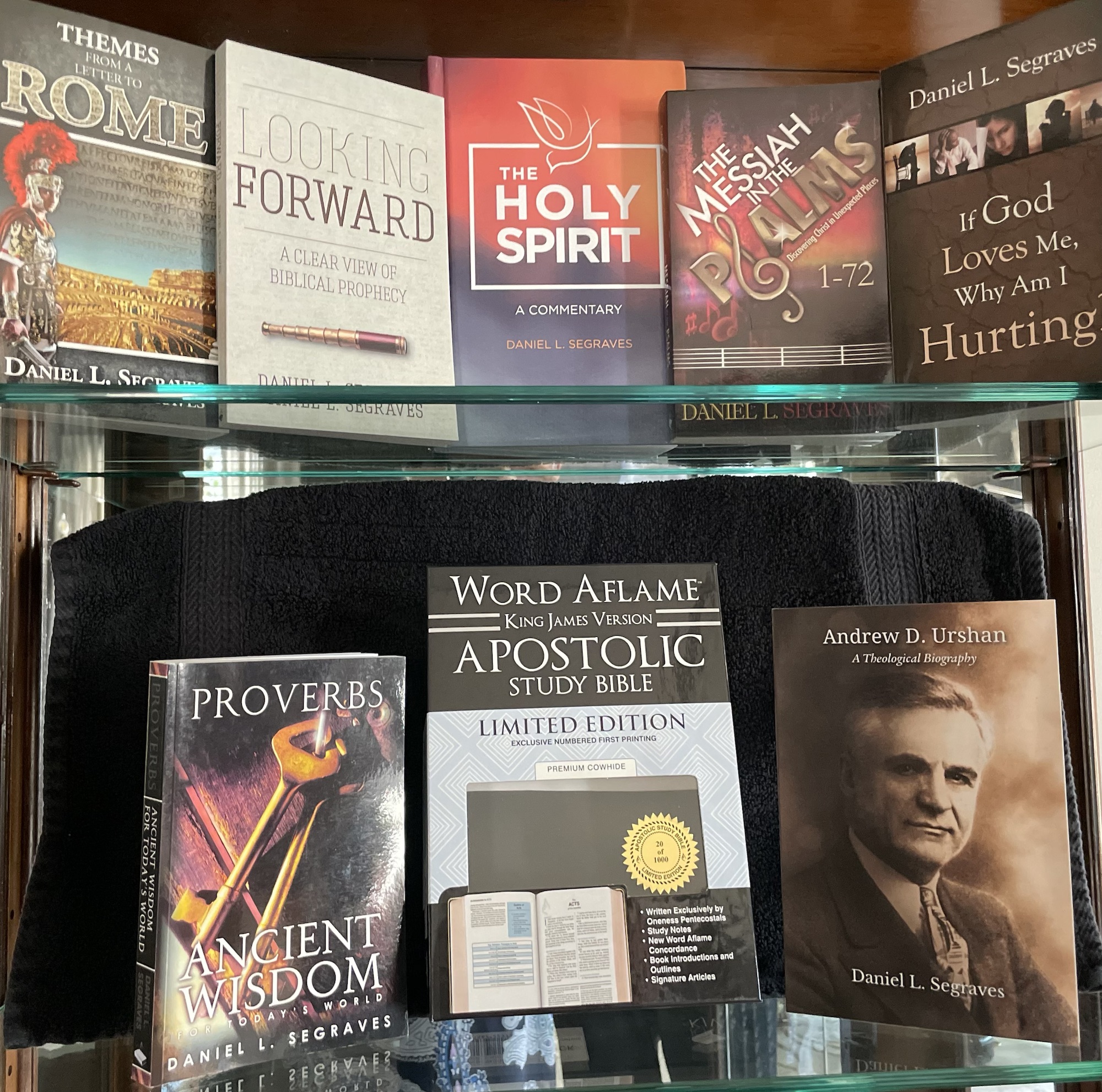

[archive]
[archive]
Available at pentecostalpublishing.com.


Visit pentecostalpublishing.com to read the first chapter for free.
[archive]
September 30, 2026 | Daniel L. Segraves, Ph.D.
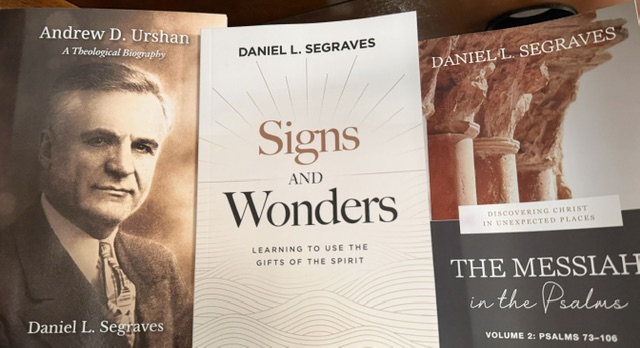
My newest book, Signs and Wonders: Learning to Use the Gifts of the Spirit, is now available from pentecostalpublishing.com. This 163-page volume includes 20 chapters and an appendix. As the subtitle indicates, it offers a practical, not merely theoretical, approach to operating the spiritual gifts.
These are the things Philip Dugas and I learned while teaching the Signs and Wonders course at Christian Life College. Briefly, we discovered that whether we are exploring the nine spiritual gifts of I Corinthians, the motivational gifts of Romans 12, or the five-fold ministry gifts of Ephesians 4, we deepen our understanding through experience.
I hope you will visit the Pentecostal Publishing House display while you’re at the general conference this week and check out this book. It has taken me many years to write.
[archive]
August 24, 2026 | Daniel and Susan Segraves
A few days ago, Susan and I watched a podcast again in which we told the story of our marriage. At the time of the interview, we had been married for seven years. Now we have enjoyed a blessed marriage for almost thirteen years.
As we watched the retelling of how God miraculously brought us together, we were reminded of His mercies, His provisions, and how He can intervene in the lives of people who trust Him with all details.
We hope you enjoy our story as we share how God brought us from grief to joy!
Before you view the video, we encourage you to read the statement below.
WE ARE UNABLE TO TRIM THIS VIDEO, AND WE CANNOT CONTROL WHAT YOU MAY SEE IF YOU CLICK ON “MORE VIDEOS,” SO WE SUGGEST THAT YOU DO NOT CLICK ON ANYTHING OTHER THAN THE PLAY ICON.
[archive]

When we arrived at our home from Sunday service today, this whitetail deer was waiting on our lawn.
It reminded me of the superscription over Psalm 22, a clear and detailed messianic psalm.
If you are interested, you can read my comments on this psalm on pages 71-77 in the first volume of my commentary on Psalms, titled The Messiah in the Psalms: Discovering Christ in Unexpected Places. Why is the superscription important?
The King James Version leaves a portion of the superscription untranslated, as follows: “To the chief Musician upon Aijeleth Shahar, A Psalm of David.”
When untranslated words appear in the superscriptions, those who cannot read Hebrew are left to wonder about their meaning. Many people overlook the superscriptions, not realizing they are actually the first verse of the psalms in the Hebrew text.
The New King James Version translates the superscription: “To the Chief Musician. Set to ‘The Deer of the Dawn.’ A Psalm of David.”
Jesus’ prayer in Psalm 22 extends from verse 1 through verse 22. We know this because of how verse 1 appears in Matthew 27:46 and Mark 15:34, and how verse 22 is used in Hebrews 2:12.
Jesus prayed, “Why are You so far from helping Me?” (Psalm 22:1). We discover in Psalm 22:21 that Jesus’ prayer was answered: “You have answered Me” (NKJV). It was not answered by sparing Him from crucifixion, but by his resurrection early on the first day of the week (Mark 16:9; Luke 24:1; John 20:1).
As Kidner points out, Aijeleth Shahar (deer of the dawn) is a clue to the resurrection: “On the help at daybreak.”
The deer waiting on our lawn reminded me of one of the profound prophecies of the Messiah who would suffer and die, but whose resurrection from the dead would provide salvation for all who believe in Him (Luke 24:45-49; John 20:24-31).
[archive]
May 15, 2026 | Daniel L. Segraves, Ph.D.

Preparing to record two videos.
From time to time, I am asked to write and film scripts for those who teach God’s Word for Life lessons for adult Bible classes.
Yesterday, Susan and I visited the recording studio at the World Headquarters of the United Pentecostal Church International so I could film videos about Nicodemus’s night-time visit with Jesus and the disciples’ request for Jesus to teach them to pray.
Thanks to L. J. Harry for the invitation to participate in this ministry!
[archive]
April 3, 2026 | Daniel L. Segraves, Ph.D.

On this Good Friday, I encourage you to read Psalm 22:1-22. This is the prayer Jesus prayed on His cross.
This scene is from Season Six of The Chosen. [https://www.facebook.com/InsideTheChosen/]
[archive]
March 31, 2026 | Daniel L. Segraves, Ph.D.
Today, I was back on the Urshan University campus to serve as a guest professor for Urshan Graduate School of Theology.


The Urshan campus is about fifteen minutes from our home … ABI is about 500 miles away. But I told the Lord at a recent Sunday morning service that I would go through any door He opened. 🙏🏻
[archive]
February 22, 2026 | Daniel L. Segraves, Ph.D.
[archive]
January 30, 2026 | Daniel L. Segraves, Ph.D.
My mother was born on January 30, 1926, in Judsonia, Arkansas. Her father, Joe Luther Hodge, was twenty-five years old at the time. Her mother, Ruth Jane Hodge, whose maiden name was Stephens, was twenty. Both of them had been born in Arkansas.

After my wife Judy and I had lived in Stockton, California, for 25 years, we decided to return to the area of St. Louis, Missouri. I was born in St. Louis, and we had lived and worked in the St. Louis metropolitan area for fifteen years before moving to Stockton.
My father, Glen Segraves, passed away on November 5, 2001, at the age of 76. He and Mom had their home in Stockton, and she retained her home there after Dad’s death. When Judy and I decided to make our move, I knew Mom needed to go with us. She was 81 at the time.
I approached the subject with Mom by asking, “If you had the choice to live anywhere else, where would it be?”
I was sure she would say, “Missouri!” After all, Mom and Dad had lived in Kennett, Missouri while pastoring there from 1959 until 1968, when they moved to London, Ontario, Canada to pioneer a church. Dad was born near Dexter, Missouri, and he and Mom were living in St. Louis when I was born in 1946, just after World War II. After spending three years in London, they had returned to Missouri where Dad served as pastor in Dexter for fourteen years.
So I expected Mom to choose Missouri. In retrospect, I should have realized she would say, “Arkansas!” That’s where her roots were. She was born there, as were her parents.
I wanted Mom to have the freedom to choose where she would live out her life. But I had to let her know Judy and I were moving back to Missouri. I had already committed to serve on the faculty of Urshan Graduate School of Theology, and it was not located anywhere in Arkansas.
Mom was brave and cheerful. With no complaints, she made the move with us.
The following pictures capture glimpses of “Moments in Time” from my mother’s life. I am grateful to Susan, my wife, and Becky Christman, Susan’s daughter, for their diligent work in arranging this presentation and helping me preserve these glimpses into Mom’s life.


[archive]