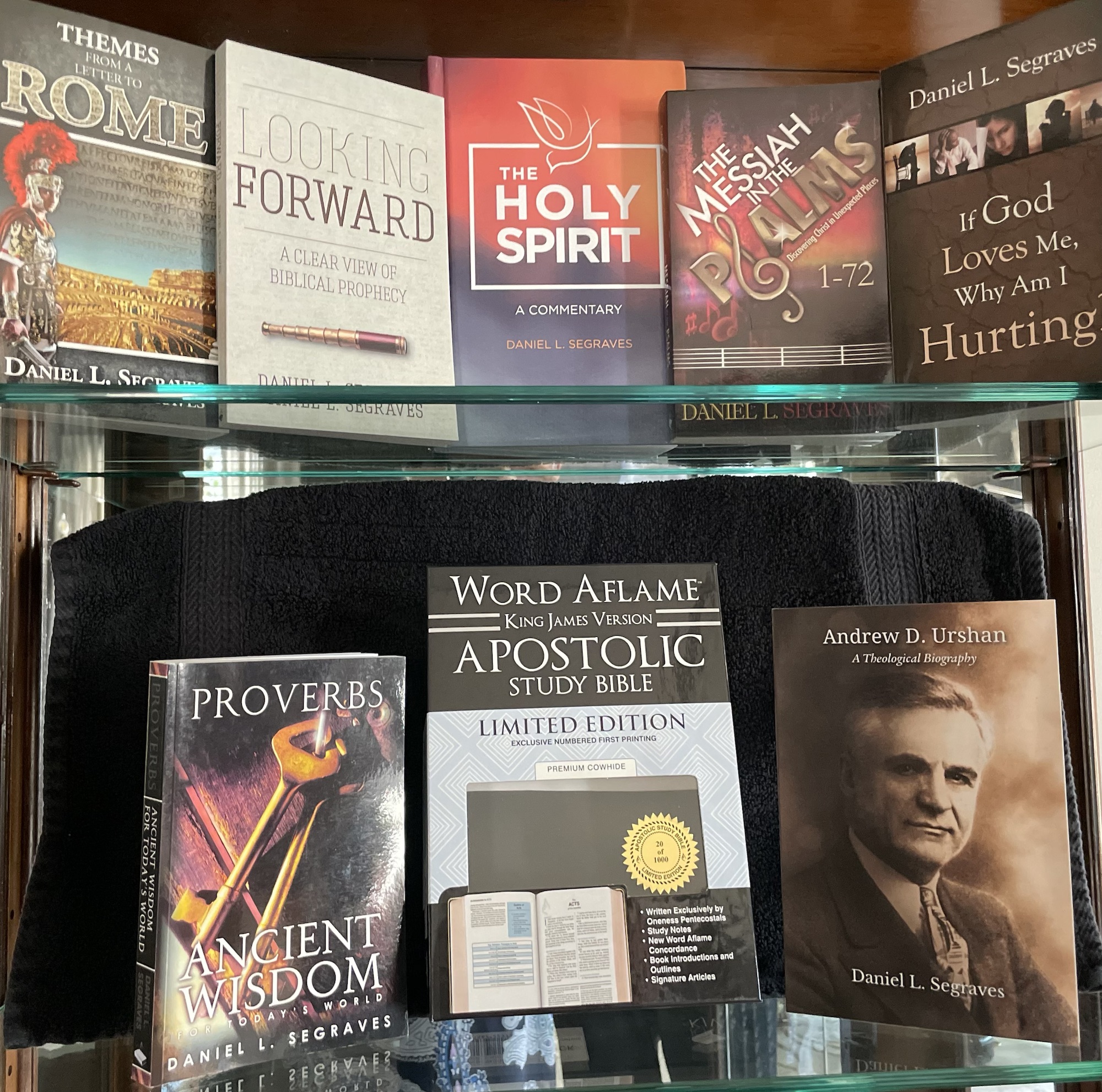
I learned a few minutes ago that my new book Looking Forward: A Clear View of Biblical Prophecy will be available as an iBook and on Nook within 24-48 hours. It is now available as a Kindle download.
Uncategorized
New Book: Looking Forward

My newest book, Looking Forward: A Clear View of Biblical Prophecy, is now available as a Kindle download from Amazon.com.
The book has thirteen chapters, as follows:
Chapter 1: There is a Lot of Prophecy in the Bible
Chapter 2: Finding Fulfillment
Chapter 3: Telling Time
Chapter 4: The Ultimate Fulfillment
Chapter 5: Now and Not Yet
Chapter 6: Always Watching
Chapter 7: The Back of the Book
Chapter 8: Signs, Symbols, and Solutions
Chapter 9: Justice, Judgment, and Eternal Rewards
Chapter 10: Rediscovery of Prophetic Truth
Chapter 11: Here Comes the Bride
Chapter 12: Retaining Historic Doctrines
Chapter 13: Perilous Times
The hard copy will be available beginning September 25, 2017 at http://www.pentecostalpublishing.com, but you can place it on back order now.
The Messiah in the Psalms Video 1
This lesson was taught on September 3, 2017 at The Sanctuary in Hazelwood, Missouri.
The Messiah in the Psalms
Psalms
September 3, 2017
The Sanctuary | Hazelwood, Missouri
Theme: The essential theme of Psalms is the coming One, the Messiah. According to Jesus (Luke 24:44-45), Peter (Acts 2:25-36), Paul (Acts 13:32-37), and the use of the psalms by the New Testament church (Acts 4:25-28), the Psalter is first and foremost a book about the Messiah. It focuses on Zion theology and the kingdom of God (i.e., the physical restoration of Davidic hope, the fulfillment of the promise God made to David that the Messiah would descend physically from him to rule on David’s throne in Zion).[1]
To say that the theme of the Psalter is messianic does not mean only that there are messianic psalms scattered throughout the book. From beginning to end, the book testifies in a variety of ways of the Messiah. When read this way, Psalms takes on a dynamic dimension beyond that of devotional literature. It is not just a section of the Holy Bible to which we turn only when searching for encouragement or wisdom; it is a book we turn to in order to know Jesus better. This does not eliminate its devotional value; it enhances it by showing us that the one with whom we identify in suffering and victory is not just David or other human authors; it is our Lord Jesus Christ.
Authors: Ninety-nine of the psalms identify the author or authors in the superscriptions, which are included in the Hebrew text as the first verse rather than being separated from the psalms as frequently done in translation. The oldest is Psalm 90, identified with Moses and dating possibly from about 1500 bc. Seventy-three psalms are identified with David and would have been written in the tenth century bc. (See Psalms 3-9, 11-32, 34-41, 51-65, 68-70, 86, 101, 103, 108-110, 122, 124, 131, 133, 138-145.) Psalms 72 and 127 are identified with Solomon. Asaph, a Levite and chief musician of David, is identified with twelve psalms. (See Psalms 50, 73-83.) Eleven psalms are attributed to the sons of Korah. Korah was a great-grandson of Levi. (See Psalms 42, 44-49, 84-85, 87-88.) Psalm 89 is identified with Ethan the Ezrahite. We are not certain of his identity, but this was the name of a wise man who lived in Solomon’s time as well as a Levitical musician contemporary with David.
Although some question the authenticity and validity of the superscriptions – they are set apart from the psalms as a kind of heading and not numbered with the verses – the fact that they are included in the Hebrew text as the first verse of the psalm, resulting in a renumbering of the rest of the verses, indicates that we should accept them as authoritative. There are also other reasons for accepting them:
- Biblical poets typically identified themselves with their work. (See II Samuel 22:1; 23:1; Isaiah 38:9; cf. Psalm 18.)
- Not all the psalms have superscriptions. This suggests the authenticity of the superscriptions, for if they had been added after the psalms were originally written, it seems that superscriptions would have been added to all the psalms.
- The Septuagint indicates that those who translated from Hebrew to Greek in the third century bc knew little about the meaning of the musical terms in the superscriptions. If this were so, the terms in the superscriptions must have substantially predated the Septuagint.
- Jesus’ use of what is now included as superscription indicated that He viewed the words as authoritative and authentic. (See Matthew 22:43-45.)
Why the Book Is Called “Psalms”: The Book of Psalms takes its English title from the Septuagint title Psalmoi, a word that means “hymns” sung to musical accompaniment. Although the Hebrew mizmor, meaning “a song sung with musical accompaniment,” appears fifty-seven times in the superscriptions, the title of the book in the Hebrew text is Tehillim, meaning “praises.”
In addition to the title Tehillim, a portion of the book is identified as “the prayers (tefillot) of David.” (See Psalm 72:20.) This is an ancient title for a book comprised of Psalms 3-72.
Original Audience: A common view is that the Psalter was intended for use in corporate worship during the second temple period. A close reading of the text suggests, however, that it was also useful for individuals, not only for the community, and that a specific intended audience is those in exile or tribulation. For these readers, it is a source of hope and comfort.
Key Apostolic Insights: The New Testament quotes from, alludes to, or paraphrases the Old Testament in nearly 800 verses. The book most frequently appealed to is Psalms, which is referred to 206 times. The Psalms show that Christ, the promised Messiah, is the Son of God and the Son of Man. As the Son of God, the Messiah is God Himself in human existence. As the Son of Man, He is a physical descendant of David. The psalms foretell the Messiah’s birth, important events in His life, His betrayal, His sufferings, His death, His resurrection, His ascension, His second coming, and the Millennium. The Psalter also anticipates the proclamation of the gospel, the Messiah’s bride, and the gifts given to the New Testament church upon His ascension.
The Structure of Hebrew Poetry: We refer to Psalms as one of the poetic books because it consists of poetry. Parallelism and figurative images are basic features of ancient poetry. Parallelism is not merely the idea of repetition of a thought in different words, so that a subsequent line (or lines) is completely synonymous with the opening line of the poem; rather, successive lines serve to further develop the thought in some way. The “rhyming” of Hebrew poetry is not similarity of sound but of ideas or concepts. This is sometimes called “thought rhymes,” but that term leads to the notion that successive lines simply recast the same idea in different words rather than advancing the idea. With biblical poetry, however, the entire meaning is not found in the first line; subsequent lines are required to fill out the intended sense of the poem. An example of this is seen immediately upon the opening of the Psalter.
Blessed is the man that walketh not in the counsel of the ungodly,
nor standeth in the way of sinners,
nor sitteth in the seat of the scornful.
The first line of Psalm 1:1 describes the characteristics of a blessed person. This person avoids the influence of the “ungodly” (reshaʻiym [wicked]), a topic that continues throughout the Psalter. The ungodly are further identified in the second line as “sinners” (ḥaṭṭa’iym), indicating that these ungodly ones “miss the way.” Their “way” is the way of the ungodly rather than the godly. Finally, the ungodly are described in the third line as “scornful” (lēṣiym). So it is not merely that the blessed person is one who avoids the influence of those who are wicked; it is that the wicked are not found in the way of the righteous (Psalm 1:6). Further, the wicked not only have their own way; they scorn those who do not walk in their way.
A further development can be seen in the first verse of the Psalter. To walk with the wicked leads to standing with sinners, which leads to sitting with the scornful. These words are not synonyms.
Parallelism gives full expression to an idea. Not only may this be done as in Psalm 1:1, where full expression is given to an idea by developing the theme of the first line in the following lines. This may be done by expressing in the second line a meaning similar to the meaning of the first line, further developing the idea in the first line by means of vivid imagery. Psalm 92:12 is an example:
The righteous shall flourish like the palm tree:
he shall grow like a cedar in Lebanon.
On the other hand, there may be a reverse parallelism so that the second line expresses a different thought than the first line, while nevertheless further developing the point of the first line. Notice, for example, Psalm 30:5:
For his anger endureth but a moment;
in his favour is life:
weeping may endure for a night,
but joy cometh in the morning.
Another use of parallelism involves the completion of the thought of the first line, as in Psalm 96:7:
Give unto the Lord, O ye kindreds of the people,
give unto the Lord glory and strength.
Parallelism may also make use of a series of figures of speech with further significance of the initial idea emerging from successive lines. Psalm 1:3 is an example:
And he shall be like a tree
planted by the rivers of water,
that bringeth forth his fruit in his season;
his leaf also shall not wither;
and whatsoever he doeth shall prosper.
The poetic parallelism of Scripture provides not only a way for meaning to unfold to the reader like an opening flower; it also contributes to the biblical idea of meditation. The word translated “meditate,” as in Psalm 1:2, means to read over and ponder what is written. The idea is to read and reread the verse of Scripture. With parallelism, the reader reads the first line, holds that thought, reads the second line, then returns to the first line, pondering what is written.
It is characteristic of poetry to use figurative language featuring comparison. The comparison can be explicit, as in a simile: “He eats like a horse.” Or the comparison can be implicit, as in a metaphor: “He champed at the bit.” The simile states that someone is like a horse in some way. The metaphor assumes comparison of someone with a horse by describing the person with the characteristics of a horse.
Here are examples of similes:
“He gathereth the waters of the sea together as an heap” (Psalm 33:7).
“And they of the city shall flourish like grass of the earth” (Psalm 72:16).
“But my horn shalt thou exalt like the horn of an unicorn” (Psalm 92:10).
Metaphors are more common than similes. Here are some examples of metaphors, where the comparison is implied:
“He layeth up the depth in storehouses” (Psalm 33:7).
Here, the waters of the ocean are compared with grain kept in storehouses. The metaphor pictures God as a farmer who gathers His grain and stores it.
“Those that be planted in the house of the Lord
shall flourish in the courts of our God.
They shall still bring forth fruit in old age;
they shall be fat and flourishing” (Psalm 92:13-14).
Righteous people are compared to trees planted in the courtyard of the Temple. They bear fruit and are green and full of sap.
The Structure of the Psalter: Since the Psalter is a collection of psalms by a variety of authors, the structure of the book as we now have it is not original with any of the authors whose psalms appear in the book. Its structure is, rather, the result of composition done after all the individual psalms were completed. There were earlier collections, some smaller and some larger, but the result was a book intentionally shaped to serve a theological purpose. (See, e.g., Psalm 72:20.) The traditional outline of the book follows its division into five books by the Masoretic Text. A common explanation of this division is that these five books correspond in some way to the five books of the Torah (i.e., the Pentateuch). The idea here is to read Psalms 1-41 in conjunction with Genesis; Psalms 42-72 with Exodus; Psalms 73-89 with Leviticus; Psalms 90-106 with Numbers; and Psalms 107-150 with Deuteronomy. It is difficult, however, to identify thematic links between the five books of the Pentateuch and the Psalter, and more recent scholarship questions whether these are the most significant structural features of the Psalter and whether the New Testament writers viewed the five-book division of the Psalms as significant for their purposes. More recent views of the structure of the Psalter include the following:
Thematic. The thematic approach to the structure of the psalms was suggested by Franz Delitzsch and further developed by Christoph Barth. The idea is that the psalms are linked together not only by key words, but also by broad themes.
Structural. As suggested by P. Auffret, this approach sees a chiastic structure within the Psalter, specifically within Psalms 15-24. A chiasm is a kind of reverse, inverted outline. Auffret based the chiasm on several key words.
Redactional. This is the idea that the current shape of the Psalter is a revision of an earlier shape, with the current shape intended to serve certain theological purposes, but not necessarily one purpose.
Canonical. Brevard Childs has suggested that we can dispense with discussion about any previous shape of the Psalter and focus on its present shape and structure. We do not need to be concerned with how the present shape came to be; all we need to be concerned with is that this is the shape found in the canon.
Compositional. The compositional approach sees the current shape of the Psalter as reflecting an inspired work bringing together previously existing materials in a form intended to advance a specific theological purpose. One compositional approach sees the Psalter as a collection of prayers for the Jewish people in exile, functioning as a replacement for temple worship.
A compositional/canonical approach seems most satisfying, because it recognizes the obvious facts concerning the variety of authors and evidence of previous collections now reshaped into the current canonical form. The following points seem evidently true:
- The Psalter is a composition with a specific purpose and literary strategy.
- The Psalter is composed for individuals, not only for the community.
- The Psalter is composed for those in exile or tribulation as a source book for hope and divine comfort.
- The framework of the Psalter is messianic: It focuses on Zion theology and the Kingdom of God, by which we mean the physical restoration of Davidic hope, the ultimate fulfillment of the promise God made to David that the Messiah would descend physically from him to rule on David’s throne in Zion. The selection and arrangement of the psalms are intended to explore the relationship between the Law of Moses and Israel’s hope for the future, or, as we might say from the Christian perspective, the relationship between law and grace. The final form of the Psalter is also intended to explore the meaning of the Davidic Covenant in view of the apostasy and exile of the House of David.
[1] This lesson is drawn from the Apostolic Study Bible, ed. Robin Johnston (Hazelwood, MO: Word Aflame Press, 2014), 853-854. It is written by Daniel L. Segraves.
How to buy books I have written.
Today I received an email from someone who wanted to know how to find and buy books I have written. I appreciate this reminder that, even with today’s technology, it can be difficult to locate the resources we’re looking for. In response to this request, I’ve spent a few minutes compiling the information that should allow you to find and purchase everything I’ve written that’s in print.
First, you can call the Pentecostal Publishing House at 1-866-819-7667. This is the number for the order department.
Second, you can go to http://www.pentecostalpublishing.com. I’ve checked this out, and it seems to me that you can order everything I’ve written except my newest book (Andrew D. Urshan: A Theological Biography) [this newest book can be bought on Amazon], but it is my understanding that work continues on the site to make all resources easily and quickly available. I’ve searched the site using various combinations of my name, and here’s what you will find. I clicked the radio button on “All” for each search.
If you enter “Segraves” (remember there’s no “a” before the “g” in Segraves), you will find (in addition to some CD or DVD resources), the following books:
- God in Flesh
- The Messiah in the Psalms: Discovering Christ in Unexpected Places
- Reading Between the Lines: Discovering Christ in the Old Testament
- Themes from a Letter to Rome (this book explores the seven major themes in Romans)
- That Which is Perfect (this is a PDF of one of my master’s theses)
If you enter “Daniel Segraves,” you will find these books:
- First Peter: Standing Fast in the Grace of God
- God in Flesh
- Hair Length in the Bible
- Hebrews: Better Things
- If God Loves Me, Why Am I Hurting?
- James: Faith at Work
- Living by Faith: A verse-by-verse study of Romans
- The Messiah in the Psalms: Discovering Christ in Unexpected Places
- The Messiah’s name: JESUS, not Yahshua
- Proverbs: Ancient Wisdom for Today’s World
- Reading Between the Lines: Discovering Christ in the Old Testament
- Second Peter and Jude
- That Which is Perfect (this is a PDF of one of my master’s theses)
- Themes from a Letter to Rome (this book explores the seven major themes in Romans)
- You Can Understand the Bible: Guidelines for Interpreting Scripture
If you enter “Daniel L. Segraves,” this is the result:
- God in Flesh
- Insights for Christian Living (this book offers insights on practical Christianity)
- Themes from a Letter to Rome (this book explores the seven major themes in Romans)
Several of my books can be purchased on Amazon.com. Some are available for Kindle. Here’s what I found with I clicked on “Books” and typed in “Daniel L. Segraves” (including the quotation marks):
- Hebrews: Better Things (1-8) [Kindle] (The first edition of my commentary on Hebrews was released in two volumes, with the first volume covering chapters 1-8 and the second volume the rest of the book. The edition now published by Word Aflame Press covers the entire book of Hebrews)
- The Messiah’s Name: JESUS, not Yahshua [Kindle]
- Themes from a Letter to Rome
- Reading Between the Lines [Kindle]
- Hair Length in the Bible
- Living by Faith [Kindle]
- James: Faith at Work
- You Can Understand the Bible [Kindle]
- Proverbs: Ancient Wisdom for Today’s World
- Andrew D. Urshan: A Theological Biography
My newest book, Andrew D. Urshan: A Theological Biography, is available at amazon.com, but it is not yet available at http://www.pentecostalpublishing.com.
I appreciate your interest in my books, and I pray they are a blessing to all who read them. I am currently on a twelve month sabbatical from Urshan Graduate School of Theology with the primary project of writing the second volume of my commentary on Psalms.
Andrew D. Urshan: A Theological Biography
I’m happy to report that my new book, Andrew D. Urshan: A Theological Biography, which was about eight or nine years in the research and writing, is now available at http://www.amazon.com. The book is 326 pages long, with two indexes and a bibliography of almost thirty pages.
This project is a revision of my Ph.D. dissertation (Regent University School of Divinity, 2011). I was grateful that my dissertation committee, which consisted of Dale Coulter, Vinson Synan and David Reed, granted “pass with distinction” to the dissertation defense.
Here is a copy of the table of contents:
Foreword / ix
Acknowledgments / xi
Chapter 1: Introduction / 1
Part 1: Life and History of Andrew D. Urshan
Chapter 2: Early Years in Persia / 7
Chapter 3: Early Years in the United States / 19
Chapter 4: Return to Persia / 57
Chapter 5: Return to the United States / 85
Part 2: Theology, Christology, and Soteriology of Andrew D. Urshan
Chapter 6: Theological Influences / 139
Chapter 7: The Mystery of the Godhead / 161
Chapter 8: Doctrine of Salvation / 217
Chapter 9: Responses to Theological Criticism / 229
Chapter 10: Conclusion / 237
Appendix / 245
Bibliography / 271
General Index / 301
Scripture Index / 311
The book is part of The Asbury Theological Seminary Series in World Christian Revitalization Movements. It is published by Emeth Press.
The back cover features endorsements by Vinson Synan, David K. Bernard, and Amos Yong. There are two forewords, one written by D. William Faupel and the other by David A. Reed.

Sabbatical Begins Today
My sabbatical begins today and will conclude on June 30, 2018. It is not a twelve month vacation, nor is it retirement!
It is time set aside for research and writing. During this period, my relationship with Urshan Graduate School of Theology is professor of biblical studies on sabbatical.
My foremost project is to complete the second volume of my commentary on Psalms. The first volume, titled The Messiah in the Psalms, covers Psalms 1-72 in 382 pages. It was published by WAP Academic, a division of Word Aflame Press, in 2007. The second volume will cover Psalms 73-150, again exploring their messianic content. I have already written my comments on Psalms 73, 74, 75, 78, 110, and 132, so I have only seventy-two more psalms to tackle!
I have completed two additional books that should be published by the time of the 2017 general conference of the United Pentecostal Church International. The first is a book titled Looking Forward: A Clear View of Biblical Prophecy, to be published by Word Aflame Press.
The second is titled Andrew D. Urshan: A Theological Biography. I finished proofreading the galleys for this book two days ago. It is a revision of my doctoral dissertation with the Regent University School of Divinity (2011), and it will be published by Emeth Press as a volume in the Asbury Theological Seminary Series in World Christian Revitalization Movements.
In addition to these projects, I have committed to write two articles for inclusion in the Early High Christology volumes edited by Dr. Jeffrey Brickle. One will address the Messiah in the Book of the Twelve (i.e., the minor prophets). The other will explore the Christology of the book of James.
I am deeply grateful for the opportunity to spend this season focusing on the research necessary to complete these tasks. I would appreciate any prayers to give me the physical strength, leading of the Holy Spirit, and clarity of thought I will need.
Reflections on More than Thirty-Five Years of Teaching
Today I emptied my office on the campus of Urshan College and Urshan Graduate School of Theology. I have completed thirty-five and one-half years of teaching at schools endorsed by the United Pentecostal Church International.
In the process of clearing out my things, it occurred to me that I was concluding this era of life not only on the same campus where it began, but also in the same building. In the fall of 1974, I moved into an office located on the first floor of the administration building of what was then known as Gateway College of Evangelism. W. C. Parkey, the president of the college, had asked me to serve as the director of Christian education. The office I vacated today is located on the second floor of that building; the name of the school is now Urshan College, which shares the campus with Urshan Graduate School of Theology. The nameplate on the door identified me as the professor of biblical studies.
I served in my role at Gateway for only one semester. Toward the end of the semester, I received a call from W.I. Black to explore my interest in pastoring. This led to seven and one-half years serving as pastor of the First Pentecostal Church in Dupo, Illinois. I had another connection with Gateway in 1980, when I developed a degree completion program for students who had done undergraduate work but who had not finished a degree program.
In the spring of 1982, I received a call from Kenneth Haney. He asked if I had ever thought about teaching in a Bible college. For the next twenty-five years, I served Christian Life College in Stockton, California. For the first nineteen and one-half years, I was the executive vice-president and chairman of the department of theology. During the final five and one-half years, I was the president of the school and continued my teaching role.
In 2007, my wife Judy and I moved back to our home state, Missouri, planning to teach part time at Urshan Graduate School of Theology. The part time work was brief, about one year. Instead, while teaching, I also served variously as academic dean and administrator. For the final three years, I filled the full time role described by my last nameplate.
I will be on sabbatical during the next academic year. The plan is to do the necessary research and to write the second volume of my commentary on the book of Psalms: The Messiah in the Psalms. I have two books that should be published this year. The first is a book on Bible prophecy to be published by Word Aflame Press. The second is a revision of my doctoral dissertation, Andrew D. Urshan: A Theological Biography. It will be published by Emeth Press. I have other writing assignments due this year, including, but not limited to, chapters in a book on early high Christology. This project is directed by Dr. Jeffrey Brickle, a member of the faculty of Urshan Graduate School of Theology.
When the sabbatical concludes, I will become professor emeritus at Urshan Graduate School of Theology. This role will hold the possibility of teaching occasional courses. My plan is to spend most of my time in the future in research and writing. I am now seventy years old.
How many students have I taught? I don’t know the exact number, but an informed guess based on a review of yearbooks is that it is about 2,000. I take great joy in knowing that included in this number are former students now serving our Lord in a wide spectrum of ministries: pastors, missionaries, district and general officials, administrators, scholars, professors, writers, editors.
After forty-six and one-half years of marriage, Judy passed away in January of 2011. God had blessed us richly with a wonderfully fulfilling marriage that produced a daughter, a son, five grandchildren, and five great-grandchildren. Judy is now present with the Lord.
On September 28, 2013, Susan Fuller and I were joined in marriage in a ceremony conducted by Timothy Dugas, Garry Tracy, and David K. Bernard. We are enjoying the sweet blessings of God with the knowledge that He brought us together for this season of life. With similar histories, mutual friends, common interests and values, and deep love for one another, we marvel at the joy we find in each day.
It is a blessed life living for Jesus. I have asked Him to enable me to live for His glory each day He chooses to give me.
∼ Daniel L. Segraves
Three Things to Know Today … and to Remember Every Day to Come!
Gospel. The Greek word translated gospel means “good news.”[1] The word appears seventy-six times[2] in all but eight of the twenty-seven New Testament books. But even though eight books do not contain the specific word, they include references to the person and work of Jesus Christ that fit within the framework of the gospel message. For example, the book of John, which does not include the word gospel, is so rich in references to the gospel message that it is commonly known as “The Gospel According to John.”[3]
Every book written by Apostle Paul except one (Titus) uses the word gospel. Early in his longest book, he wrote, “For I am not ashamed of the gospel of Christ, for it is the power of God to salvation for everyone who believes, for the Jew first and also for the Greek. For in it the righteousness of God is revealed from faith to faith; as it is written, ‘The just shall live by faith’” (Romans 1:16-17).[4]
Before we think about defining the gospel, we should note that it is God’s power, it produces salvation, it is for all believers and that from beginning to end, it is a matter of faith.
Because of the characteristics of various world languages, the Louw-Nida Greek-English Lexicon of the New Testament suggests that in some languages, it may be necessary to translate the Greek word behind the English gospel as something like “news that makes one happy,” “information that causes one joy,” “words that bring smiles,” or “a message that causes the heart to be sweet.”
Paul wrote a clear definition of the gospel and its connection with salvation:
Moreover, brethren, I declare to you the gospel which I preached to you, which also you received and in which you stand, by which also you are saved, if you hold fast that word which I preached to you – unless you believed in vain. For I delivered to you first of all that which I also received: that Christ died for our sins according to the Scriptures, and that He was buried, and that He rose again the third day according to the Scriptures (I Corinthians 15:1-4).
Let’s examine three aspects of Paul’s words. Together, they comprise the gospel.
1. Christ died for our sins according to the Scriptures. This is amazingly good news! Since Christ died for our sins, we don’t have a sin problem. If we believe and obey the gospel, we are washed from our sins.
And such were some of you. But you were washed, but you were sanctified,[5] but you were justified[6] in the name of the Lord Jesus and by the Spirit of our God (I Corinthians 6:11).
To Him who loved us and washed us from our sins in His own blood (Revelation 1:5).[7]
But God be thanked that though you were slaves of sin, yet you obeyed from the heart that form of doctrine to which you were delivered (Romans 6:17).
But they have not all obeyed the gospel (Romans 10:16).
… when the Lord Jesus is revealed from heaven with His mighty angels, in flaming fire taking vengeance on those who do not know God, and on those who do not obey the gospel of our Lord Jesus Christ (II Thessalonians 1:7-8).
And having been perfected, He became the author of eternal salvation to all who obey Him (Hebrews 5:9).
For the time has come for judgment to begin at the house of God; and if it begins with us first, what will be the end of those who do not obey the gospel of God (I Peter 4:17)?
Although there are warnings about the fate of those who do not obey the gospel, these need not strike fear in our hearts. These warnings are for those who stubbornly refuse to believe on Jesus, those who reject Him, those who insist on going their own way rather than following His way.
For God has not given us a spirit of fear, but of power and of love and of a sound mind (II Timothy 1:7).
Before we leave our discussion of the first aspect of the gospel, notice that Christ died for our sins according to the Scriptures. This means that in His death, Jesus fulfilled all the Old Testament prophecies about how the Messiah would bear our sins. For example:
But He was wounded for our transgressions, He was bruised for our iniquities; … and the Lord has laid on Him the iniquity of us all. … He was cut off from the land of the living; For the transgressions of My people He was stricken. … By His knowledge My righteous Servant shall justify many, for He shall bear their iniquities. … He poured out His soul unto death … Because He was numbered with the transgressors, and He bore the sin of many, and made intercession for the transgressors (Isaiah 53:5-6, 8, 11-12).
2. He was buried. How can this be good news? Is this really part of the gospel? It is, because Christ’s burial is proof of His death. If He had not died for our sins, we would have no hope of salvation. We have all sinned, and the wages of sin is death (Romans 3:23; 6:23). Jesus was sinless, but He suffered and died for us.
Christ also suffered for us … “Who committed no sin, nor was deceit found in His mouth” … who Himself bore our sins in His own body on the tree (I Peter 2:21-22, 24).
For we do not have a High Priest who cannot sympathize with our weaknesses, but was in all points tempted as we are, yet without sin (Hebrews 4:15).
Therefore take heed to yourselves and to all the flock, among which the Holy Spirit has made you overseers, to shepherd the church of God, which He purchased with His own blood (Acts 20:28).
The death of the Messiah was foretold in the Hebrew Scriptures, but so was His burial.
And they made His grave with the wicked – But with the rich at His death (Isaiah 53:9).
3. He rose again the third day according to the Scriptures. Christ’s resurrection from the dead is our assurance that we too will rise.
There were some people among the Corinthians in the first century who denied the resurrection of the dead.[8] Nearly sixty verses in I Corinthians 15 are given to Paul’s defense of the resurrection. This includes the fact that after Jesus’ resurrection He was seen by more than 500 people.[9]
Without the resurrection of Christ, it is pointless to preach or to believe.[10] But the fact that Christ has risen means that all who belong to Him will also rise “at His coming.”[11]
Fifteen verses of I Corinthians 15 discuss the nature of the resurrection body.[12] Our present bodies are corruptible, but in the resurrection they will become incorruptible. They are now mortal, but they will become immortal.[13]
As he neared the end of his defense of the resurrection, Paul wrote these astonishing words:
So when this corruptible has put on incorruption, and this mortal has put on immortality, then shall be brought to pass the saying that is written: “Death is swallowed up in victory.”
“O Death, where is your sting? O Hades, where is your victory?” (I Corinthians 15:54-55).
Remember These Three Things …
The good news, the gospel, includes the death of Christ for our sins, His burial, and His resurrection from death. These things were foretold by the ancient Hebrew prophets and are included in the Scriptures we commonly refer to as the Old Testament.
The gospel is the basis of salvation. Without it we could not be saved.
On the birthday of the Church, Apostle Peter preached the gospel in response to the questions of those who were in Jerusalem for the celebration of the Day of Pentecost. The Holy Spirit had fallen upon about 120 people in Jerusalem who believed on Jesus, and all of them began speaking in languages they had never learned. In these languages, they spoke of the wonderful works of God, amazing and perplexing those who had not yet believed on Jesus.
Some said, “Whatever could this mean?” Mocking, others said, “They are full of new wine.”[14]
In response, Peter explained that this event was the fulfillment of a prophecy given by Joel.[15] Then, he talked about the death and resurrection of Jesus, pointing out that this was prophesied by David.[16]
Those who heard Peter’s words were “cut to the heart” and asked, “What shall we do?” Peter answered,
Repent, and let every one of you be baptized in the name of Jesus Christ for the remission of sins; and you shall receive the gift of the Holy Spirit. For the promise is to you and to your children, and to all who are afar off, as many as the Lord our God will call (Acts 2:38-39).
This first proclamation of the gospel after the resurrection and ascension of Jesus resulted in about 3,000 people being saved that day.[17] Since that day, only God knows how many people have heard and responded to the good news of Christ’s death for our sins, His burial, and His resurrection.
Whether they heard the gospel in the English language as good news or in other languages of the world as news that makes one happy, or information that causes one joy, or words that bring smiles, or a message that causes the heart to be sweet, all who have heard and believed the gospel have experienced transformed lives.
And they now know that death is not the end. The promise of the resurrection has removed death’s sting and robbed the grave of victory.
Just as Christ arose, so shall we!
Beloved, now we are the children of God; and it has not yet been revealed what we shall be, but we know that when He is revealed, we shall be like Him, for we shall see Him as he is (I John 3:2).
We are
Looking for the blessed hope and glorious appearing of our great God and Savior Jesus Christ (Titus 2:13).
[1] The Greek word translated gospel is εὐαγγέλιον [euangelion]. The word gospel developed from “Old English godspel ‘glad tidings announced by Jesus; one of the four gospels,’ literally ‘good spell,’ from god ‘good’ … + spel ‘story, message’ … [http://www.etymonline.com/index.php?term=gospel].
[2] https://billmounce.com/greek-dictionary/euangelion.
[3] To see some of the references to gospel content in books that do not use the word, see John 1:29; 3:16; 19:28, 36-37; 20:9; Titus 2:13-14; 3:4-5; James 2:1, 19; II Peter 1:1, 19; I John 1:7; 2:1-2; 3:5, 16; 4:14; 5:13; II John 9:10 (in II John, the “doctrine [teaching] of Christ includes verses 3 and 7); III John 4 (the reference to “the truth” would include all that was declared to be true by the Scriptures); Jude 3, 4, 21 (the “common salvation”) would refer to all that was commonly believed about salvation by the first century church.
[4] All quotations from the Bible in this lesson are from the New King James Version.
[5] To be sanctified is to be made holy.
[6] To be justified is to be placed in right standing with God.
[7] See also Revelation 7:14.
[8] I Corinthians 15:12.
[9] I Corinthians 15:5-8.
[10] I Corinthians 15:14-19.
[11] I Corinthians 15:20-23.
[12] I Corinthians 15:35-49.
[13] I Corinthians 15:50-53.
[14] See Acts 2:1-13.
[15] Compare Acts 2:16-21 with Joel 2:28-32.
[16] Compare Acts 2:22-36 with Psalm 16:8-11; 110:1.
[17] Acts 2:40-41.