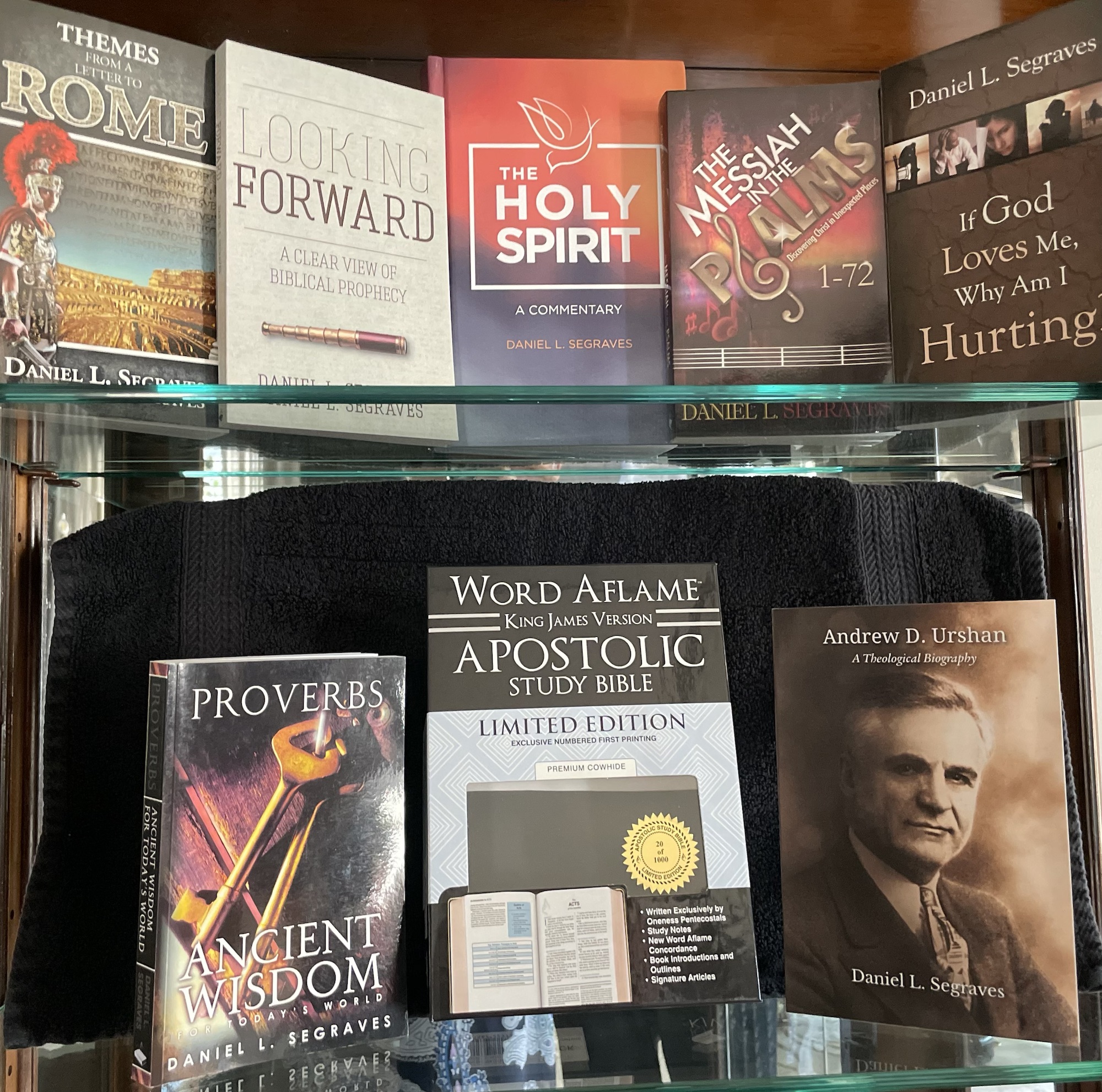
Uncategorized
Proverbs 24:12[3]
Discovering Christ in Unexpected Places Lesson 10 Video
Discovering Christ in Unexpected Places Lesson 10
Lesson 10 | November 27, 2016
Prepared by Daniel L. Segraves, PhD
Psalm 132
Psalm 132 is the longest of the fifteen psalms included in the “Songs of Ascents.” A variety of theories have been offered as to the significance of these psalms. A common theory is that the ascents refer “to journeys made by pilgrims to the three annual festivals observed in Jerusalem (Deut. 16:16). . . . The psalms on this theory are a collection for use by pilgrims either in their journey or in processionals during a festival.”[1] Another suggestion is that these psalms were a liturgy for “a choir ranged up a flight of fifteen stairs, such as we know existed in the Jerusalem temple.”[2] It is also pointed out that “in the book of Ezra exiles returning from captivity in Babylon are repeatedly said to ‘go up’ to Jerusalem, and Ezra’s own ‘journey’ (7:9) is literally his ‘going up,’ his aliyah, the noun in our psalm headings.”[3]
We will read these psalms from the perspective of the third suggestion, for if we “look at the term within the book of Psalms . . . the word appears to refer to Israel’s ‘coming up’ out of exile, thus setting the theme of these psalms within the context of Israel’s return from Babylonian captivity.”[4]
Throughout the OT, the notion of the return from Babylonian captivity is seen as a picture of the times of the Messiah (cf. Isa 40). The Psalms of Ascents are thus to be read within Psalms as an expression of the hope of God’s faithfulness to David and the fulfillment of his messianic promise. . . . The central psalm is Ps 132, which specifically recounts the Davidic covenant of 2 Sa 7.[5]
Peter understood Psalm 132 to be about the Messiah. On the Day of Pentecost, in order to affirm that Jesus was the promised Messiah, Peter referred to Psalm 132:11. Peter said, concerning David, “Therefore, being a prophet, and knowing that God had sworn with an oath to him that of the fruit of his body, according to the flesh, He would raise up the Christ to sit on his throne, he, foreseeing this, spoke concerning the resurrection of the Christ, that His soul was not left in Hades, nor did His flesh see corruption” (Acts 2:30-31).
Peter coupled Psalm 132:11 together with Psalm 16:10, indicating that both psalms are about the Messiah. Psalm 132:11 reads, “The Lord has sworn in truth to David; He will not turn from it: ‘I will set upon your throne the fruit of your body.’” The fruit of David’s body is the Messiah, Jesus Christ.[6]
In Psalm 132, verses 1-10 form a prayer request that concludes with the words, “For Your Servant David’s sake, do not turn away the face of Your Anointed” (10). The word translated “Anointed” is from Mashiyach, which transliterates into English as “Messiah.” Verses 11-18 in Psalm 132 form the answer to the prayer request, with verse 11 promising that the Lord will not turn away the face of His Messiah. He will, instead, as He swore to David, set the Messiah, a physical descendant of David, on David’s throne.
We do not know who wrote this psalm or when it was written. What we do know is that it contains extensive quotations: “a vow of David (vv. 3-5), an oath of the Lord concerning the Davidic succession (vv. 11b-12), a word of the Lord about the election of Zion (vv. 14-16), and another joined to it about the future of David’s dynasty (vv. 17-18).”[7]
The interpretation of individual psalms is aided more by the context in which they are found in the Psalter and by textual linkages than by speculations about authorship, provenance, and the circumstances under which they were originally written. After the return from Babylonian exile, when the composition of the Psalter took its final shape, the psalms were apparently arranged in an intentional and interpretive form. It is this form that is most helpful in determining meaning, not the concerns of historical criticism.
Psalm 132 begins as a prayer, asking the Lord to remember David “and all his afflictions” (1). The prayer centers on David’s vow not to allow anything to stand in the way of finding “a place for the Lord, a dwelling place for the Mighty One of Jacob” (2-5). Although we do not find the precise words of this vow elsewhere in Scripture, we know that these verses reflect David’s desire to find a place for the Ark of the Covenant that was more suitable than Baale Judah (II Samuel 6:2).[8] Another name for Baale is Kirjath Jearim (Joshua 15:9), which means “city of forests.” The Ark had been taken to Kirjath Jearim after it was returned by the Philistines (I Samuel 6:20-21; 7:1-2). It remained there for twenty years.[9] The Israelites lamented this situation, and their lament finds full expression in David’s vow: “Surely I will not go into the chamber of my house, or go up to the comfort of my bed; I will not give sleep to my eyes or slumber to my eyelids, until I find a place for the Lord, a dwelling place for the Mighty one of Jacob (3-5).”
Then comes a possible link that looks not only backward to the historic event of the return of the Ark to Jerusalem, but also ahead to the birth of the Messiah in Bethlehem: “Behold, we heard of it in Ephrathah; we found it in the fields of the woods” (6). The word “woods” is translated from ya‘ar, a form of which is transliterated “Jearim.” As it relates to the Davidic event, this refers to the fact that the Ark had been kept in the wooded district around Kirjath Jearim. But as it looks ahead to the birth of the Messiah, it may refer to the fact that He was born in Bethlehem.
In seeking to interpret this psalm, it is essential to remember that as it is now placed in the Psalter, it looks ahead to the coming of the promised Messiah (11). David is dead, and the throne of David is empty. The Ark has not been seen since 587 b.c., when the Babylonians invaded Jerusalem and destroyed the temple.[10] So, for its post-exilic readers, the words “let us go into His tabernacle; let us worship at His footstool. Arise, O Lord, to Your resting place, You and the ark of Your strength” (7-8) cannot refer only to an event in the distant past, when David finally returned the Ark to Jerusalem or when Solomon’s temple was completed. There would be little hope to be gained from a recitation of a past, long gone and impossible to revive. Instead, these words now look ahead to a new tabernacle and Ark, and priests who will “be clothed with righteousness” and saints who will “shout for joy” (9).
A significant link in making this connection is found in Micah 5:2, a post-exilic prophecy: “But you, Bethlehem Ephrathah, though you are little among the thousands of Judah, yet out of you shall come forth to Me the One to be Ruler in Israel, whose goings forth are from of old, from everlasting.” The New Testament sees this as a prophecy that the Messiah would be born in Bethlehem. (See Matthew 2:6; John 7:42.) Ephrathah is consistently connected with Bethlehem in the Hebrew Scriptures. (See Ruth 4:11; I Chronicles 2:50; 4:4.) The Messiah would come from Ephrathah and, as Psalm 132 looks ahead to the fulfillment of the Davidic Covenant, it connects that fulfillment with Ephrathah, that is, with Bethlehem. The statement, “We found it in the fields of the woods” (6b) brings to mind Luke’s record that the shepherds, the poor among Israel[11] and the first to discover and worship the Messiah, “were in the same country [around Bethlehem] living out in the fields, keeping watch over their flock by night” (Luke 2:8). It was here in the fields that an angel of the Lord told them the good news of a Savior, Christ the Lord, born in the city of David, Bethlehem (Luke 2:9-12).
Under the Old Covenant, the Ark was God’s dwelling place. Under the New Covenant, God “tabernacles” or dwells among us in the Incarnation.[12] As sacred as it was, the Ark of the Covenant was merely a shadow or type of the presence of God that would take up residence among human beings in the Person of Jesus Christ.[13] In a very real sense, when the shepherds found Jesus in Bethlehem-Ephrathah in a manger, they went into His tabernacle and worshipped at His footstool (Psalm 132:7). Because of the fulfillment of the Davidic Covenant, God’s priests are clothed with righteousness and His saints shout for joy (Psalm 132:9, 16).[14]
Although David’s more immediate sons were not obedient to God and thus lost the privilege of sitting on David’s throne (12), God would nevertheless keep His promise that the Messiah would descend from David and sit on David’s throne (11). This was included in Peter’s message on Pentecost, as he explained that Jesus is now exalted to the right hand of God (Acts 2:33; Psalm 110:1). From this position of exaltation, Christ pours out the Holy Spirit (Acts 2:33). The same Person who was crucified has been made both Lord and Christ (Acts 2:36).
It was this message, composed in part from a quote from Psalm 132:11, that cut those who heard Peter to the heart, causing them to say, “Men and brethren, what shall we do?” (Acts 2:37). Peter replied, “Repent, and let every one of you be baptized in the name of Jesus Christ for the remission of sins; and you shall receive the gift of the Holy Spirit” (Acts 2:38).
All of this happened in Jerusalem, on Mount Zion, in harmony with the final verses of Psalm 132:
For the Lord has chosen Zion; He has desired it for His dwelling place: “This is My resting place forever; here I will dwell, for I have desired it. I will abundantly bless her provision; I will satisfy her poor with bread. I will also clothe her priests with salvation, and her saints shall shout for joy. There I will make the horn of David grow; I will prepare a lamp for My Anointed. His enemies I will clothe with shame, but upon Himself His crown shall flourish” (13-18).
These words have a New Covenant ring. In the first century, Jewish Christians read these words:
But you have come to Mount Zion and to the city of the living God, the heavenly Jerusalem, to an innumerable company of angels, to the general assembly and church of the firstborn who are registered in heaven, to God the Judge of all, to the spirits of just men made perfect, to Jesus the Mediator of the new covenant, and to the blood of sprinkling that speaks better things than that of Abel (Hebrews 12:22-24).
In an extended allegory comparing Hagar to Mount Sinai and Mount Sinai to the earthly Jerusalem, Paul wrote, “but the Jerusalem above is free, which is the mother of us all” (Galatians 4:26). Bruce points out that the
events of the Exodus and the wilderness wanderings . . . are treated in the apostolic age as parables of Christian experience. But Christians have come to no sacred mountain which can be touched physically but to the heavenly dwelling-place of God, the true and eternal Mount Zion. . . . by virtue of accepting the gospel, the readers of [Hebrews] had come to that spiritual realm some of whose realities are detailed in the following clauses.[15]
This does not negate the promise of “the holy city, New Jerusalem, coming down out of heaven from God” (Revelation 21:2).
. . . the new Jerusalem has not yet come down to mankind, but in the spiritual realm they already have access to it. They have become fellow-citizens with Abraham of that well-founded city for which he looked; it is the city or commonwealth which comprises the whole family of faith, God’s true dwelling-place. Even now this city has not been manifested in its fullness; it is still in one sense “the city which is to come” (13:14), but the privileges of its citizenship are already enjoyed by faith.[16]
On the other hand, the Jerusalem that is only earthly, which Paul compared to Hagar and Mount Sinai, is compared by John with Sodom and Egypt (Revelation 11:8). It seems quite apparent that promises like those found in Psalm 132:13 should not be limited to the earthly Jerusalem. Although God does indeed love that city and continued to extend mercy to it by pouring out His Holy Spirit there to inaugurate the new era, His Spirit is not confined to that geographic location. When He says, “This is My resting place forever; here I will dwell, for I have desired it” (Psalm 132: 14), this cannot mean that God dwells in the earthly Mount Zion alone. He dwells in the Mount Zion that is also identified as the heavenly Jerusalem, the church (Hebrews 12:22-23).
Just before His departure, Jesus commanded His disciples not to depart from Jerusalem, for it was the place where the Holy Spirit would be poured out.[17] In this pouring out, people were abundantly blessed and satisfied. They were clothed with salvation and shouted for joy. There the horn [strength or government] of David began to grow[18] and a lamp was prepared for the Messiah.[19] The Messiah’s enemies will be “clothed with shame, but upon Himself His crown shall flourish” (18). But Jesus also informed His disciples that what began in the earthly Jerusalem would extend over the entire earth: “But you shall receive power when the Holy Spirit has come upon you; and you shall be witnesses to Me in Jerusalem, and in all Judea and Samaria, and to the end of the earth” (Acts 1:8).
Psalm 132 is a key text among the “Songs of Ascents,” assuring the returning exiles that God’s promise was not confined to the past. Their historic focus on a sacred Ark was transformed into a future hope. The throne of David would be filled once again, and the good news would first be heard in the fields around Bethlehem.
The videos and study guides for this class can be accessed at http://www.danielsegraves.com/blog.
[1] James, Interpretation, Psalms, 385-386.
[2] Michael Wilcock, The Message of the Psalms 73-150, 219.
[3] Ibid.
[4] Sailhamer, NIV Compact Bible Commentary, 343.
[5] Ibid.
[6] See Matt 1:1; Luke 1:32; 3:31; Acts 13:22-23; Rom 1:3; Rev 5:5; 22:16.
[7] Mays, 409.
[8] See II Samuel 6-7.
[9] The Ark was neglected during the time Saul was king (I Chronicles 13:3).
[10] Wilcock, The Message of the Psalms 73-15, 242.
[11] See Psalm 132:15.
[12] John 1:14. The word translated “dwelt” is eskēnōsen, which includes the meaning “to abide or dwell in a tabernacle or tent.”
[13] See Hebrews 9:1-10; 10:1-25; 12:24.
[14] See I Peter 2:5-9.
[15] F. F. Bruce, The Epistle to the Hebrews, The New International Commentary on the New Testament, rev. ed. (Grand Rapids: William B. Eerdmans Publishing Company, 1990), 355.
[16] Ibid., 357.
[17] See Luke 24:49-52; Acts 1:4-8.
[18] See Isaiah 9:6-7. The word translated “grow” [tsamach] is also found in the messianic references to the “Branch.” See Jeremiah 23:5; 33:15; Ezekiel 29:21; Zechariah 3:8; 6:12.
[19] “My Anointed” is a reference to the Messiah. The “lamp” connects with II Samuel 21:17, where David is described as the “lamp of Israel” and with I Kings 11:36; 15:4, where David’s descendants Rehoboam and Abijam ruled in Jerusalem even after the division of the kingdom in order to give David a “lamp in Jerusalem.” With the coming of the Messiah, this lamp will never go out.
Discovering Christ in Unexpected Places Lesson 9 Video
Discovering Christ in Unexpected Places Lesson 9
Lesson 9 | November 13, 2016
Prepared by Daniel L. Segraves, PhD
Psalm 31
Psalm 31 continues the theme of the blessings associated with the Lord’s presence in His temple. Specifically, verse 20 reads, “You shall hide them in the secret place of Your presence from the plots of man; You shall keep them secretly in a pavilion from the strife of tongues.” This same idea is seen in Psalm 27:5, which shares in advancing the theme begun in Psalm 23:6: “For in the time of trouble He shall hide me in His pavilion; in the secret place of His tabernacle He shall hide me; He shall set me high upon a rock.” The temple is described as His pavilion or as the secret place. (See Psalm 27:4.)
Various ideas connect Psalm 31 with previous psalms. Compare the request “lead me and guide me” of verse 3. (Compare with Psalm 25:4-5, 9; 27:11.) Compare the “wide place” of verse 8 with the “even place” of Psalm 26:12 and the “smooth path” of Psalm 27:11. Also compare verse 17 with Psalm 25:3.
It should be noted that on the cross Jesus prayed the words of Psalm 31:5: “Into Your hand I commit my spirit.” (See Luke 23:46.) Similarly, He prayed the words of Psalm 22:1 on the cross. (See Matthew 27:46.) As we compared Psalm 22 with Jesus’ experiences on the cross, it became evident that we should read the entirety of Psalm 22 as a messianic psalm, with the possibility that His prayer on the cross may have included most of Psalm 22.
Since Jesus also prayed words from Psalm 31 on the cross, should we view the entire psalm as messianic? In view of the common translation of verses 5 and 10, this may seem problematic: “Into Your hand I commit my spirit; You have redeemed me, O Lord God of truth” (verse 5). Although Jesus prayed the first phrase of this verse on the cross, we may reject the idea that the last phrase has any messianic reference in view of the idea of the redemption of the Messiah. How could the sinless Messiah be redeemed? This problem may vanish, however, since the Hebrew padah, translated “redeemed,” contains within its range of meaning the idea of “rescue.”[1] For this reason, the NLT translates the verse, “I entrust my spirit into your hand. Rescue me, Lord, for you are a faithful God.” If we understand the verse to be a plea for rescue, it fits within the context of the prayers of Jesus in the Garden of Gethsemane and on the cross.[2]
Verse 10 may seem to be a problem for reading the entire psalm as a messianic prayer: “For my life is spent with grief, and my years with sighing; My strength fails because of my iniquity.” The Messiah had no iniquity. But the word translated “iniquity” (‘avon) also contains the idea of punishment or ruin. Note the following translations:
My life is consumed by anguish and my years by groaning; my strength fails because of my affliction, and my bones grow weak (NIV).
For my life is spent with sorrow, and my years with sighing; my strength fails because of my misery, and my bones waste away (RSV; NRS).
For my life is wasted with grief: and my years in sighs. My strength is weakened through poverty and my bones are disturbed (DRA).
For my life is spent with grief, and my years with groanings: my strength has been weakened through poverty, and my bones are troubled (LXX).
Perhaps most significant here is that the LXX translates the Hebrew ‘avon with ptocheiai, a word meaning “poverty.” If translating verse 10 as a reference to the Messiah’s affliction, misery, or poverty is closer to the inspired intent here than to translate it as a reference to someone’s iniquity, not only is the problem of verse 10 removed, but the meaning of the verse is in complete harmony what other descriptions of the Messiah’s suffering.[3]
As it was originally written as an individual psalm, Psalm 31 is a prayer that David prayed for help from the Lord. But as it is placed here in the post-exilic arrangement of the psalms, it seems to fit the general messianic intent of the arrangement of the psalms, advancing the messianic theme and pointing Israel to a future which will include a suffering Messiah. For that reason, we will read it as a messianic psalm, like Psalm 22.
As He faces the crucifixion, the Messiah puts His trust in the Lord (verse 1a). He prays that He will not be ashamed (compare with Psalm 25:1-3) – that is, that His trust will not be disappointed – and that He will be delivered (verse 1b). This should be compared with Psalm 22:1-5, 8; Matthew 26:39; Hebrews 5:7-8.
The Messiah prays that His deliverance will be speedy (verse 2). This should be compared with Psalm 22:19.
He proclaims the Lord to be His rock and fortress, and asks for the Lord to lead and guide Him for the Lord’s “name’s sake” (verse 3). Compare this with Psalm 22:22; Hebrews 2:12; John 12:28; 17:6.
The Messiah asks to be pulled from the net secretly laid for Him and recognizes God to be His strength (verse 4). Compare this with John 5:18; 7:1.
Verse 5 is clearly a prayer of the Messiah: “Into Your hand I commit my spirit.” (See Luke 23:46.) Even though Jesus may not have prayed all the words of Psalm 31 on the cross, or at any other time, just as He may not have prayed all the words of Psalm 22, the placement of this psalm seems intended to bring the reader to see the psalm as descriptive of the Messiah’s experiences and sentiments.
As we have already noted, the last phrase of verse 5 can be read as a plea to be rescued or as a confession, “You have rescued me.” Compare this to Psalm 22:20-21.
Verse 6 describes the Messiah’s hatred of idolatry. He trusts only in the Lord. This should be compared with Matthew 4:8-10.
In verses 7-8, the Messiah rejoices in the Lord’s mercy and that His trouble has been considered and His soul known in adversities. Compare this with Psalm 22:22.
Verse 9 is a plea for mercy by One who is in trouble, whose material and immaterial parts “wastes away with grief.” Compare this with Isaiah 53:3-5, 10, 12.
As we have seen previously, verse 10 describes the poverty, affliction, or misery of the Messiah. Compare this with Psalm 22:14-17; Isaiah 52:14; 53:3-8, 10-12; II Corinthians 8:9.
In verse 11 the Messiah describes Himself as a reproach among His enemies and His neighbors and as so repulsive to His acquaintances that they flee from Him. Compare this with Psalm 22:6-7 and Matthew 26:56.
In verse 12 the Messiah describes Himself as “forgotten like a dead man, out of mind … a broken vessel.” Compare this with Psalm 22:15; Isaiah 53:8-9, 12.
In verse 13 the Messiah recounts the slander and fear accompanying the plans of those who would take His life. Compare this with Psalm 2:2; 22:12-13, 16; Matthew 17:23; 26:4; Mark 9:31; 10:34; Luke 22:2; John 5:18; 7:1.
The Messiah reaffirms His trust in the Lord (verse 14). (See comments on verse 1.)
The Messiah confesses that His life is in the hand of the Lord and prays for deliverance from His enemies who persecute Him (verse 15). Compare this with Psalm 22:20-21; Matthew 26:39, 42.
In verse 16, He prays that God’s face would shine upon Him, the Servant of the Lord, and that He would be saved (“delivered,” yasha‘). The Messiah is identified as the Servant of the Lord. (See Isaiah 52:13.)
The Messiah reiterates his prayer not to be ashamed (verse 17). (See comments on verse 1.)
He prays that “lying lips” will be silenced (verse 18). Compare this with Matthew 26:59-61.
The Messiah testifies to the greatness of the goodness of the Lord to those who fear and trust Him (verse 19). Compare with Psalm 22:22-23.
In verse 20 the Messiah acknowledges that the Lord will hide those who fear Him and trust Him in His “secret place … a pavilion.” As we have seen, this is a reference to the Temple of the Lord.
The Messiah blesses the Lord for His marvelous kindness “in a strong city” (verse 21). This may be a reference to the future restoration of Jerusalem and the Temple, as seen in the references to the “secret place” and the “pavilion” in verse 20.
In verse 22 the Messiah acknowledges that He spoke with haste when He said He was “cut off” from the eyes of the Lord, and confesses that the Lord heard His prayer. Compare this with Psalm 22:1-2, 21.
The psalm concludes with a command to love the Lord, who preserves those who are faithful and repays those who are proud (verse 23). The conclusion includes a command to those who hope in the Lord to “be of good courage.” The result of obeying this command is that the Lord “shall strengthen your heart” (verse 24).
Read in this way, Psalm 31 is not only a messianic prayer, it is also encouragement for all people of faith from the Messiah, who found God to be faithful even during the most painful circumstances of life.[4]
The videos and study guides for this class can be accessed at http://www.danielsegraves.com/blog.
[1] Note how padah is used in Job 33:28 and Psalm 55:18.
[2] Texts may sometimes be translated in more than one way. In such cases, translators may be influenced by their theology. The most important influences should be, however, context and biblical theology, or the perspective that arises from a broad overview of biblical teaching. In the case of Psalm 31, there is good reason in the context to view the psalm as messianic, both within the psalm and the psalter, and the fact that Jesus used the words as His own on the cross indicates that it is appropriate to read the psalm as messianic.
[3] Compare with Psalm 22:1, 14-17; Isaiah 52:14; 53:3-8, 10-12; II Corinthians 8:9.
[4] This lesson is adapted from Daniel L. Segraves, The Messiah in the Psalms (Hazelwood, MO: WAP Academic, 2007), 100-105.
Discovering Christ in Unexpected Places Lesson 8 Video
Discovering Christ in Unexpected Places Lesson 8
Prepared by Daniel L. Segraves, PhD
Psalm 91
After His baptism by John, “Jesus was led up by the Spirit into the wilderness to be tempted by the devil” (Matthew 4:1). In his second temptation, the devil took Jesus up into the holy city and set Him on the pinnacle of the temple. Then he said to Jesus,
If You are the Son of God, throw Yourself down. For it is written: “He shall give His angels charge over you,” and “in their hands they shall bear you up, lest you dash your foot against a stone” (Matthew 4:6).
In this temptation, Satan quoted from Psalm 91:11-12. We should not understand the word “if” to indicate Satan questioned whether Jesus was the Son of God. In New Testament Greek, a variety of conditional statements are possible, moving from the first class condition that affirms the reality of the condition to the fourth class condition that assumes the condition is possible in the future. In Matthew 4:6, the first class condition is used. The meaning is, “Since you are the Son of God, throw Yourself down.” Satan knew Jesus was the Son of God, so he quoted from a messianic prophecy in his temptation.
Jesus did not resist Satan by claiming the promise of Psalm 91 did not pertain to Him. Instead, He quoted yet another Scripture to show the promises of God must not be treated presumptuously; He replied, “It is written again, ‘You shall not tempt the LORD your God’ ” (Matthew 4:7).
If we keep Genesis 3:15 in mind when we look at Psalm 91, it becomes clear this psalm, like so many others, is about the Messiah. When we read the psalms, we should always remember Jesus said everything written concerning Him in the psalms must be fulfilled.
Notice the context of Psalm 91:11-12: “For He shall give His angels charge over you, to keep you in all your ways. In their hands they shall bear you up, lest you dash your foot against a stone.” The next verse reads, “You shall tread upon the lion and the cobra, the young lion and the serpent you shall trample underfoot.” Throughout Scripture, Satan is represented as, among other things, a serpent, a dragon, and a lion. For example, in Psalm 22, the words of which Jesus prayed on the cross when He cried out, “My God, My God, why have You forsaken Me?”, the prayer includes these words:
The congregation of the wicked has enclosed Me. They pierced My hands and My feet; I can count all My bones. They look and stare at Me. They divide My garments among them. And for My clothing they cast lots. But you, O LORD, do not be far from Me; O My Strength, hasten to help Me! Deliver Me from the sword, My precious life from the power of the dog. Save Me from the lion’s mouth and from the horns of the wild oxen! (Psalm 22:16-21).
The apostle John described the binding of Satan like this:
Then I saw an angel coming down from heaven, having the key to the bottomless pit and a great chain in his hand. He laid hold of the dragon, that serpent of old, who is the Devil and Satan, and bound him for a thousand years (Revelation 20:1-2).
The apostle Peter wrote that believers should be “sober, be vigilant; because your adversary the devil walks about like a roaring lion, seeking whom he may devour” (I Peter 5:8). Paul wrote these words: “But I fear, lest somehow, as the serpent deceived Eve by his craftiness, so your minds may be corrupted from the simplicity that is in Christ” (II Corinthians 11:3). So when we see, in Psalm 91:13, the promise, “You shall tread upon the lion and the cobra, the young lion and the serpent you shall trample underfoot,” we should not think this has to do exclusively with a promise to believers in general that they will have authority over the animal kingdom. Instead, we should notice the connection this promise has with Genesis 3:15—its inter-textuality which is apparent by comparing the statement “He shall bruise your head” with the statement “the serpent you shall trample underfoot”—and the way Psalm 91 is used in the New Testament—another example of inter-textuality.
If Psalm 91 is not a promise to the Messiah, there would have been no point for Satan to quote from it in his attempt to gain a victory over Jesus. It was a temptation precisely because it was a promise to the Messiah, but Jesus resisted the temptation because He recognized Satan’s effort to cause Him to abuse this promise by presumptuously taking it for granted. To do this would be to tempt or to test God, and this was forbidden elsewhere in Scripture.
The Death of the Serpent
The prophecy of Genesis 3:15 anticipated the death of the Messiah; the serpent would bruise His heel. But it also foretold the death of the serpent. The Messiah would crush the serpent’s head. How would this happen? The answer is alluded to in the prophecy itself; it would be by means of the miracle of the Incarnation—God would be manifest in flesh. In other words, the Seed of the woman, the descendent of Eve, would not only be a human being; He would also be God Himself. This idea is developed in Hebrews 2:14-17:
Inasmuch then as the children have partaken of flesh and blood, He Himself likewise shared in the same, that through death He might destroy him who had the power of death, that is, the devil, and release those who through fear of death were all their lifetime subject to bondage. For indeed He does not give aid to angels, but He does give aid to the seed of Abraham. Therefore, in all things He had to be made like His brethren, that He might be a merciful and faithful High Priest in things pertaining to God, to make propitiation for the sins of the people.
Notice again this phrase: that through death He might destroy him who had the power of death, that is, the devil. Although the serpent would bruise His heel, a reference to the Messiah’s death, it would be through that very death the Messiah would crush the serpent’s head or, in other words, destroy him who had the power of death, the devil. This can be seen also in I John 3:8: “For this purpose the Son of God was manifested, that He might destroy the works of the devil.”
Death Is Separation
In Scripture, death always refers to some kind of separation. James wrote, “For as the body without the spirit is dead, so faith without works is dead also” (James 2:26). Physical death occurs when the human spirit and body are separated. So what did Paul mean when he wrote, “And you He made alive, who were dead in trespasses and sins” (Ephesians 2:1)? This is a description of the human condition when we are separated from fellowship with God by our sins. And this is what God referred to when He told Adam, “Of every tree of the garden you may freely eat; but of the tree of the knowledge of good and evil you shall not eat, for in the day that you eat of it you shall surely die” (Genesis 2:16-17). This was not a reference to physical death; Adam lived to be 930 years old. Instead, God’s warning was about the spiritual death Adam would experience if he sinned. Because of his spiritual death—his separation from fellowship with God—Adam also experienced physical death, for he was barred from the Garden of Eden and the Tree of Life so he would not live forever in a physical body in a less than ideal state.
To obtain redemption for us, it was necessary for Christ to fully embrace human existence and the human experience. This included the experience of death. As Gregory of Nazianzus, a fourth century Christian theologian said, “The unassumed is the unhealed.” His point was that if there is anything about essential humanity not experienced by Christ, that aspect of human existence was not included in Christ’s redemptive work. Here is how Paul put it in Philippians 2:5-11:
Let this mind be in you which was also in Christ Jesus, who, being in the form of God, did not consider it robbery to be equal with God, but made Himself of no reputation, taking the form of a bondservant, and coming in the likeness of men. And being found in appearance as a man, He humbled Himself and became obedient to the point of death, even the death of the cross. Therefore God also has highly exalted Him and given Him the name which is above every name, that at the name of Jesus every knee should bow, of those in heaven, and of those on earth, and of those under the earth, and that every tongue should confess that Jesus Christ is Lord, to the glory of God the Father.
The prophesied enmity between the serpent and Eve’s descendant would result in death for both, but the Messiah, the Seed of the woman, would rise from the dead. For Satan, there would be no resurrection. His eternal destiny is to be cast into the lake of fire and brimstone, where he will be tormented day and night forever and ever (Revelation 20:10).
Death Is Swallowed Up in Victory
By Christ’s resurrection, “Death is swallowed up in victory” (I Corinthians 15:54). In I Corinthians 15:55, Paul followed these words with a quote from Hosea 13:14: “O Death, where is your sting? O Hades, where is your victory?” Then, Paul continued, “The sting of death is sin, and the strength of sin is the law. But thanks be to God, who gives us the victory through our Lord Jesus Christ” (I Corinthians 15:56-58). Christ’s victory over death becomes our victory over death. Because Christ stands in solidarity with us, we are united with Him in His death, burial, and resurrection. Paul explained it this way:
. . . do you not know that as many of us as were baptized into Christ Jesus were baptized into His death? Therefore, we were buried with Him through baptism into death, that just as Christ was raised from the dead by the glory of the Father, even so we also should walk in newness of life. For if we have been united together in the likeness of His death, certainly we also shall be in the likeness of His resurrection, knowing this, that our old man was crucified with Him, that the body of sin might be done away with, that we should no longer be slaves of sin. For he who has died has been freed from sin. Now if we died with Christ, we believe that we shall also live with Him, knowing that Christ, having been raised from the dead, dies no more. Death no longer has dominion over Him. For the death that He died, He died to sin once for all; but the life that He lives, He lives to God. Likewise you also, reckon yourselves to be dead indeed to sin, but alive to God in Christ Jesus our Lord (Romans 6:3-11).
We have been discussing inter-textuality, or the way later Scripture uses earlier Scripture. A fascinating example of this is Paul’s use of Hosea 13:14 in I Corinthians 15:55, where Paul quotes Hosea to point out that the resurrection has taken the sting out of death and victory from the grave. In some English translations of Hosea 13:14, the LORD declares in a very dramatic way that He will destroy death and the grave: “I will ransom them from the power of the grave; I will redeem them from death. O Death, I will be your plagues! O Grave, I will be your destruction! . . .” (NKJV). In the New Testament, Jesus said, “I am the resurrection and the life. He who believes in Me, though he may die, he shall live” (John 11:25).
It is true the serpent dealt a death blow to the Messiah’s heel. But he could do this only because the Messiah was willing to place His foot on the serpent’s head, thus delivering a crushing and deadly wound from which the serpent would never recover. Meanwhile, the Messiah, our Lord and Savior Jesus Christ, would live again. Death could not keep Him! The grave could not hold Him! In the words of Charles Wesley’s timeless hymn, “Christ Our Lord Is Risen Today,” “Love’s redeeming work is done . . . fought the fight, the battle won . . . death in vain forbids Him rise . . . Christ has opened Paradise. Alleluia!”[1]
The videos and study guides for this class can be accessed at http://www.danielsegraves.com/blog.
[1] This lesson is adapted from Daniel L. Segraves, Reading Between the Lines: Discovering Christ in the Old Testament (Hazelwood, MO: WAP Academic, 2008), 41-48.
Discovering Christ in Unexpected Places Lesson 7 Video
Discovering Christ in Unexpected Places Lesson 7
Lesson 7 | October 30, 2016
Prepared by Daniel L. Segraves, PhD
Psalm 34
The superscription of this psalm declares it is “a psalm of David when he pretended madness before Abimelech, who drove him away, and he departed.” Abimelech is apparently the same person as Achish the king of Gath. (See I Samuel 21:10-15.) It may be that Abimelech was the king’s official royal name and that Achish was his personal name. Abimelech means “my father is king.” Achish has a variety of meanings, including “only a man.”
David fled from Saul’s violent anger (see I Samuel 18-20) to Achish. The servants of Achish recognized David, causing David to fear for his life. (See I Samuel 21:10-15.) So David pretended to be insane, scratching on the gate and drooling. Achish said to his servants, “Look, you see the man is insane. Why have you brought him to me? Have I need of madmen, that you have brought this fellow to play the madman in my presence? Shall this fellow come into my house?” (I Samuel 21:14-15).
David’s pretense resulted in Achish having a lack of interest in him, and David was able to escape. He wrote Psalm 34 in thanksgiving to God for his deliverance.
The question before us, however, is this: Is there any sense in which this psalm, which originally had to do with David’s deliverance from Abimelech, should be viewed as pointing ahead to the Messiah? The general context of the Psalter would certainly suggest that this, like all previous psalms, is messianic, but is there anything in the psalm itself to advance a messianic theme?
Five points indicate that we are to read this psalm as pointing to the Messiah.
First, it is placed in the Psalter in the context of other psalms that are clearly messianic in intent. If Psalm 34 is not about the Messiah, the continuity that we have seen to this point is broken.
Second, the general content of the psalm, including the blessing of the Lord, praise, deliverance, the righteous, and trust in the Lord, is in harmony with the general content of the previous psalms.
Third, there seems to be an allusion to verse 8 in Hebrews 6:4, where to “taste the heavenly gift” is descriptive of the New Covenant, and thus messianic, experience.[1]
Fourth, the Septuagint translation of verse 5a “was early used in the Christian baptismal liturgy.”[2] If early Christians used the words of this verse in conjunction with Christian baptism, it means they read Psalm 34 as a messianic psalm.
Fifth, the psalm is an acrostic. Verse 1 begins with aleph, verse 2 with beth, and so forth. The waw, however, is missing. There are twenty-two letters in the Hebrew alphabet, and the twenty-two verses in this psalm are maintained by the addition of the final verse, which is outside of the acrostic. This final verse connects the psalm to the general theme of the previous psalms as established in Psalm 2:12b: “Blessed are all those who put their trust in Him.” Psalm 34:22b reads, “And none of those who trust in Him shall be condemned.” The structure of the psalm suggests that in its original form, as written by David to celebrate his escape from Abimelech, there was a verse beginning with waw, and the psalm ended with what is now verse 21. When the Psalter was arranged into its present shape during the post-exilic era, an inspired shape that points to the Messiah, the verse beginning with waw was not included, and the current verse 22 was added. Although this is speculation, it seems reasonable to conclude that the verse beginning with waw was not included because it did not advance the messianic intent of the Psalter, and verse 22 was added to contribute to the messianic theme.
Sixth, and perhaps most convincing, is the fact that verse 20 is quoted in John 19:36 as being specifically fulfilled in the events surrounding Jesus’ death. Verse 20 reads, “He guards all his bones; not one of them is broken.” In John’s account of Jesus’ death, he points out that the Jews asked Pilate to have the legs of Jesus and those who were crucified with Him broken so they would die quickly enough to be taken down from the crosses before the beginning of the Sabbath (John 19:31). The soldiers broke the legs of the thieves, but “when they came to Jesus and saw that he was already dead, they did not break His legs” (John 19:33). John wrote, “For these things were done that the Scripture should be fulfilled, ‘Not one of His bones shall be broken’” (John 19:36). This indicates that an inspired writer of a New Testament book viewed Psalm 34 as a messianic psalm. If he did, so should we. Since Psalm 34 is intentionally placed and composed, the entire psalm is messianic, not merely verse 20. As with Psalm 31 (see verse 5) and Psalm 22 (see verses 1-22), Psalm 34 should be read as expressing the sentiments of the Messiah wherever possible. The words that originally expressed David’s gladness at being delivered from Abimelech now express the Messiah’s gladness at being delivered from death by means of the resurrection.
The psalm begins with praise and blessing given to the Lord (verse 1). The second verse continues this theme, and introduces the idea that those who are humble will be glad when they hear the Lord exalted. The third verse begins with a command to join in magnifying the Lord and concludes with an invitation to join in the exaltation of His name. (Compare with the messianic intent of Psalm 22:22.)
The reason the Lord is to be praised is that He heard the Messiah when He sought Him and delivered Him from all His fears (verse 4). It may seem strange to think of the Messiah as praying for deliverance from fear, but this seems quite in keeping with Hebrews 5:7: “[W]ho, in the days of His flesh, when He had offered up prayers and supplications, with vehement cries and tears to Him who was able to save Him from death, and was heard because of His godly fear.” If it seems problematic to think of the Messiah as facing fear, we should note that the Septuagint, widely quoted in the New Testament with its messianic intent, translates the Hebrew meguwrah [fear] with the Greek errusato, which includes the meanings, “to draw out of danger,” “to rescue,” “to save,” and “to deliver.”
Those who look to the Lord are “radiant” and “not ashamed” (verse 5). The Septuagint translates this verse: “Draw near to him, and be enlightened: and your faces shall not by any means be ashamed.”
The Messiah, who was made “poor” that we might be “rich,” cried out to the Lord, who heard him and delivered Him out of all His troubles (verse 6).[3]
The role of angels in ministering to the Messiah may be seen in Matthew 4:11 and Luke 22:43 (verse 7).
Verse 8 offers an imperative to “taste and see that the Lord is good” and promises that the person who trusts in Him (compare with verse 22) is blessed.
Similarly, verse 9 is a command for the saints of the Lord to fear Him, with the promise that those who fear Him will not want (lack). This promise follows a theme seen in Psalm 23:1.
Although young lions may lack, not so those who seek the Lord (verse 10). We should be careful to note that this verse does not promise that those who seek the Lord will never experience physical hunger. The promise is that they will not lack “any good.” As it relates to the Law of Moses, there was a promise of plenty on the condition of perfect obedience to all the commands of the Law. (See Deuteronomy 28.) But as it relates to the New Covenant, there must be a willingness to suffer, if necessary, for our faith.
Another imperative is found in verse 11, a command to come and listen and to be taught the fear of the Lord.
If a person wishes to live long and experience good things (verse 12), he must not speak evil or deceit (verse 13), and he must depart from evil, do good, and seek and pursue peace (verse 14).
The Lord sees the righteous (compare with Psalm 1:5-6) and hears their cries (verse 15), but He is against those who do evil (compare with Psalm 1:1, 4-6). They will be forgotten (verse 16).
Again, as in verse 15, the righteous are assured that the Lord hears them when they cry out; He delivers them from all their troubles (verse 17). This doesn’t they will never experience trouble; it means God will not abandon them to their troubles. (See verse 19.)
The Lord values a broken heart and a contrite spirit (verse 18). As seen elsewhere, He resists the proud, but He extends grace to those who are humble. (See Proverbs 3:34; James 4:6; I Peter 5:5.)
The Lord does not promise that those who are righteous will not experience afflictions, but He does promise to deliver them (verse 19). (Compare with I Corinthians 10:13.)
As this psalm relates to the Messiah, there is a precise fulfillment in that not one of His bones was broken (verse 20). (See John 19:36.)
The evil in which the wicked engage shall slay them, and those who hate the righteous will be held guilty (verse 21). (See Psalm 7:15-16.)
The final verse, apparently added by inspiration during the post-exilic period, ties this psalm together with all the preceding psalms: “the Lord redeems the soul of His servants, and none of those who trust in Him shall be condemned” (verse 22). (Compare with Psalm 2:12b; 16:9-10.)
In view of the content of Psalm 34, the context in which it is found, the acrostic arrangement with the missing waw and the non-acrostic final verse, and the precise messianic fulfillment of verse 20, it seems quite clear that the entire psalm should be viewed as advancing the messianic theme of the Psalter.
The videos and study guides for this class can be accessed at http://www.danielsegraves.com/blog.
[1] See F.F. Bruce in Gordon D. Fee, gen.ed., The Epistle to the Hebrews, rev. ed., The New International Commentary on the New Testament (Grand Rapids: William B. Eerdmans Publishing Company, 1990), 137, n. 5.
[2] Ibid., 145, n. 40.
[3] See II Corinthians 8:9.