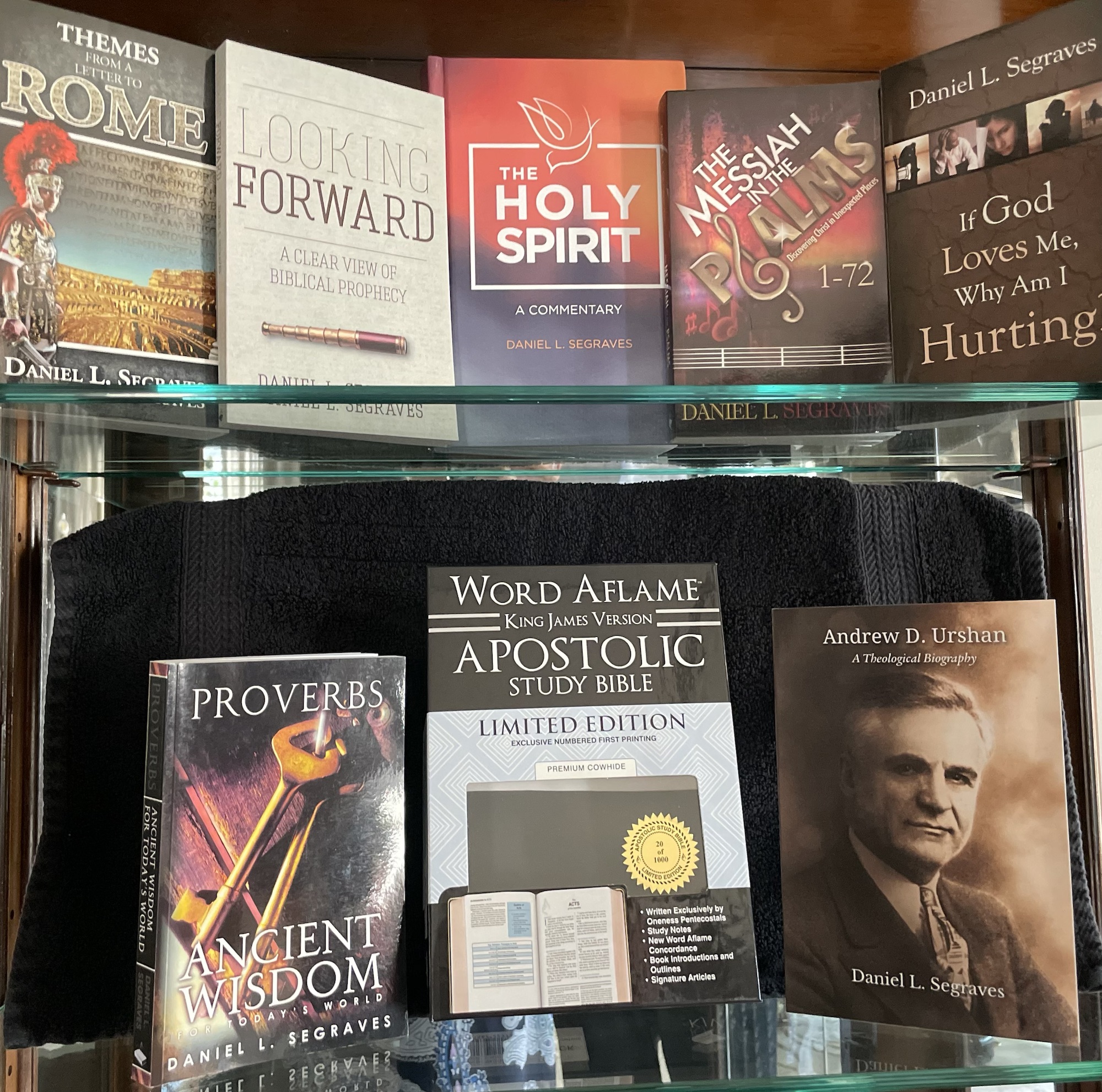
Discovering Christ in Unexpected Places Lesson 6 Video
Lesson 6 | October 23, 2016
Prepared by Daniel L. Segraves, PhD
In our previous lesson, we saw substantial evidence that Psalm 69 is a messianic psalm.[1] We will continue our exploration in this lesson with Jesus’ reference to Psalm 69:4a in John 15:25.
As He described His solidarity with the Father, a solidarity so complete that those who hated Jesus hated His Father also, Jesus said, “But this happened that the word might be fulfilled which is written in their law, ‘They hated Me without a cause’” (John 15:25). This refers to Psalm 69:4: “Those who hate me without a cause are more than the hairs of my head….”[2]
The idea here and in John 8:17; 10:34 may be that, when the Old Testament is read without a Christ-centered consciousness, it becomes a book other than what God intended. Jesus did not say, “As it is written in our law,” or even, “As it is written in the law.” Suddenly, the “law” becomes the law as it is identified with and owned by the unbelieving Jewish leaders who rejected the central theme of the law: The Messiah. This is not God’s law; it is their law. The words are the same, but the words – stripped of the meaning intended by God – are no longer His; they are theirs.
The enmity of the religious leaders who – had they been able – would have killed Jesus is bound up with the words of verse 4. They were numerous (“more than the hairs of my head”) and mighty.[3] The wrongfulness of their enmity is captured in the words, “Though I have stolen nothing, I still must restore it” (verse 4). Wilcock observes that we “do not know in what sense the psalmist was forced to restore what [he] did not steal,”[4] but this could be a reference to the view of Jesus’ unbelieving enemies that He had “stolen” the messianic claim. They did not believe it was rightfully His, so they demanded that He “restore it.” Even if this is not the point, the statement indicates that their claims – whatever they were – were false.
Verse 5 is the only one in the psalm that may seem to prohibit us from reading the text as a reference to the Messiah: “O God, You know my foolishness; and my sins are not hidden from You.” If this is indeed a necessary reference to the foolishness of the speaker and to sins he has personally committed, the verse cannot refer to the Messiah. In that case, if we view the psalm as an integrated unit, we shall have to deny that it has any reference to the Messiah. But the psalm’s use in the New Testament does not allow this position. Perhaps we could agree with Wilcock that although much of the psalm has to do with the Messiah, some of it does not.[5] But we have previously taken a position similar to Dodd’s, who saw quotations from the psalms as carrying their context with them.[6] If the individual psalms are integrated units within which some words are attributed to the Messiah, and if there is no change of speaker within the psalm, the entire psalm must be attributed to the Messiah.
But what are we to do with the statement, “O God, You know my foolishness”? As Mays points out, verse 5
can be read two ways. It is either a further claim of innocence (“If I had committed folly, you, God, would know”) or it is a statement that what folly he has done is known by God and not a cause for those who hate him and seek to destroy him (v. 4).[7]
In Gaebelein’s view, verse 5 indicates that “He [the Messiah] owns the foolishness and trespass of lost sinners as His own.”[8] The second half of verse 5 (“and my sins are not hidden from You”) can be understood in the same way as the sin references in previous messianic psalms.[9] That is, the reference is not to personal sins committed by the Messiah, but to His role as a sin-bearer. In this case, the word ’ashmah, translated “sins,” has within its semantic range the meaning “trespass-offering.”[10] If the verse is read this way, the meaning is similar to that of II Corinthians 5:21: “For He made Him who knew no sin to be sin for us ….” The fact that ’ashmah is plural in verse 5 may seem to be a problem for understanding the verse this way (i.e., is it appropriate to think of the Messiah’s redemptive work in terms of trespass offerings?). But this would not be the only place in Scripture where the concept of Christ’s offering for sins is described with a plural word: “Therefore it was necessary that the copies of the things in the heavens should be purified with these, but the heavenly things themselves with better sacrifices than these” (Hebrews 9:23).
That the heavenly things are cleansed with “better sacrifices” does not mean that the one sacrifice of Christ is insufficient. In view of the author’s insistence that Christ’s singular sacrifice was sufficient (9:28; 10:10, 14), we should understand the word “sacrifices” as a generic plural that, still in the language of the old covenant, states the necessity of sacrifice to deal with the sin problem. The focus is not on how many sacrifices are necessary under the new covenant, but on the need for something superior to the blood of animals to cleanse the heavenly things.[11]
If we read ’ashmah as a reference to the Messiah bearing the sins of the people as in Isaiah 53, the plural form poses no problem. If we read it as a reference to the trespass-offering made by Christ in His death, with the plural form picking up the language of the Old Covenant, no problem is posed. There is but one sacrifice for sin, but that one sacrifice fulfills the prophetic significance of all of the sacrifices for sin offered under the Law of Moses.
Verse 6 is the Messiah’s plea that none that wait for the Lord God (i.e., those who trust Him) would be ashamed or confounded because of Him. This prayer was certainly answered, as were all of Jesus’ prayers. No person of genuine faith found Christ to be a stumbling block. But He was a stumbling block to those who lacked faith.[12]
The Messiah bore the reproaches of those who reproached the Lord God (verses 7, 9b).[13] He was so closely identified with God in these reproaches that He was rejected even by His siblings (verse 8).[14] In the context of bearing God’s reproaches, the Messiah was consumed with zeal for the purity of God’s house (verse 9a).[15] The Messiah was reproached for His weeping and fasting (verses 10-11a). Although we don’t read a specific reference in the New Testament reflecting this, we do read that Jesus’ fasting experience was for the purpose of being tempted by the devil.[16]
The Messiah became a byword, the object of verbal opposition, and the subject of drinking songs (verses 11b-12). Some of this may be seen in the claims that Jesus was a Samaritan who was possessed of a devil, that He was born of fornication, and that He was empowered by Beelzebub.[17]
In the face of the opposition He faced, the Messiah prayed (verse 13a). He prayed that at the right time (verse 13b), on the basis of His mercy (verse 13c), God would hear Him (verse 13d) and deliver Him “out of the mire,” a metaphor for those who hated Him (verses 14-15). The description of His dangerous circumstances as a “pit” connects with a theme reaching all the way back to Psalm 7:15.[18]
In verse 16, the words of the Messiah’s prayer echo the words of David’s prayer in Psalm 51:1. This may reflect the purpose of Psalm 69 as originally written; perhaps it was a prayer of David in the midst of dire but unspecified circumstances.
The identification of the supplicant as God’s “servant” in verse 17 connects with the Messiah’s identification as His “servant” elsewhere.[19]
The prayer for redemption in verse 18 does not require the idea of redemption from sin, although it certainly could have that meaning in the right context. But if this is a prayer of the Messiah, it could simply be a plea for deliverance from His enemies. The word translated “redeem” (ga’al) is also used, for example, of the deliverance or redemption of Israel from bondage in Egypt.
The Messiah refers again to His reproach, shame, and dishonor (verses 19-20a). He had no human comforters (verse 20). Indeed, all of His disciples forsook Him and fled.[20]
Verse 21 anticipates Jesus’ experience on the cross when He was given vinegar laced with gall – a poison – to drink.[21]
Verses 22-23 anticipate the consequences of rejecting the Messiah for unbelieving Israelites.[22] It is significant that these verses follow immediately on the heels of a verse (verse 21) that describes Jesus’ experience on the cross. Their rejection of Jesus came to its ultimate expression in His crucifixion; its consequence was spiritual blindness. The “table” was a symbol of blessing. Because of their rejection of the Messiah, the covenant God had made with the nation of Israel became a snare and trap for them. Because their eyes were darkened so they could not see the truth, they focused on the Law of Moses rather than on the Messiah to whom the law pointed.[23] Metaphorically, the nation experiences continual shaking of the loins. That is, they have no peace, no stability, no relief from suffering. As the Septuagint puts it – and as quoted by Paul – their backs are always bowed down.
The prayer that those who rejected Him would experience God’s indignation and anger (verse 24) indicates the severity and magnitude of the nation’s sin. As Jesus warned the Israelites who rejected Him, it would be more tolerable for unbelieving Gentiles – including Sodom – in the day of judgment than for unbelieving Israelites who were recipients of special revelation and who had every reason to believe.[24]
Although verses 25-28 refer in the plural to those who persecute others who are stricken by God, Peter interpreted verse 25 to refer to one specific person – Judas – who betrayed Jesus.[25] The fate of Judas is the fate of all those who reject the Messiah.
The plural references in verses 25-28 suggest that in its original form, before it was placed in its context in the Psalter, Psalm 69 had other referents. But in its context here, the plural referents can be read as generic plurals; they are collapsed down to one whose dwelling place will be desolate, to one who persecutes, to one who has iniquity added to his iniquity, to one who will not come into God’s righteousness, to one who will be blotted out of the book of the living: Judas. The plurals are also collapsed down to One who has been struck by God,[26] One who was wounded[27]: Jesus.
The Messiah confesses to His poverty and sorrow, praying for God’s salvation to set Him “up on high” (verse 29). As Isaiah put it, the Messiah was “a Man of sorrows and acquainted with grief” (Isaiah 53:3). Paul described the richness of the Christian experience as a consequence of the Messiah’s poverty (II Corinthians 8:9).
The Messiah promises to “praise the name of God with a song” and to “magnify Him with thanksgiving” (verse 30). This connects with Psalm 40:3, where the Messiah has a “new song.” Verse 30 is one of those places where the name of God represents God Himself in poetic parallelism.
As in Psalm 51:15-17, verse 31 sees sincere worship as being better than animal sacrifices. This, together with the Messiah’s zeal for the temple in verse 9, seems to point to a day when the temple will not feature sacrifices that are efficacious for sin. In other words, a temple is standing in Psalm 69. This may indicate a post-exilic date for the psalm, since there was no temple during David’s reign. But, on the other hand, the tabernacle was also referred to as a temple.[28] But the psalm’s messianic focus, and its reference to an offering more pleasing to God than animal sacrifices, may point ahead to the temple described by Ezekiel. Although sacrifices will be offered at that temple – and they are referred to as sin offerings – they may serve as memorials.[29] There is no ark in the Holy of Holies upon which to sprinkle blood; the Messiah occupies that most sacred place as His throne room.[30]
Verse 32 reprises Psalm 34:2: Those who are humble (i.e., they are people of faith) rejoice at heart-felt worship. These are people who seek God; they shall live. If we read the superscription of the psalm as does the Septuagint, with an eschatological reference to those who will be changed, the idea connects with the promise of life found in verse 32.
It is certain that those who seek God shall live, for “the Lord hears the poor, and does not despise His prisoners” (verse 33). The concept of believers being God’s “prisoners” is picked up by Paul.[31] As Kidner points out, the term “His prisoners” is an expression that “reveals what touches God particularly closely … and brings out the contrast between Him and the grasping gods of heathendom; namely our relationship to Him, and our need.”[32]
Universal praise is called for in verse 34, in view of the fact that “God will save Zion and build the cities of Judah, that they may dwell there and possess it” (verse 35). This connects with the Zion theology theme that begins in Psalm 2:6. The psalm expresses “the fervent desire of the psalmist for God’s salvation of Zion and the establishment of his kingdom (vv. 34-36).”[33] It looks “back to God’s promise to David (cf. Ps 2:7; 2 Sa 7:16) and eagerly await[s] its fulfillment in Zion.”[34]
The land promised to Abraham, Isaac, and Jacob will be inherited by their descendants; those who occupy it will be those who love God’s name (verse 36).
Psalm 69 advances the messianic theme of the Psalter. It is one of the psalms relied on most heavily by the writers of the New Testament to describe and interpret the events of the Messiah’s life.
The videos and study guides for this class can be accessed at http://www.danielsegraves.com/blog.
[1] This lesson is abbreviated from the comments on Psalm 69 in Daniel L. Segraves, The Messiah in the Psalms (Hazelwood, MO: WAP Academic, 2007), 276-290.
[2] See also Psalm 35:19 and the comments there.
[3] See Matthew 26:4; Luke 4:28-29; 22:2; John 5:18; 7:1, 19, 25; 8:37, 40.
[4] Michael Wilcock, The Message of Psalms 1-72: Songs for the People of God (Downers Grove, IL: InterVarsity Press, 2001), 241.
[5] Wilcock, 241.
[6] See Steve Moyise, The Old Testament in the New (New York: Continuum, 2001), 12.
[7] James Luther Mays, Psalms (Louisville: John Knox Press, 1994), 230.
[8] Arno Clemens Gaebelein, The Book of Psalms (New York: “Our Hope” Publications, 1939), 272.
[9] See comments on Psalm 31:10; 40:12 in Segraves, The Messiah in the Psalms, 101-102, 139-141.
[10] Francis Brown et al., The New Brown Driver, Briggs, Gesenius Hebrew and English Lexicon: with an Appendix Containing the Biblical Aramaic (Peabody, MA: Hendrickson, 1979), 80.
[11] Daniel L. Segraves, Hebrews: Better Things, vol. 2 (Hazelwood, Mo.: Word Aflame Press, 1997), 48-49.
[12] See Isaiah 8:14; Romans 9:33; Galatians 5:11; I Peter 2:8.
[13] See Romans 15:3.
[14] See John 7:3-5.
[15] See John 2:17.
[16] See Matthew 4:1.
[17] See Matthew 12:24; John 8:41, 48.
[18] See also Psalms 9:15; 28:1; 30:3, 9; 35:7; 40:2; 55:23; 57:6.
[19] See Isaiah 42:1; 52:13; Zechariah 3:8.
[20] See Matthew 26:56; Mark 14:50.
[21] See Matthew 27:34.
[22] See Romans 11:9-10.
[23] See Romans 9:30-33.
[24] See Matthew 10:15; 11:22, 24.
[25] See Acts 1:20.
[26] See Isaiah 53:4, 8.
[27] See Isaiah 53:5.
[28] See I Samuel 1:9; 3:3.
[29] See Ezekiel 40-47 and comments on Psalm 51:5.
[30] See Ezekiel 43:1-7.
[31] See Ephesians 3:1; Philemon 1:1, 9.
[32] Derek Kidner, Psalms (Downers Grove, IL: Inter-Varsity Press, 1973), 248-249.
[33] John H. Sailhamer, NIV Compact Bible Commentary (Grand Rapids: Zondervan, 1994), 330.
[34] Ibid.
Lesson 5 | October 16, 2016
Prepared by Daniel L. Segraves, PhD
The rich vein of messianic prophecy found in Psalm 69 is mined frequently by the writers of the New Testament.[1] Together with Psalms 22 and 110, Psalm 69 “is one of the three psalms most often quoted in the New Testament.”[2] The following verbal connections may be readily seen:
Those who hate me without a cause are more than the hairs of my head … (verse 4a).
But this happened that the word might be fulfilled which is written in their law, “They hated Me without a cause” (John 15:25).
Because zeal for Your house has eaten me up … (verse 9a).
Then His disciples remembered that it was written, “Zeal for Your house has eaten Me up” (John 2:17).
And the reproaches of those who reproach You have fallen on me (verse 9b).
For even Christ did not please Himself; but as it is written, “The reproaches of those who reproached You fell on Me” (Romans 15:3).
They also gave me gall for my food, and for my thirst they gave me vinegar to drink (verse 21).
… they gave Him sour wine mingled with gall to drink. … Immediately one of them ran and took a sponge, filled it with sour wine and put it on a reed, and offered it to Him to drink (Matthew 27:34a, 48).
Let their table become a snare before them, and their well-being a trap. Let their eyes be darkened, so that they do not see; and make their loins shake continually (verses 22-23).
And David says: “Let their table become a snare and a trap, a stumbling block and a recompense to them. Let their eyes be darkened, so that they do not see, and bow down their back always” (Romans 11:9-10).
Let their dwelling place be desolate; let no one live in their tents (verse 25).
For it is written in the book of Psalms: “Let his dwelling place be desolate, and let no one live in it …” (Acts 1:20a).
In addition to these verses which are specifically connected in the New Testament with the person of Christ or with the affairs of His kingdom, there are other statements in Psalm 69 which may not be quoted by the writers of the New Testament but which are conceptually related to the Messiah, His experiences, or His kingdom. For example:
I am weary with my crying; My throat is dry; My eyes fail while I wait for my God (verse 3).
And about the ninth hour Jesus cried out with a loud voice, saying, “Eli, Eli, lama sabachthani?” that is, “My God, My God, why have You forsaken Me?” (Matthew 27:46).
After this, Jesus, knowing that all things were now accomplished, that the Scripture might be fulfilled, said, “I thirst!” (John 19:28).
Because for Your sake I have borne reproach; shame has covered my face (verse 7).
… looking unto Jesus, the author and finisher of our faith, who for the joy that was set before Him endured the cross, despising the shame, and has sat down at the right hand of the throne of God (Hebrews 12:2).
I have become a stranger to my brothers, and an alien to my mother’s children (verse 8).
His brothers therefore said to Him, “Depart from here and go into Judea, that Your disciples also may see the works that You are doing. … For even His brothers did not believe in Him (John 7:3, 5).
When I wept and chastened my soul with fasting, that became my reproach. I also made sackcloth my garment; I became a byword to them (verse 10-11).
Then Jesus was led up by the Spirit into the wilderness to be tempted by the devil. And when He had fasted forty days and forty nights, afterward He was hungry (Matthew 4:1-2).
In addition to these conceptual links, we will see that there are other thematic indications that Psalm 69 should be read as pointing ahead to the Messiah. The New Testament sees Psalm 69 as specifically fulfilled in the life, experiences, and kingdom of Christ. Jesus Himself considered verse 4 to be fulfilled in His own experiences.[3] This, together with Jesus’ broader statements about the nature of messianic prophecy, lifts texts such as Psalm 69 above the level of mere generic instruction.[4] If we read the Old Testament as the New Testament does, we will see these texts as specifically anticipating the Messiah and the events of His life and kingdom. When Jesus cleansed the temple, it caused His disciples to remember Psalm 69:9a.[5] Paul saw Christ’s selflessness as having been anticipated in Psalm 69:9b.[6] He also saw the consequences of Jewish rejection of the Messiah as having been foreseen in Psalm 69:22-23.[7] Peter appealed to Psalm 69:25 for support in the need to replace Judas.[8] As Wilcock points out, “the New Testament relates [Psalm 69] directly to Christ.”[9]
In view of the nature of the use of Psalm 69 in the New Testament, the larger view of Jesus and the New Testament church concerning the messianic focus of the Old Testament, and the influence of the messianic context of the Psalter, we will read Psalm 69 as a psalm that specifically points to the person of Christ, to His experiences, and to the affairs of His kingdom. Like Psalm 22, Psalm 69 could well be one of the prayers of Jesus, the entire content of which is not revealed in the New Testament.
The fact that Psalm 69 is set to the tune “The Lilies” distinguishes it from all but three other psalms.[10] David Mitchell sees eschatological significance in the Septuagint translation of ‘l shoshannim [“Set to ‘The Lilies’”] as huper tōn alloiōthēsomenōn [“for those who will be changed”] in Psalms 45, 69, and 80, and as tois alloiōthēsomenois eti [“for those who shall yet be changed”] in Psalm 60, Mitchell points out that
At first glance this seems to be no translation at all. But there is an underlying idea that links lilies and the transformation (of the year) – the idea of springtime, when lilies bloom. So this may be an interpretation rather than a departure from the Hebrew. And there may be eschatological implications. For the idea of the transformation of the earth in spring connotes the image-complex of Passover, new creation and resurrection, for which lilies are an ancient symbol.[11]
If we accept Mitchell’s suggestion, it may further strengthen the idea that Psalm 69 is specifically messianic: It points ahead to the Messiah, whose sufferings – so vividly described in the psalm – result in new life for those who believe on Him. That the psalm includes the promise of new life for those who trust in the Messiah may be seen in verse 32: “The humble shall see this and be glad; and you who seek God, your hearts shall live.”
It is not difficult to read Psalm 69 as a prayer of the Messiah in the midst of His suffering. The prayer begins with a plea for deliverance (verse 1). The danger is described metaphorically as deep mire and waters that make it impossible to stand (verses 1-2). The Messiah has cried to the point of exhaustion; His throat is dry. The combination of tears and dehydration has hindered His eyesight (verse 3). Lest we think this is too dramatic a description, we must remember that the New Testament describes the Messiah’s prayers as “vehement cries and tears” (Hebrews 5:7).
As He described His solidarity with the Father, a solidarity so complete that those who hated Jesus hated His Father also, Jesus said, “But this happened that the word might be fulfilled which is written in their law, ‘They hated Me without a cause’” (John 15:25). This is, of course, a reference to Psalm 69:4: “Those who hate me without a cause are more than the hairs of my head….”[12]
The idea here and in John 8:17; 10:34 may be that, when the Old Testament is read without a Christ-centered consciousness, it becomes a book other than what God intended. Jesus did not say, “As it is written in our law,” or even, “As it is written in the law.” Suddenly, the “law” becomes the law as it is identified with and owned by the unbelieving Jewish leaders who rejected the central theme of the law: The Messiah. This is not God’s law; it is their law. The words are the same, but the words – stripped of the meaning intended by God – are no longer His; they are theirs.
The enmity of the religious leaders who – had they been able – would have killed Jesus is bound up with the words of verse 4. They were numerous (“more than the hairs of my head”) and mighty.[13] The wrongfulness of their enmity is captured in the words, “Though I have stolen nothing, I still must restore it” (verse 4). Wilcock observes that we “do not know in what sense the psalmist was forced to restore what [he] did not steal,”[14] but this could be a reference to the view of Jesus’ unbelieving enemies that He had “stolen” the messianic claim. They did not believe it was rightfully His, so they demanded that He “restore it.” Even if this is not the point, the statement indicates that their claims – whatever they were – were false.
In our next lesson, we will examine the rest of Psalm 69, including verse 5, which may seem impossible to reconcile with the idea that the entire psalm is messianic.
[1] This lesson is abbreviated from the comments on Psalm 69 in Daniel L. Segraves, The Messiah in the Psalms (Hazelwood, MO: WAP Academic, 2007), 276-290.
[2] Michael Wilcock, The Message of Psalms 1-72: Songs for the People of God (Downers Grove, IL: InterVarsity Press, 2001), 239.
[3] See John 15:25.
[4] See Luke 24:25-27, 44-48.
[5] See John 2:17.
[6] See Romans 15:3, and note how Paul connects this quote from Psalm 69 with the fact that “whatever things were written before were written for our learning” in the next verse (Romans 15:4a). The point seems to be that when we read the Scriptures messianically, “we through patience and comfort of the Scriptures might have hope” (Romans 15:4b).
[7] See Romans 11:9-10.
[8] See Acts 1:20.
[9] Wilcock, 241.
[10] See Psalms 45, 60, and 80.
[11] David C. Mitchell, The Message of the Psalter: an Eschatological Programme in the Books of Psalms (Sheffield, England: Sheffield Academic Press, 1997), 19-20.
[12] See also Psalm 35:19 and the comments there.
[13] See Matthew 26:4; Luke 4:28-29; 22:2; John 5:18; 7:1, 19, 25; 8:37, 40.
[14] Wilcock, 241.
Lesson 4 | October 2, 2016
Prepared by Daniel L. Segraves, PhD
Psalm 45 is “a contemplation of the sons of Korah” addressed to the “Chief Musician.” It is “set to ‘The lilies’.”
The superscription of Psalm 45 further identifies it as “a song of loves.” This is connected to the wedding theme of the psalm. In the psalm, the marriage of an idealized King is portrayed.[2] It is typical to view Psalm 45 as “a royal psalm [that] functioned as a wedding song at the occasion of the wedding of a royal couple.”[3]
Our chief concern, however, is not with the use that may have been made of this psalm as it was originally composed in isolation from other psalms, but with the use it is given in its new context in the Psalter. This is connected with the remarkable use made of Psalm 45 in the New Testament.
As it relates to its immediate context in the Psalter, Psalm 45 is the answer to the cry for redemption that concludes Psalm 44: “Arise for our help, and redeem us for Your mercies sake” (Psalm 44:26).[4] In Psalm 45, the Divine King arises to defeat the enemy. (See Psalm 45:3-6.)
The messianic connection of Psalm 45 with the New Testament may be seen by comparing verses 6-7 with Hebrews 1:8-9:
Your throne, O God, is forever and ever; a scepter of righteousness is the scepter of Your kingdom. You love righteousness and hate wickedness; therefore God, Your God, has anointed You with the oil of gladness more than Your companions (Psalm 45:6-7).
But to the Son He says: “Your throne, O God, is forever and ever; a scepter of righteousness is the scepter of Your kingdom. You have loved righteousness and hated lawlessness; therefore God, Your God, has anointed You with the oil of gladness more than Your companions” (Hebrews 1:8-19).
The writer of Hebrews, in a discussion of the superiority of Jesus Christ to the angels, appeals to Psalm 45:6-7 to demonstrate both the deity and humanity of the Son. The angels are inferior to Him. They are not Sons of God in the sense that the Messiah is. (See Hebrews 1:4-5.) They worship the Son. (See Hebrews 1:6.) They are serving spirits. (See Hebrews 1:7.) The Son, on the other hand, is identified as the God and Lord Who created all things. (See Hebrews 1:8, 10-12.)
Since the New Testament reads Psalm 45:6-7 as being about the Messiah, and since the Person addressed in these verses is the subject of the entire psalm, we should read the entire psalm as being about Him in some way.
Following the superscription, Psalm 45 begins, “My heart is overflowing with a good theme; I recite my composition concerning the King; my tongue is the pen of a ready writer” (verse 1). The words translated “a good theme” (dabar tov) mean literally, “a good word.” In view of the messianic connection between this psalm and the New Testament, it may be appropriate to read “a good word” as a reference to the gospel message. The gospel is, by definition, “good news.” The same letter that connects Psalm 45 with the Messiah, Hebrews, identifies New Testament believers as those who have “tasted the good word of God” (Hebrews 6:5). Since the theme of Psalm 45 is “the King” (verse 1), and since the King is God (verse 6), it seems reasonable to understand the psalm as a poetic description of events surrounding the proclamation of the gospel message. (The contrastive connection with Psalm 44 is remarkable. Psalm 44, a psalm of national lament, cries for the Lord to awaken and redeem the people. Psalm 45 declares the means of this redemption; it is the “good word.”)
The King, the Messiah, is “fairer than the sons of men” (verse 2a). As the “Son of man,” He is the most excellent of all men.[5] Grace “is poured upon” His lips (verse 2b). When Jesus ministered in Nazareth, the people marveled “at the gracious words which proceeded out of His mouth” (Luke 4:22). John wrote that “the law was given through Moses, but grace and truth came through Jesus Christ” (John 1:17). The Messiah is eternally blessed of God (verse 2c).
The Messiah, identified as the “Mighty One” prepares for battle against His enemies by girding His sword upon His thigh (verse 3a). The word translated “Mighty One” (gibbor) may be compared with Isaiah 9:6, where the Messiah is identified as the “Mighty God” (’el gibbor). The Messiah is girded not only with a sword, but also with glory and majesty (verse 3b).[6] (See Jude 25.)
In His majesty, the Messiah is pictured as a conquering King on a steed, riding “prosperously because of truth, humility, and righteousness” (verse 4a). In other words, His military campaign will succeed because He is characterized by truth, humility, and righteousness. A parallel may be seen in Revelation 19:11: “Now I saw heaven opened, and behold, a white horse. And He who sat on him was called Faithful and True, and in righteousness He judges and makes war.” (See also Revelation 19:12-16.) In the New Testament, humility is connected with faithfulness. (Compare Micah 6:8 with Matthew 23:23.)
The “right hand” metaphor is connected with the military imagery (verse 4b). The “right hand” symbolizes military strength, and the phrase could be translated, “Then your right hand will accomplish mighty acts!”[7] (Compare with Psalm 2:9; Revelation 2:27; 19:15.)
The military imagery continues in verse 5: “Your arrows are sharp in the heart of the King’s enemies; the peoples fall under you.” (Compare with Revelation 19:15; I Corinthians 15:24-25.) This picks up and continues the theme of the Messiah’s conquest of those who rebel against Him. (See Psalm 2:7-9; 110:1-2, 5-6.)
The use of verses 6-7 in Hebrews 1:8-9 indicates that Psalm 45 has definite messianic content. According to the writer of Hebrews, the words of verses 6-7 are “to the Son” (Hebrews 1:8). The words “Your throne … is forever and ever” reflect the promise of the Davidic Covenant. God promised David, “When your days are fulfilled and you rest with your fathers, I will set up your seed after you, who will come from your body, and I will establish his kingdom. He shall build a house for My name, and I will establish the throne of his kingdom forever. … And your house and your kingdom shall be established forever before you. Your throne shall be established forever” (II Samuel 7:12-13, 16). As it related to David’s purely human descendant, Solomon, there was an additional promise and warning: “I will be his Father, and he shall be My son. If he commits iniquity, I will chasten him with the rod of men and with the blows of the sons of men. But My mercy shall not depart from him, as I took it from Saul, whom I removed from before you” (II Samuel 7:14-15). If David’s descendants through Solomon were unfaithful to God, they would be punished, but their disobedience would not invalidate the covenant God made with David. (See Psalm 89:20-37.) Wickedness among Solomon’s descendants reached a low point with Coniah, also known as Jeconiah. He was so wicked that his removal from the throne was the beginning of the Babylonian captivity of Judah. Jeremiah declared, “Thus says the Lord: ‘Write this man down as childless, a man who shall not prosper in his days; for none of his descendants shall prosper, sitting on the throne of David, and ruling anymore in Judah’” (Jeremiah 22:30). This precipitated Israel abiding “many days without king or prince, without sacrifice or sacred pillar, without ephod or teraphim” (Hosea 3:4). But for Israel to be without a king was not to be a permanent situation: “Afterward the children of Israel shall return and seek the Lord their God and David their king. They shall fear the Lord and His goodness in the latter days” (Hosea 3:5).
The ultimate fulfillment of the Davidic Covenant would come through a human descendant of David: “The Lord has sworn in truth to David; He will not turn from it: ‘I will set upon your throne the fruit of your body’” (Psalm 132:11). But how could this be, in view of Coniah’s unfaithfulness and the fact that none of his descendants would continue the Solomonic lineage from David?
The precise fulfillment of God’s promise to David came through the incarnation, wherein the virgin Mary conceived and brought forth the Son of God, who was at the same time the Son of David. (See Luke 1:31-35.) Mary was a descendant of David through David’s son Nathan, not through Solomon. (See Luke 3:23-31.[8]) Joseph was a descendant of David through Solomon. Thus, Jesus’ legal claim to David’s throne came through His legal father, Joseph. If Joseph had been Jesus’ physical father, Jesus would not have qualified to sit on David’s throne due to Coniah’s defilement. But this defilement was avoided because Mary was also David’s descendant, but through Nathan. God’s promise to David that the Messiah would descend physically from him to sit on his throne was thus fulfilled. (See Acts 2:29-31.)
As it was originally written in isolation from the Psalter, Psalm 45 may have been a royal psalm functioning as a wedding song at a royal wedding.[9] But as it is included in the Psalter, in its new messianic context, it functions to declare the deity of the Messiah and the eternality of His throne. Verse 6 identifies the Son, the One on the throne, as Elohim. His rule is characterized by righteousness.
Verse 7, however, declares that the Divine King is somehow human: “You love righteousness and hate wickedness; therefore God, Your God, has anointed You with the oil of gladness more than Your companions.” First, this Divine King has “companions” (habar). Habar indicates a real equality of some kind.[10] As quoted in Hebrews 1:9, the Greek metochous also indicates a real sharing, partaking, partnership, participation, and fellowship. The context in Hebrews indicates that the Messiah’s companions are human beings; since He is human, He stands in solidarity with humanity.[11] Second, God is the God of this Divine King. In order for this to be true, the Divine King must be not only divine, but also human.
The Messiah is “anointed … with the oil of gladness more than” His companions (verse 7b). All of Israel’s merely human kings were anointed, but the anointing of the Divine-human King exceeded their anointing. (Compare I Samuel 16:1, 13 with Luke 4:16-21.)
At verse 8, the psalm turns to a discussion of the preparations for the wedding of the King and His bride. The King’s garments “are scented with myrrh and aloes and cassia” (verse 8). The phrase translated “out of the ivory palaces, by which they have made You glad” could be translated “from the luxurious palaces comes the music of stringed instruments that makes you happy.”[12]
Verse 9 addresses the members of the wedding party that include the bride, the queen, and her attendants. The queen’s adornment includes “gold from Ophir.” Ophir was known as the source of fine gold.[13] In conjunction with its messianic theme, this should be compared to Revelation 19:7-9.
The queen seems to be from a foreign country; she is urged to forget her own people and her father’s house (verse 10).[14] This may be intended to foreshadow the fact that the Messiah’s bride would not be characterized by a prescribed ethnicity. (See Galatians 3:28; Colossians 3:11.) If this is the case, the bride is not exclusively Jewish. Thus, it is not the nation of Israel.
The King will “greatly desire” His bride’s beauty. But He is more than her husband; He is her Lord, and she is to worship Him (verse 11). This “strongly suggests that she is to be taken as a figure of the congregation’s faithful trust in the King.”[15]
The facts that the “daughter of Tyre will come with a gift” and that the “rich among the people will seek” the bride’s favor (verse 12) evoke prophecies found elsewhere concerning the universal homage that will be paid to the Messiah and thus to His royal court. (See Isaiah 60:3; Zechariah 14:16-17; Revelation 21:24-26.)
The queen’s beautiful clothing is described in verses 13-14a. This may be compared with Revelation 19:7-8.[16]
The queen’s companions, the members of the wedding party who accompany her, are brought before the King “with gladness and rejoicing” (verses 14b-15). These may be the wise virgins to whom Jesus referred in Matthew 25:1-13. They may also be in view in Revelation 19:9 as those who “are called to the marriage supper of the Lamb.”
Where the Messiah’s human ancestors have previously reigned, His sons will share in His reign as princes (verse 16). (See Romans 5:17; II Timothy 2:12; Revelation 5:10; 20:4-6.)
The Messiah’s name will “be remembered in all generations” and the people shall praise Him forever and ever (verse 17).
The videos and study guides for this class can be accessed at http://www.danielsegraves.com/blog.
[1] This lesson is from Daniel L. Segraves, The Messiah in the Psalms: Discovering Christ in Unexpected Places (Hazelwood, MO: WAP Academic, 2007), 159-166.
[2] See John H. Sailhamer, NIV Compact Bible Commentary (Grand Rapids, MI: Zondervan, 1994), 324.
[3] Willem A. VanGemeren, in Frank E. Gaebelein, gen. ed., The Expositor’s Bible Commentary, vol. 5 (Grand Rapids, MI: Zondervan, 1991), 343.
[4] See Sailhamer, 324.
[5] The NIV translates the phrase, “You are the most excellent of men.”
[6] See VanGemeren, 345.
[7] http://www.bible.org/cgi-bin/netbible.pl#note_14.
[8] Luke records Jesus’ physical descent through Mary; Matthew records his legal descent through Joseph. Joseph’s father was Jacob. (See Matthew 1:16.) Joseph was Mary’s husband, but he was not the physical father of Jesus. The words “of whom” (ex hes) require Jesus to be born of Mary, but not of Joseph. Hes is the feminine singular pronoun. Luke’s genealogy from Abraham to David is identical to Matthew’s genealogy from Abraham to David. (Compare Matthew 1:2-6 with Luke 3:31-34.) The difference between the genealogies begins with David’s descendant. In Matthew, it is Solomon (Matthew 1:6). In Luke, it is Nathan (Luke 3:31). In Luke, the father of Joseph is not Jacob, but Heli (Luke 3:23). It was customary in Jewish genealogies not to list the mother as the final ancestor, but the father. Luke points out that Jesus was only “supposed” to be the son of Joseph (Luke 3:23). Heli was Joseph’s father-in-law.
[9] VanGemeren, 343.
[10] See the use of habar in Exodus 36:10; 39:4; Psalm 119:63; Proverbs 28:24. See the use of various forms of metochous in Luke 5:7 and II Corinthians 6:14.
[11] See comments on Hebrews 1:9 in Segraves, Hebrew: Better Things, vol. 1, 52-53.
[12] http://www.bible.org/cgi-bin/netbible.pl#note_26
[13] See I Kings 9:28; 10:11; 22:48; I Chronicles 29:4; II Chronicles 8:18; 9:10; Job 22:24; 28:16; Isaiah 13:12.
[14] See VanGemeren, 347.
[15] Sailhamer, 324.
[16] The word translated “white” (lampros) by the KJV includes within its range of meaning “shining, brilliant, splendid, magnificent.”
Lesson 3 | September 18, 2016
Prepared by Daniel L. Segraves, PhD
A close reading of the messianic texts in Scripture often reveals the biblical witness to both the Messiah’s humanity and His deity. Neither must be minimized or denied. Jesus Christ is the central focus of Scripture, and the full-orbed testimony of these inspired words is that He is both God and man.
Since Psalm 22 was understood as a messianic text by the first century church, it is no surprise that the New Testament linked the psalm not only to the genuineness of Christ’s human existence as demonstrated by His suffering, but also to His identity as Lord and God as indicated by His resurrection. This lesson will briefly explore both themes as they are specifically connected with the New Testament.
“My God, My God, why have you forsaken me?” (Ps 22:1).
“And about the ninth hour Jesus cried out with a loud voice, saying, ‘Eli, Eli, lama sabachthani?’ that is, ‘My God, My God, why have you forsaken Me?’” (Matt 27:46).[1]
The New Testament frequently mentions the prayers of Jesus. His were genuine prayers offered not in pretense or merely as an example for us. His prayers arose from his authentic humanity. Jesus prayed because He was human, and humans need to pray.
“…who, in the days of His flesh, when He had offered up prayers and supplications, with vehement cries and tears to Him who was able to save Him from death, and was heard because of His godly fear …. of whom we have much to say, and hard to explain, since you have become dull of hearing (Heb 5:7, 11).
There was no charade here. Jesus prayed to Him and was heard. Matters related to the humanity of Christ are hard to explain. Indeed, they cannot be understood apart from faith[2] because the Incarnation is a mystery.[3]
“I will declare Your name to My brethren; In the midst of the assembly I will praise You” (Ps 22:22).
“I will declare Your name to My brethren; In the midst of the assembly I will sing praise to You” (Heb 2:12).
Hebrews 2:12 quotes the final verse of the Messiah’s prayer. These words declare the Messiah’s solidarity with the human race even to the point of lifting up His voice in praise to God “in the midst of the assembly,” or in the same way that human beings lift up their voices as they assemble to praise God.
The Messiah’s conversation with God arises from His human nature, not from His deity. It is not a picture of one divine person speaking to another, but of a genuinely human Messiah speaking to God just as surely as any human being would.
The point in quoting Psalm 22:22 is to reinforce and demonstrate the identification of the Messiah with His human peers (“My brethren”), a theme that continues from Hebrews 1:9. The Messiah’s declaration of God’s name to His brethren (human beings) is best understood in the context of the Hebrew idea of “name,” sometimes called “name theology.” The Jewish readers of this letter understood the statement that the Messiah declared God’s “name” to His brethren to mean that the Messiah declared God Himself. There is no idea in Hebrew thought of a name being a mere appellation or label by which one is known. A person is his name. This idea lingers somewhat today in statements like “He has a good name.” In prayer, Jesus said, “I have manifested Your name to the men whom You have given me out of the world” (John 17:6). This was another way of saying Jesus manifested God Himself.[4]
“They pierced My hands and My feet” (Ps 22:16).[5]
“And I will pour on the house of David and on the inhabitants of Jerusalem the Spirit of grace and supplication; then they will look on Me whom they pierced. Yes, they will mourn for Him as one mourns for his only son, and grieve for Him as one grieves for a firstborn” (Zechariah 12:10).
“But one of the soldiers pierced His side with a spear, and immediately blood and water came out. And he who has seen has testified, and his testimony is true; and he knows that he is telling the truth, so that you may believe. For these things were done that the Scripture should be fulfilled, ‘Not one of His bones shall be broken.’ And again another Scripture says, ‘They shall look on Him whom they pierced’” (John 19:34-37).
“Then, the same day at evening, being the first day of the week, when the doors were shut where the disciples were assembled, for fear of the Jews, Jesus came and stood in the midst, and said to them, ‘Peace be with you.’ When He had said this, He showed them His hands and His side. Then the disciples were glad when they saw the Lord. … Now Thomas, called the Twin, one of the twelve, was not with them when Jesus came. The other disciples therefore said to him, ‘We have seen the Lord.’ So he said to them, ‘Unless I see in His hands the print of the nails, and put my finger into the print of the nails, and put my hand into His side, I will not believe.’ And after eight days His disciples were again inside, and Thomas with them. Jesus came, the doors being shut, and stood in the midst, and said, ‘Peace to you!’ Then he said to Thomas, ‘Reach your finger here, and look at My hands; and reach your hand here, and put it into My side. Do not be unbelieving, but believing.’ And Thomas answered and said to Him, ‘My Lord and my God!’ Jesus said to him, ‘Thomas, because you have seen Me, you have believed. Blessed are those who have not seen and yet have believed’” (John 20:19-20, 24-29).
It is significant that a text from Psalms that seems at first only to underscore the genuineness of the Messiah’s humanity – He had an authentic human body that could be pierced – becomes through the eyes of faith in the New Testament a powerfully convincing sign of Jesus’ deity: He is not only human; He is also Lord and God!
Some deny that Thomas’ response to Jesus’ invitation to move from doubt to faith is a proclamation of the deity of Christ. This denial fails on the facts of Greek grammar. Here is the Greek text of John 20:28:
Καὶ ἀπεκρίθη Θωμᾶς, καὶ εἶπεν αὐτῷ, Ὁ κύριός μου καὶ ὁ θεός μου.[6]
Notice first the word αὐτῷ (autō). This masculine singular personal pronoun is in the dative case and means that Thomas was speaking directly to Jesus. That is why it is translated “to him.” Thus, Thomas’ statement was not merely an exclamation or an expletive. Devout Jews in the first century would not have used the language of deity to express shock, astonishment, or joy. To do so would have been to take the name of God in vain.
Next, κύριός (kyrios [Lord]) and θεός (theos [God]) are both preceded by the article (i.e., the) and in the nominative case. This means these nouns function as vocative, the case of address. The point of this is that Thomas addressed Jesus as his Lord and God. The structure of the Greek text allows no other possibility.[7]
Thomas’ confession of Jesus as his Lord and God evokes the Shema: “Hear, O Israel: The Lord our God, the Lord is one!” (Deut 6:4). We can be certain that this was in the mind of this Jewish disciple who had previously declared that he would not believe in the resurrection of Christ unless he had visible and tangible evidence. In one moment of time, however, he moved beyond doubt and beyond belief in the resurrection alone; he identified the risen Christ as the God (Yahweh) of Israel and as his Lord and God.[8]
Jesus did not rebuke Thomas for his confession. Had Jesus been anyone less than Lord and God, He could not have neglected this rebuke.[9] Not only did Jesus not rebuke Thomas; He commended him for the faith Thomas had just expressed and pronounced a blessing on all who come to the same faith even though they have not seen Him in His resurrection.
There is no reason to doubt that Thomas remembered Jesus’ words, “Destroy this temple, and in three days I will raise it up” (John 3:19; see also verses 18-22). His confession indicates that he realized only the Lord God could raise Himself from the dead.
None of the other disciples rebuked Thomas or expressed disagreement with his confession. Their frequent arguments before this time suggest they would not have hesitated to reprove him if they thought he was wrong. Their silence is mute testimony of their agreement.
In uttering this confessional cry Thomas recognized the lordship of Jesus in the physical and spiritual realms as well as over his own life … and the essential oneness of Jesus with the Father which made his worship of Jesus legitimate …. As used in this verse, κύριός and θεός are titles, not proper names, the first implying and the second explicitly affirming the substantial deity of the risen Jesus.[10]
The videos and study guides for this class can be accessed at http://www.danielsegraves.com/blog.
[1] See also Mark 15:34.
[2] See Hebrews 6:1.
[3] I Timothy 3:16. Some recent translations have readings like “He,” “Who,” or “He who” instead of “God” in this verse. It has been pointed out, however, that “over 300 Greek MSS read ‘God’ while only eleven read something else. Of those eleven, two have private readings, two have a third reading, and seven agree in reading ‘who.’ So we have to judge between 97% and 2% , ‘God’ versus ‘who’” (Wilbur N. Pickering, The Identity of the New Testament Text, rev. ed. [Nashville: Thomas Nelson, 1980], 118).
[4] See John 1:18; I Timothy 3:16; Hebrews 1:3. Also see Daniel L. Segraves, Hebrews: Better Things (Hazelwood, MO: Word Aflame Press, 1997), 75-77 and R. Youngblood, “Significance of Names in Bible Times” in Evangelical Dictionary of Theology (Walter A. Elwell, ed.; Grand Rapids: Baker, 1984), 750.
[5] The Masoretic text reads “like a lion” rather than “they pierced.” But “[a]ll the external evidence, the manuscripts and versions, supports the presence of a verb in the verse, probably with the meaning ‘they pierced’” (Allen P. Ross, A Commentary on the Psalms, vol. 1 [Grand Rapids: Kregel, 2011], 524). See also Daniel L. Segraves, The Messiah in the Psalms (Hazelwood, MO: WAP Academic, 2007), 353, n. 46.
[6] There are no textual variants for this phrase.
[7] See Walter Bauer et al., A Greek-English Lexicon of the New Testament and Other Early Christian Literature (Chicago: University of Chicago Press, 1979), 357 and Ray Summers, Essentials of New Testament Greek (Thomas Sawyer, rev.; Nashville: Broadman & Holman, 1995), 17.
[8] In at least thirty places where the New Testament uses the words Lord and God in the same verse, there is no question that both words refer to the same Person: The Lord is God and God is the Lord. This is in keeping with the Shema.
[9] See Revelation 22:8-9.
[10] Murray J. Harris, Jesus as God: The New Testament Use of Theos in Reference to Jesus (Eugene, OR: Wipf & Stock, 1992), 129.
Lesson 2 | September 11, 2016
Prepared by Daniel L. Segraves, PhD
To read Matthew 27:33-46 and Psalm 22:1-22 together is to see the evident connection between these texts. Psalm 22 has long been viewed as a messianic psalm fulfilled in the sufferings of Jesus on the Cross, and this is certainly supported by a reading of Matthew.
Matthew wrote, “Then they crucified Him, and divided his garments, casting lots, that it might be fulfilled which was spoken by the prophet: ‘They divided My garments among them, and for My clothing they cast lots’” (Matthew 27:35). The prophet Matthew had in mind was David (see Acts 2:29-30), who wrote, “They divided My garments among them, and for My clothing they cast lots” (Psalm 22:18).
The crucifixion was accomplished by driving nails through the hands and feet of Jesus to fasten Him to the Cross. (See Luke 24:39-40; John 20:25, 27.) David wrote, “For dogs have surrounded Me; the congregation of the wicked has enclosed Me. They pierced My hands and My feet” (Psalm 22:16).
Matthew wrote, “And those who passed by blasphemed Him, wagging their heads and saying, ‘You who destroy the temple and build it in three days, save Yourself! If You are the Son of God, come down from the cross.’ Likewise the chief priests also, mocking with the scribes and elders, said, ‘He saved others; Himself He cannot save. If He is the King of Israel, let Him now come down from the cross, and we will believe Him. He trusted in God; let Him deliver Him now, if He will have Him; for He said, “I am the Son of God”’” (Matthew 27:39-43). David wrote, “All those who see Me ridicule Me; they shoot out the lip, they shake the head, saying, ‘He trusted in the Lord, let Him rescue Him; let Him deliver Him, since He delights in Him!” (Psalm 22:7-8).
Matthew wrote, “Now from the sixth hour until the ninth hour there was darkness over all the land” (Matthew 27:45). This means that from noon until 3:00 P.M. night interrupted the day. David wrote, “O My God, I cry in the daytime, but You do not hear; and in the night season, and am not silent” (Psalm 22:2).
Matthew wrote, “And about the ninth hour Jesus cried out with a loud voice, saying, ‘Eli, Eli, lama sabachthani?’ that is, ‘My God, My God, why have You forsaken me?’” (Matthew 27:46). David begins the psalm, “My God, My God, why have You forsaken me?” (Psalm 22:1).
Another aspect of fulfillment is recognized by John, who wrote, “After this, Jesus, knowing that all things were now accomplished, that the Scripture might be fulfilled, said, ‘I thirst!’” (John 19:28). This is an apparent reference to Psalm 22:15, where David wrote, “My strength is dried up like a potsherd, and My tongue clings to My jaws; You have brought me to the dust of death.”
In Psalm 22:1-21a, the Suffering Messiah is speaking, describing His experiences on the Cross. In Psalm 22:21b He proclaims that His prayer for deliverance has been answered. We know, from the New Testament account, that His prayer was answered not by sparing Him from the suffering of the Cross, but by the resurrection. In Psalm 22:22, the Messiah declares His intent to declare the name of the Lord to His brethren and to praise Him in the midst of the assembly. (See Hebrews 2:11-12.)
In Psalm 22:23-24, David speaks to the congregation, to those who “fear the Lord,” about the suffering of the Messiah.
In Psalm 22:25-27, David speaks to the Messiah.
In Psalm 22:30-31, David looks to the future and declares that the events of Psalm 22 will be recognized by “a people who will be born” to be the work of the Lord. This “posterity shall serve Him.”[2]
Some have thought that Jesus’ plaintive cry, “My God, My God, why have You forsaken me,” indicates that at the moment of His greatest need, God abandoned Jesus. This is not the case. Jesus’ words indicate instead the genuine depth of the emotional trauma He experienced; His suffering was not just physical; it affected every aspect of His being, materially and immaterially. In the same way that any human being in the midst of the horrors of painful circumstances might cry out, “God, where are you?” (see Psalm 10:1), so Jesus on the Cross cried out of His experience of aloneness and the feeling of being forsaken.
When Jesus uttered the words of Psalm 1:1a, He acknowledged the messianic import of the psalm. Although we have no record that He prayed all of the words in Psalm 22:1-22, we should understand His use of the first words as representative of His entire experience. This is how the psalm was understood by the writers of the gospels.
Jesus’ feeling of being forsaken is further developed in the words, “Why are You so far from helping Me, and from the words of my groaning?” (verse 1b). Although Jesus prayed, and His prayer was heard (see Hebrews 5:7), the answer was not to deliver Him from the experience of death. His prayer was answered by means of the resurrection. (See Psalm 22:21b-22.)[3]
Because the light of day was interrupted by the darkness of night for three hours, from noon until 3:00 P.M., Jesus cried out to God “in the daytime” and “in the night season” (verse 2). There was no answer from God at that time; God’s answer would come with resurrection. (See Romans 1:4.)
On the cross, Jesus acknowledged the holiness of God, which is demonstrated by His enthronement “in the praises of Israel” (verse 3). The phrase “praises of Israel” is a figure of speech used as a “confessional reference to God’s rule,”[4] as seen between the cherubim on the Ark of the Covenant. (See Psalms 80:1; 99:1.) This makes very significant the tearing of the curtain separating the Holy Place from the Most Holy Place in the Jerusalem temple at the time of Christ’s death. (See Matthew 27:51.) The tearing of this veil represented the access into God’s presence that is now available to all people of faith on the basis of Christ’s death. (See Hebrews 10:19-22.)
In Psalm 22:4-8, the Messiah contrasted His experience on the Cross with the experiences of the “fathers”[5] who trusted in God and were delivered (verses 4-5). In contrast to those who were delivered, He said, “But I am a worm, and no man; a reproach of men, and despised by the people” (verse 6). The first part of this verse is, of course, a figure of speech intended to describe the extent of the reproach Jesus experienced on the Cross.[6]
The extent of the way the unbelievers despised Jesus can be seen in their ridicule of Him (verse 7). They denied that God had any interest in the events of the Cross (verse 8).
The Messiah acknowledges the genuineness of His human existence and His dependence on God since His birth (verses 9-10).
The words of verse 11 are similar to those of verse 1b. Although His prayer was heard, the answer was not deliverance from death. The answer was resurrection from death. (See comments on verse 1b.)
In Bashan, a fertile region east of the Jordan River known for its sheep and plump cattle, “a breed of ferocious undomesticated cattle roamed free.”[7] The imagery of danger is vividly presented in the words, “Many bulls have surrounded Me; strong bulls of Bashan have encircled Me. They gape at Me with their mouths, like a raging and roaring lion” (verses 12-13).
The Messiah describes His physical condition in verses 14-15. He is “poured out like water” and His heart is like “wax.” These are metaphors expressing formlessness and His inner feelings of anguish; He can no longer function as a human being. Like a dried-out and useless potsherd, He has exhausted his resilience and is unable to cope with the trauma.[8] On the Cross, He cries out, “I thirst” (John 19:28). Not only did Jesus experience dehydration; His bones were out of joint; He was brought “to the dust of death.”
Although dogs were domesticated at this time, “they still lived as scavengers, often roaming in packs on the outskirts of town (Ps 59:6, 14) and scavenging in town itself (1 Kings 14:11). For these reasons the term dog is often one of derision and contempt in the Bible.”[9]
The Messiah described those who were involved in His crucifixion as “dogs” (verse 16). They pierced His hands and feet.
On the Cross, the Messiah endured the shame of nakedness: All of His bones could be counted; the onlookers stared at Him (verse 17).
His garments were divided among those who participated in His crucifixion. They cast lots for His robe (verse 18). (See Matthew 27:35.)
The Messiah’s prayer in verses 19-21a recapitulates the danger He faced on the Cross. He prayed that the Lord would not be far from Him (19a; see verses 1b and 11a). He prayed for help (19b; see verse 1b). He prayed for deliverance from the sword, the chief weapon used by the Roman military (verse 20a). (See Romans 13:4.) He returns to the imagery of the dog, the lion, and the oxen, or bulls (verses 20b-21a; see verses 12-13, 16.)
If Psalm 22 is a messianic psalm, we would expect the superscription to make some contribution to the messianic theme. The KJV offers a partial translation and transliteration: “To the chief Musician upon Aijeleth Shahar, A Psalm of David.” The NKJV offers a translation: “To the Chief Musician. Set to ‘The Deer of the Dawn.’ A Psalm of David.” Why, then, does the LXX translate the superscription as “For the end, concerning the morning aid, a Psalm of David”?
Kidner’s comments are helpful:
This may be a tune-name . . . but is better explained as a glimpse of the theme, and translated . . . ‘On the help of (i.e., at ) daybreak’. The word ’ayyelet (‘Hind’, rsv) is very close to the rare word ’eyalut, ‘help’ (19, Heb. 20), and could be vocalized to coincide with it, if it is not indeed a feminine form of ’eyal (help), Psalm 88:4 (Heb. 5). So the title draws attention to the deliverance which will light up the final verses of the psalm.[10]
If this is the way we should read the superscription, the psalm begins by pointing to the resurrection of Christ: This was His aid or help on the morning of the first day of the week.[11]
Psalm 22 is not the only Old Testament reference to the events Jesus experienced in His suffering on the Cross, but it is certainly a clear and sustained prophecy of the Event that brought redemption for the human race.
The videos and study guides for this class can be accessed at http://www.danielsegraves.com/blog.
[1] This lesson is abbreviated from the comments on Psalm 22 in Daniel L. Segraves, The Messiah in the Psalms (Hazelwood, MO: WAP Academic, 207), 71-77.
[2] The broad outline of Psalm 22 presented here follows John H. Sailhamer, NIV Compact Bible Commentary (Grand Rapids: Zondervan, 1994), 319.
[3] Notice the contextual connection between the death of Jesus and the words of Psalm 22:22 in Hebrews 2:9-12.
[4] Willem A. VanGemeren in Frank E. Gabelein, gen. ed., The Expositor’s Bible Commentary, vol. 5 (Grand Rapids: Zondervan, 1991), 201.
[5] When Jesus says “our fathers,” He acknowledges His solidarity with the people of Israel. This is attributable to the genuineness and fullness of His human existence.
[6] The statement “I am a worm, and no man” is certainly not intended to deny Christ’s humanity, any more than it is intended to be literally understood to mean that He is a worm.
[7] John H. Walton, Victor H. Matthews, and Mark W. Chavalas, The IVP Bible Background Commentary, Old Testament (Downers Grove, IL: InterVarsity Press, 2000), 523.
[8] VanGemeren, 205.
[9] Walton, Matthews, and Chavalas, 524.
[10] Derek Kidner, Psalms 1-72 (Downers Grove, Ill.: InterVarsity Press, 1973), 41-42.
[11] See Mark 16:9.