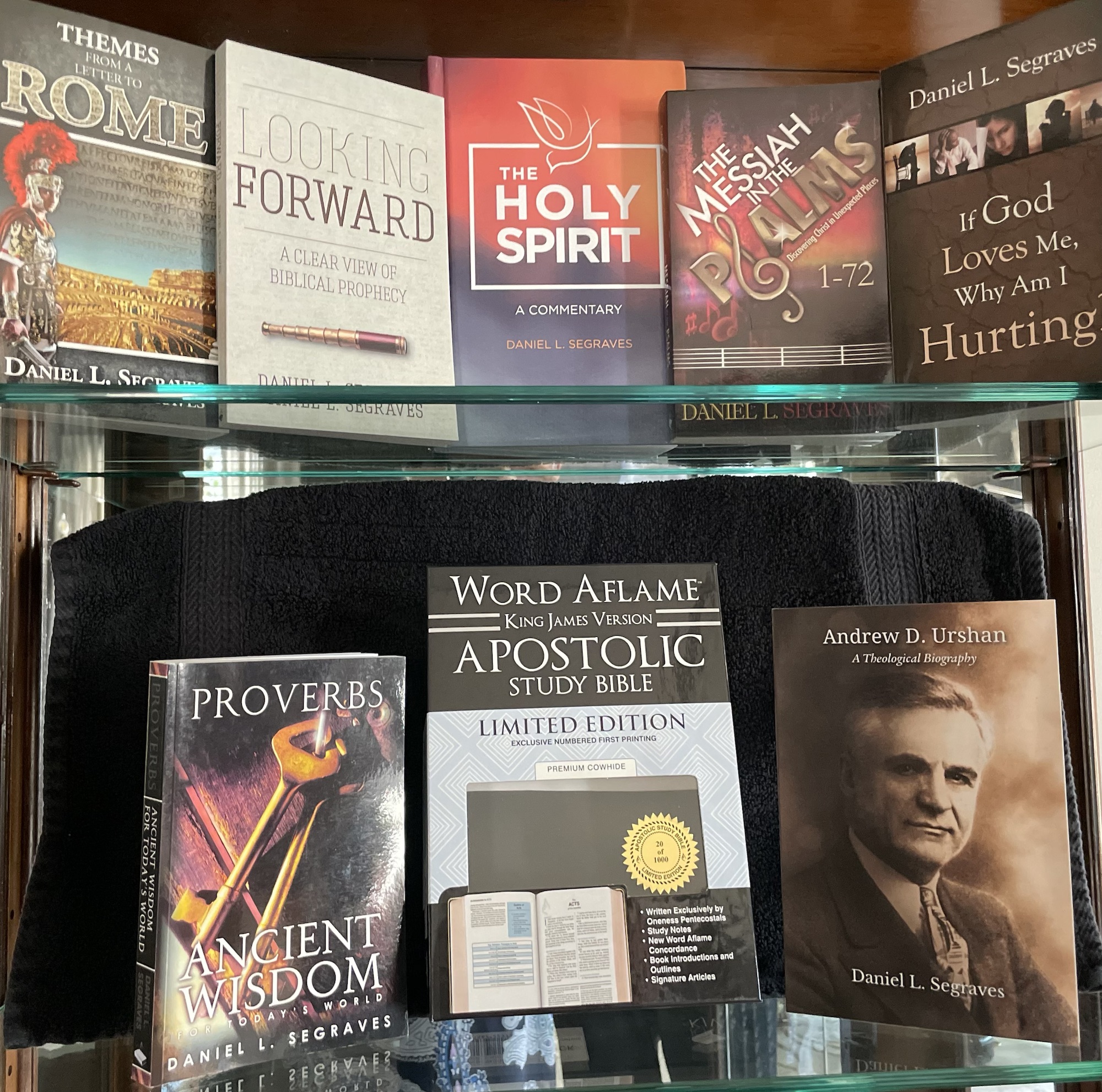
This Sunday, December 2, 2018, I will begin teaching a series of thirteen weekly lessons at The Sanctuary UPC in Hazelwood, Missouri. The lessons will be drawn from a book I am writing on the Holy Spirit, which I hope will fill the need for a book on pneumatology to be published by Word Aflame Press.
From week to week, I plan to post the lesson handout here, followed early the next week by the video of the class session. Here is the handout for the first week.
Introduction
The development of a truly biblical understanding of the Holy Spirit requires more than a mere listing of all the verses that mention the Spirit.[1] It requires more than a systematic categorization of these verses into topical headings. We must allow our understanding to arise from the text itself as we weave together the various contexts of the biblical witness to the Holy Spirit. This contextual interweaving occurs not only within individual books of Scripture, but also among them. It also includes the way in which the two testaments embrace one another in their doctrine of the Holy Spirit (i.e., pneumatology).
When it comes to the development of biblical pneumatology, it is helpful to avoid the limitations of systematic theology. This is not to say there is no value to systematic theology; it is, however, but one approach. Scripture was not written as a systematic theology.[2] The text presents itself to us as a book, in such a way that a natural reading of it results in a biblical theology.
As it relates to pneumatology, for example, it is interesting that the Spirit appears extremely early and very late in the text. The second verse of Scripture informs us that “the Spirit of God was hovering over the face of the waters” (Genesis 1:2). The third from the last verse reads, “And the Spirit and the bride say, ‘Come!’ ” (Revelation 22:17). Regardless of the implications of the immediate contexts in which these verses are found, and regardless of how many other verses may be found describing the Spirit as “hovering” or as participating in an invitation, the location of these two verses indicates that the Holy Spirit has an extremely high profile in Scripture. We could say all of Scripture is bracketed by the Holy Spirit.
Pentecostal pneumatology has by default always been a more biblical pneumatology in that the Pentecostal experience heightens our interest in the full scope of Scripture’s testimony to the Holy Spirit. Oneness, or apostolic, Pentecostals emphasize as normative the experience of baptism with the Holy Spirit with the initial sign of speaking with tongues. As a result, virtually all of those identified with Oneness Pentecostalism speak with tongues. This does not mean, however, that all have developed a view of the Holy Spirit that could be described as a biblical pneumatology. A single-minded focus only on speaking with tongues sometimes comes at the expense of minimizing other experiences with the Holy Spirit such as the full range of spiritual gifts, empowerment, and fruit.
We must not be satisfied with approaches to the text that do anything less than reading it as it was meant to be read, in a holistic literary fashion, allowing the text to speak for itself and refusing to reshape it into our own image.
The Holy Spirit
The Hebrew word translated “spirit” is ruach. It appears 377 times in the Old Testament with the usual range of meaning also including wind or breath. In about eighty cases, ruach refers to the Holy Spirit, but this precise term is used only three times. (See Psalm 51:11; Isaiah 63:10-11.) Other references to the Holy Spirit in the Old Testament use phrases like “the Spirit of the Lord,” “the Spirit of God,” “my Spirit,” “your Spirit,” “His Spirit,” and “the Spirit.” In some cases, the word “spirit” may not be used, but the context makes it clear the Spirit is in view.
In the New Testament, the Greek word pneuma is translated “spirit.” It is a virtual synonym for ruach and includes the ideas of wind or breath. In nearly 250 cases, a form of pneuma refers to the Holy Spirit, but other phrases include “the Spirit of the Lord,” “the Spirit of God,” “my Spirit,” “His Spirit,” and “the Spirit.” One phrase refers even to “the Spirit of His Son” (Galatians 4:6) and another to “the Spirit of Christ” (I Peter 1:11).
Altogether, then, there are more than 330 references to the Holy Spirit in Scripture. Since there are 1,189 chapters in the Bible, this means the Spirit is mentioned on average about once every 3.6 chapters. In the Old Testament, the Spirit is referred to about once every 11.6 chapters. In the New Testament, with 260 chapters, the Spirit is referred to almost once per chapter.
The first reference to the Spirit of God appears in the second verse of the Bible: “The earth was without form, and void; and darkness was on the face of the deep. And the Spirit of God was hovering over the face of the waters” (Genesis 1:2). The word translated “God” is the Hebrew noun Elohim, which appears thirty-three times in Genesis 1. Although Elohim is plural in form, the referent is singular. This is because in the Hebrew language, the verb governs the number of the noun. When there is a singular verb with a plural noun, the noun does not refer to more than one of something; the plural form is used for other reasons.[3] Elohim must be accompanied by plural modifiers and plural verb forms to function as a plural noun. If accompanied by singular modifiers and singular verb forms, it functions as a singular noun.[4]
In the phrase “Spirit of God,” the word “Spirit” is in the construct state, which means it is grammatically bound to the word “God.”[5] It is the Spirit possessed by God.[6] There is no suggestion here that the Spirit is a person distinct from God. Instead, the context created by the relationship between the first two verses of Genesis is that the phrase “Spirit of God” in this case refers to God in activity. In Genesis 1:1, the word translated “created” (bara’) is in the perfect form, indicating action that is completed. In English, the perfect is usually translated as the “simple past or present perfect.”[7] The point is that Genesis 1:1 describes a completed action.
In Genesis 1:2, the word translated “was hovering” (rachaph) is a participle, suggesting “continuous occurrence of an activity or a mode of being.”[8] As the Pentateuch draws to a close, a form of the word translated “was hovering” appears again for the first time since Genesis 1:2. Here, in the Song of Moses, the Lord[9] is described as an eagle that stirs up its nest and hovers over its young (Deuteronomy 32:11). It is significant that this image of God appears both at the beginning and ending of the Torah.[10] As with the entirety of Scripture, we could say that the Torah is bracketed by the Holy Spirit. This is especially true since the fourth verse from the end of the Pentateuch tells us that Joshua “was full of the spirit of wisdom, for Moses had laid his hands on him” (Deuteronomy 34:9).
It should also be noted that just as the Spirit of God was involved in His creative work, so the Spirit was involved in the work of the building of the tabernacle. Indeed, the thing that enabled Bezalel to accomplish his work was that he was filled with the Spirit of God (Exodus 31:3; 35:30-31).[11]
Endnotes
[1] From the perspective of systematic theology, the doctrine of the Holy Spirit is referred to as pneumatology. In this series of lessons, we will avoid excessive use of theological terms in favor of biblical language.
[2] Although the biblical text can be approached and interpreted in a variety of ways (e.g., historical theology, philosophical theology, practical theology, exegetical theology, systematic theology, or in various ideologically driven ways), none of these captures fully the way the text presents itself to us.
[3] Concerning Elohim, C. L. Seow points out that “[t]he form of the noun is plural, but the referent is singular. This is sometimes called ‘plural of majesty’ ”(A Grammar for Biblical Hebrew, [Abingdon Press, 1987], 19n. He further notes that “[n]ouns that occur in the plural of majesty . . . take the singular verb” (Ibid., 96).
[4] Page H. Kelly, Biblical Hebrew: An Introductory Grammar (Grand Rapids, MI: William B. Eerdmans Publishing Company 1992, 32.
[5] Seow, A Grammar of Biblical Hebrew, 70.
[6] See Logos Exegetical Guide.
[7] Seow, A Grammar for Biblical Hebrew, 92-93.
[8] Seow A Grammar for Biblical Hebrew, 47.
[9] In this series of lessons we will follow the common practice of presenting the Hebrew Yahweh as Lord.
[10] See the discussion by John H. Sailhamer, The Expositor’s Bible Commentary, vol. 2 (Grand Rapids, MI: Zondervan, 1990), 25.
[11] As Sailhamer points out, “The parallels between God’s work in Creation and Israel’s work on the tabernacle are part of the Pentateuch’s larger emphasis on the importance of the work of God’s Spirit among his people. This is the same emphasis found in later biblical books where the new covenant notion of faith and of internal change of heart are put at the center of the human relationship with God. Genuine obedience to the will of God comes only after the renewal of the human heart by the Spirit of God (cf. Eze 36:26-27). It is of interest here to note that the two key characters in the Pentateuch who provide a clear picture of genuine obedience to God’s will, Joseph and Joshua, are specifically portrayed in the narrative as those who are filled with the Spirit of God (Ge 41:38; Dt 34:9).” See John H. Sailhamer, The Pentateuch as Narrative (Grand Rapids, MI: Zondervan, 1992), 309.
Copyright (c) 2018 by Daniel L. Segraves
- My newest book … just released!
- My newest book has just been released!
- Telling the story of our marriage.
- Aijeleth Shahar
- Back to the studio!
- He was led as a lamb to the slaughter (Isaiah 53:7).
- Back to school ….
- Introducing my second volume on Psalms to an adult Sunday school class.
- My mother, Agnes Segraves, would have been 100 years old today.
- Second volume of The Messiah in the Psalms is now available in Kindle format.
- Do you know the meaning of your name?
- What does a Calvinist say after falling down the stairs?
- A Wonderful Gift for Babies.
- Let Us Make Man [Revisited]
- My 115 year old Christmas gift.
- Update on Book Signing this Wednesday, December 3, 2025 at 10 a.m.
- Have Thine Own Way
- Book signing event coming up December 3, 2025
- Thanks for visiting my book signing event!
- Will I see you at 9:15 tonight?
- UPCI GENERAL CONFERENCE 2025
- New book available in both paperback and eBook formats.
- New book now available at pentecostalpublishing.com
- At last, Psalms volume 2 has arrived!
- All that Thrills My Soul
- Closer by the moment!
- Back to my roots.
- Nearing the finish line.
- The Hermeneutical Circle and Canonical-Compositional Hermeneutics
- It has taken me only about 2,555 days ….
- Your greatest power.
- The Role of Tongues in Praying in the Spirit
- How videos are produced at the UPCI headquarters.
- Is speaking in tongues the evidence or the sign of baptism with the Holy Spirit?
- Sixty years of ministry.
- How consumerism redefines our values.
- Jesus taught hermeneutics.
- Pneumatology at Urshan Graduate School of Theology
- Purpose Institute and Bible Project
- Israel and Paul’s great sorrow and continual grief.
- Goodbye World, Goodbye!
- The first purchase for our new home.
- Good News!
- With gratitude ….
- All done!
- Almost there ….
- A New Year and a New Era for Logos Bible Software
- Marching on …
- Psalm 92 and Old Age
- Here’s what has happened in recent weeks.
- Somewhere …
- A glance toward the future from a very old psalm: Psalm 90
- Does Psalm 89 include an internal contradiction?
- Psalm 88 … Is There Any Hope?
- Is Psalm 87 a Pentecostal psalm?
- Now, on to Psalm 87
- Celebrating our first date!
- At last, Psalm 85 is finished.
- Videos on YouTube
- The Christology of John: In the Beginning [video]
- The Christology of John: In the Beginning
- Interesting and little known information about the New King James Version.
- Checking out the $130,000 Shigeru Kaiwai.
- Daniel and Susan Segraves on the Nancy Grandquist Podcast
- A Surprising Discovery of a Blog Written by David K. Bernard and Something I Didn’t Know About Myself.
- Messiah in the Psalms, Lesson Three, Discovering Christ in Unexpected Places
- Messiah in the Psalms, Lesson Two, Discovering Christ in Unexpected Places
- Messiah in the Psalms: Discovering Christ in Unexpected Places, Lesson One
- Pentecost Sunday at The Sanctury UPC
- Tomorrow…Pentecost Sunday
- Urshan University
- Living a Holy Life
- Here’s a sign for you …
- Good news from Urshan Graduate School of Theology!
- Presentation at the Urshan Graduate School of Theology Symposium
- Morning Has Broken
- An Unusual Post
- Urshan Symposium of Apostolic Pentecostal Scholars
- Learning Biblical Aramaic
- Substantial Savings Until December 31, 2023
- Getting Up to Date on the Psalms Project
- Praying for the Peace of Jerusalem
- Hamas [חמס]
- Curriculum Vitae
- Letting Our Hair Down: Another Look at I Corinthians 11:2-16 [A]
- Another Look at I Corinthians 11:10: A Plea for Caution
- Upcoming Urshan Symposium of Apostolic Pentecostal Scholars
- First-Century Jewish Christology
- First-Century Jewish Christology
- First Century Jewish Christology
- First Century Jewish Christianity
- First Century Jewish Christology
- 15% discount on my books until July 14, 2023
- “The sick … shall recover” (Mark 16:18).
- The Arkansas District Camp Meeting is scheduled for July 11-14, 2023.
- Oneness Pentecostalism: Race, Gender, and Culture
- Bits and Pieces ….
- The Messiah in the Psalms
- Psalm 83 and the future of volumes 2 and 3 of The Messiah in the Psalms
- Psalm 82 and its 2389 words.