Praying for the Peace of Jerusalem

November 3, 2023 | Daniel L. Segraves, Ph.D.

A bit earlier this afternoon, I sent a text to my son, Mark, with the following message:

With the war today in the Middle East, Susan (my wife) and I have been following the news much more closely and talking quite a bit about the Jewish people and antisemitism. When Susan was a student at the Apostolic Bible Institute, she worked for a Jewish family in the afternoons when classes were over and on Saturdays, doing light housework and helping with the evening meals. The family was very kind to her, providing a nice upstairs room where she could study and stay overnight when needed. Susan also had the privilege of driving their beautiful Buick convertible if she had need of it when the family was not using it. Susan was very popular in school! She just showed me that our wall oven has an automatic setting for the Sabbath, so devout Jews will not need to violate the Law’s prohibition against lighting a fire on the Sabbath!

Mark responded:

That’s interesting! We’ve been praying for the peace of Jerusalem. I think that may be the same as praying, “Jesus, come quickly!”

I answered, “It could very well be!” I had been thinking about Scripture’s command to pray for the peace of Jerusalem, but I hadn’t connected it to the idea of praying for the Second Coming. So Mark’s comment provoked me to check and see what John H. Sailhamer, one of my favorite seminary professors, may have said about this idea. I had the privilege of taking two classes from Sailhamer when I was working on my Master of Theology degree at Western Seminary. The first was his class on Psalms and Daniel, which transformed my thinking on Psalms so that I wrote a 382 page book titled The Messiah in the Psalms: Discovering Christ in Unexpected Places (Hazelwood, MO: WAP Academic, 2007). This book is available at pentecostalpublishing.com and in the Kindle format from Amazon.com. I am also working now on the second volume of this commentary on Psalms, which I hope to have in publication by the time of the 2024 general conference of the United Pentecostal Church International.

So, I turned to Sailhamer’s thoughts on Psalm 122 and read these words:

To pray for the peace of Jerusalem is to pray for the coming of the Promised Seed of David, the Messiah.

Jerusalem is mentioned by name three times in Psalm 122. There is a reference to the house of David. It is a good thing to meditate on the entire psalm:

PSALM 122

A Song of Ascents. Of David.

1 I was glad when they said to me, “Let us go into the house of the LORD.”
2 Our feet have been standing
  Within your gates, O Jerusalem!

3 Jerusalem is built
  As a city that is compact together,
4 Where the tribes go up,
  The tribes of the LORD,
  To the Testimony of Israel,
  To give thanks to the name of the LORD.
5 For thrones are set there for judgment,
  The thrones of the house of David.

6 Pray for the peace of Jerusalem:
  “May they prosper who love you.
7 Peace be within your walls,
  Prosperity within your palaces.”
8 For the sake of my brethren and companions,
  I will now say, “Peace be within you.”
9 Because of the house of the LORD our God
  I will seek your good.

[NKJV]

[archive]

15% discount on my books until July 14, 2023

I am often asked how many books I have written. The number is twenty-one. I’m now working on number twenty-two, which will be the second volume of my commentary on Psalms. I would, of course, like to get these books into the hands of as many readers as possible. Like preachers, pastors, and teachers, Christian authors have a sense of calling, and they believe God has given them a message they need to communicate to people of faith.

For that reason, I’m happy to tell you that the Pentecostal Publishing House, now known as the Pentecostal Resources Group, has informed me that I can offer a 15% discount on all of my books and other resources from now through July 14, 2023, which is the last day of the Arkansas District Camp Meeting.

Tim Gaddy, the district superintendent of the Arkansas District of the United Pentecostal Church International, has asked me to do the Bible teaching for the Arkansas district’s camp meeting this year, which is scheduled for July 12-14. Due to scheduling challenges, the Pentecostal Publishing House will not have a display set up at the camp meeting. That is the reason the discount is available. We want to make these resources as accessible as possible.

How to obtain the 15% discount

Keep in mind the discount code is DS15. You can take advantage of this special discount by phone or email.

Customer Service Phone: 866-819-7667

Customer Service Email: customerservice@pentecostalpublishing.com

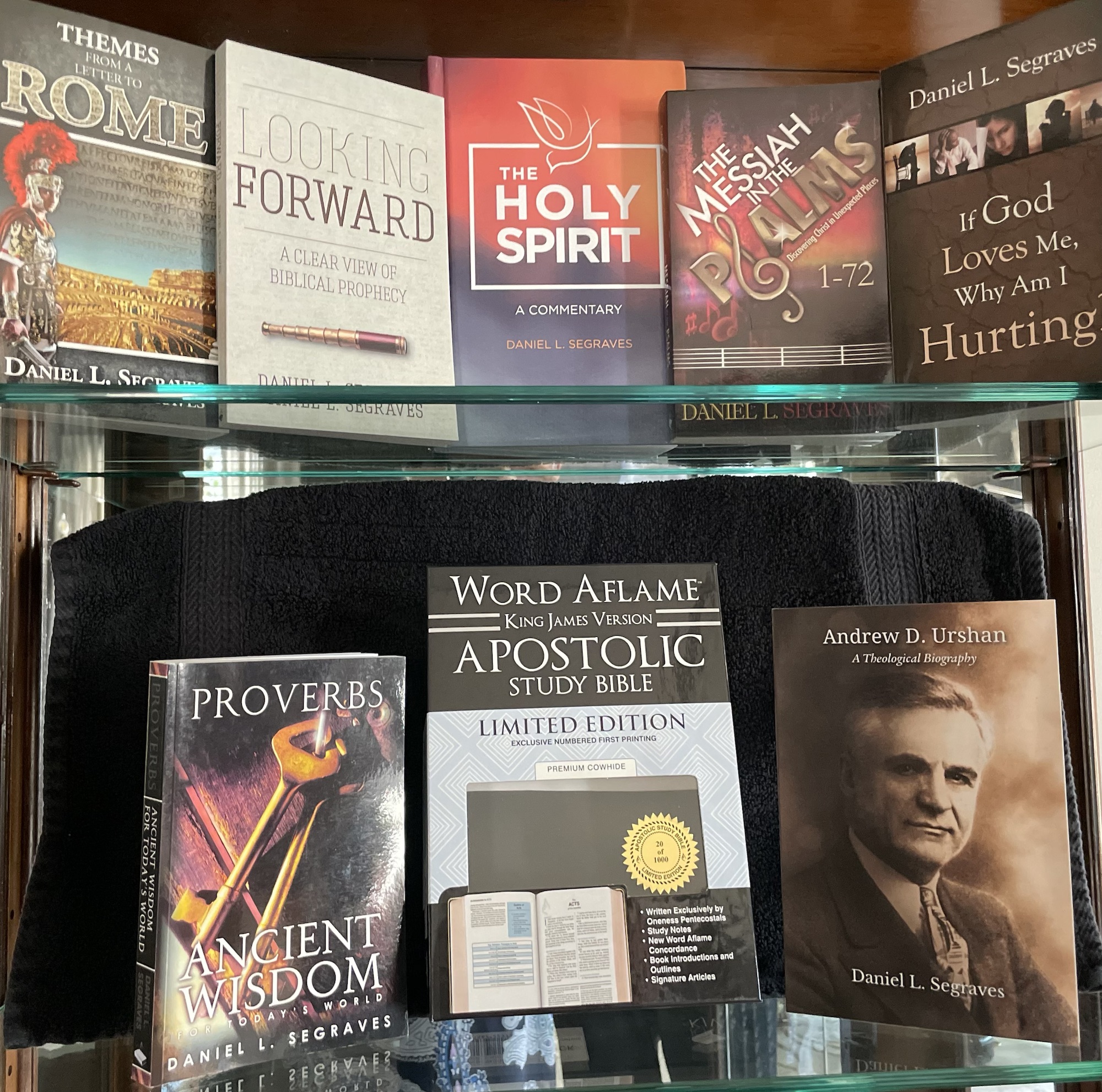
In order to see the fifty-two resources available, check out the PPH website at pentecostalpublishing.com. Type “Segraves” in the search window. This will enable you to see each of the twenty-one books by title and with brief descriptions. One is available in the Spanish language as well a English. Some are offered as e-books as well as in hard copy. In addition to the books, resources are available as CDs. Here is a summary of what you will find:

Verse by verse commentaries:

Romans: Living by Faith
Hebrews: Better Things
James: Faith at Work
First Peter: Standing Fast in the Grace of God
Second Peter and Jude
Proverbs: Ancient Wisdom for Today's World
Doctrine:

God in Flesh
Hair Length in  the Bible
The Messiah's Name: JESUS, not Yahshua
Elohim and the Plural Passages (audio and video)
The Influence of Hellenistic Philosophy on the Development of Christology to Chalcedon (audio)
Binding and Loosing: The Authority of the Church (audio)
The Holy Spirit (This 314 page hard-back book is my most recent publication. It is a treatment of apostolic pneumatology that explores nearly every reference to the Holy Spirit in the entire Bible, beginning with Genesis 1:2 and ending with Revelation 22:17.
Christian Growth:

Insights for Christian Living
You Can Understand the Bible
If God Loves Me, Why Am I Hurting?
Spiritual Gifts
That Which is Perfect
Biblical Studies:

The Messiah in the Psalms, 1-72: Discovering Christ in Unexpected Places
Reading Between the Lines: Discovering Christ in the Old Testament
Themes from a Letter to Rome
Prophecy:

Looking Forward: A Clear View of Biblical Prophecy (available in English and Spanish)
Biography:

Andrew D. Urshan: A Theological Biography
This 312 page book is a professionally edited treatment of my Ph.D. dissertation on the life and theology of Andrew D. Urshan, one of the four most influential early twentieth century Oneness Pentecostals.
General Conference, Daniel Segraves 2001:

This CD is a recording of my defense of the genuineness of Christ's humanity.

Pentecostal Publishing House || 36 Research Park Ct || Weldon Spring, MO 63304 || (636) 229-7900

Psalm 83 and the future of volumes 2 and 3 of The Messiah in the Psalms

photo of child reading holy bible
Photo by nappy on Pexels.com

Not only am I finished with Psalm 83, but after a discussion with Everett Gossard, Book Editor for the Pentecostal Resources Group, UPCI, I have clear direction for the future of The Messiah in the Psalms.

As many of you know, there are five books within the Book of Psalms. They are arranged in this way: Book 1: Psalms 1-41; Book 2: Psalms 42-72; Book 3: Psalms 73-89; Book 4: Psalms 90-106; Book 5: Psalms 107-150. My first volume covers Psalms 1-72 plus three appendices for a total of 382 pages.

Some commentaries on the Book of Psalms are released in one volume, some in two volumes, and some in three. My final work on the Psalter will be in three volumes. The second volume will include books three and four (i.e., Psalms 73-106). The third volume will consist of book five (i.e., Psalms 107-150).

Thus, volume two will include my comments on 679 verses and volume three my comments on 694 verses. I can’t predict the total page length of each volume, but they should be about the same.

I’m focusing on this project, and the more I do, the more clearly I see what Jesus meant when He said, “These are the words which I spoke to you while I was still with you, that all things must be fulfilled which were written in the Law of Moses and the Prophets and the Psalms concerning Me” (Luke 24:44, NKJV).

I have been invited to speak for two hours on this subject at an upcoming meeting of the general board of the United Pentecostal Church and their spouses. I’m looking forward to this event!

[archive]

Psalm 81 … it took a while, but now it’s finished!

Işıl Agc at Pexels

He would have fed them also with the finest of wheat; And with honey from the rock I would have satisfied you (Psalm 81:16, NKJV).

At last I have completed my work on Psalm 81. Now, to Psalm 82, which Jesus quoted in John 10:34.

I am repeatedly surprised by the revelation of the Messiah in the Book of Psalms. What a wonderful thing it would be if I could finish this project by the end of 2023!

[archive]

Finding the time to do the important thing.

Tara Winstead at Pexels

Since I retired from Urshan Graduate School of Theology on July 1, 2018, I’ve been trying to find the time to finish the second volume of my commentary on the Book of Psalms. The first volume, titled The Messiah in the Psalms: Discovering Christ in Unexpected Places, covers Psalms 1-72. Since retirement, I’ve continued to work on the second volume, posting updates on my progress from time to time.

It’s not that I haven’t completed any writing projects since 2018. For instance, I have started and finished a 314 page commentary covering nearly every biblical reference to the Holy Spirit, titled The Holy Spirit (Weldon Spring, MO: Word Aflame Press Academic, 2020). I have written several articles published in Pentecostal Life and lessons published in “God’s Word for Life,” the all-church curriculum available from the United Pentecostal Church International. I have contributed a chapter to a volume in the series “Studies in Holiness and Pentecostal Movements.” The volume is titled Oneness Pentecostalism: Race, Gender, and Culture. It is scheduled for publication in 2023 by the Pennsylvania State University Press.

But the completion of volume two of The Messiah in the Psalms remains before me. I am passionate about this project, because Jesus said, “All things must be fulfilled which were written in the Law of Moses and the Prophets and the Psalms concerning Me” (Luke 24:44, NKJV). From my previous research, I realize the psalms include rich insight on the person and work of Jesus Christ.

What shall I do?

In yesterday’s early morning hours, an idea came to me that may be the answer.

I have worked on this now for two days. I don’t know precisely how much time this will free up, but I think it will be substantial.

Unsubscribe to the many emails I regularly receive. Even those I value. Even those I enjoy reading.

I am determined, with the help of our Lord, to finish my work on Psalms, this wonderful book that includes so much concerning Jesus Christ, opening our understanding that we might comprehend the Scriptures (Luke 24:45).

[archive]

The Messiah in the Psalms Lesson 6

Psalms

October 8, 2017

The Sanctuary | Hazelwood, Missouri

By Daniel L. Segraves

Our study guide consists of notes from the Apostolic Study Bible.[1]

Psalms 9-10

The phrase “Muth-lab’ben” in the superscription means “death of the son.” The idea is that Psalm 9 was to be sung to the tune of a song by this name. Other psalms also identify the tunes by which they are to be sung, but we have no information about these melodies. Psalm 8 did not address the death of the Son of Man, but the reference to the death of the son in Psalm 9 links these psalms together, continuing the contextual theme of the Son that begins in Psalm 2. The significance of Psalm 9 being about the death of the Son may be seen in the identification of Psalm 8 as a messianic psalm in Hebrews 2:6-8. In the context in Hebrews, the Son is “crowned with glory and honor” as a consequence of His death, which He experienced “for every man” (Hebrews 2:9). Although Psalm 8 declares that the Son of Man has been “crowned . . . with glory and honour” (Psalm 8:5), it does not discuss His death. The idea of the death of the Son of Man is found in Psalm 9. The linkage of Psalm 9 with Psalm 8 by means of the “Son” motif provides linkage all the way back to Psalm 2 and ahead to Psalm 10, because Psalms 9 and 10 were apparently one psalm in an earlier form. The evidence for this is as follows: (1) When Psalms 9 and 10 are placed together, they form an acrostic. Psalm 9 takes us through exactly half of the Hebrew alphabet; Psalm 10 takes us through the second half; (2) The Septuagint puts the two together as one. Thus, Psalm 11 in the English translation is Psalm 10 in the Septuagint; (3) Only Psalm 9 has a superscription. If the two are not to be read as one, Psalm 10 is the only psalm without a superscription between Psalm 3 and Psalm 32.  There is some irregularity in the acrostic which seems to be because of an emphasis on “the wicked one,” indicating an emphasis on the contrast between “the righteous” and “the wicked” that begins in Psalm 1, where a form of the same word that is translated “wicked” in Psalm 9 is translated “ungodly.”

Psalm 9 is a psalm of thanksgiving, describing the Lord coming to aid those who are in distress. Psalm 10 is a psalm of lament, but at the points where the acrostic is interrupted in Psalm 10, the lament is changed back into the defeat of the enemy. Psalm 10 is about the eschatological judgment of God upon all the nations, as found in Daniel 7 and Ezekiel 38. The pattern of praise followed by lament is followed up to and including Psalm 41. Hope is found in this group of Davidic psalms, but it is hope against the backdrop of trouble.

Psalm 10

1 The opening verse of Psalm 10 invites comparison with Psalm 22:1, words prayed by Jesus on the cross. In view of the superscription of Psalm 9 identifying the psalm with the “death of the son,” this further indicates that Psalms 9-10 should be read as one psalm.

15 The arm was a symbol of strength.

16 Although Psalm 10 is a psalm of lament, it concludes in hope in view of the fact that the “Lord is King forever and ever” and that the gōyim (nations, translated as “heathen” by the KJV) have “perished out of his land.” This is an allusion to the Davidic covenant with its divinely ordained king who is reigning on behalf of the Lord and to the promise of land made to Abraham, Isaac, and Jacob. (See Genesis 15:18-21.)

17 Although it may have seemed that the Lord was distant and hidden (verse 1), He actually “heard the desire of the humble (compare with verse 12). Since He heard their desire, He would “prepare their heart” (i.e., comfort them).

Psalm 11

Psalm 11 continues the theme begun in Psalm 10. The house of David was troubled by “the wicked” (verses 2, 5, 6). (Compare with Psalm 10:2-4, 13, 15.) The wicked are contrasted with the righteous. The psalm acknowledges a challenge to God’s messianic purpose, a challenge that is doomed.

1 The theme of trust in the Lord continues the motif begun in Psalm 2:12: trust in the Son, the Messiah. In this psalm, David was either in conversation with his advisors, or he was consulting with himself. Either he was being counseled to flee from the wicked, like a bird flies away from a snare, or he was considering flight. (Compare with Psalm 55:6; 124:7.) But how can flight be considered when one is trusting in the Lord?

2-3 If his advisors were counseling David, they justified their counsel to flee in these words. It is common in Psalms and elsewhere to describe the words of those who are wicked metaphorically as deadly weapons. (See Psalm 37:14-15; 57:4; 64:3-4; Proverbs 12:18; Isaiah 54:17; Jeremiah 9:8.)

3 The “foundations” refer in a metaphor to the social order established by God. (See Psalm 75:3; 82:5; Ezekiel 30:4.) The idea is that a challenge to David was a challenge to the Davidic covenant and ultimately to the Messiah’s rule. The “foundation” of Israel, and ultimately of the world, was the throne of David, occupied by the Messiah.

Psalm 12

Like Psalm 11, Psalm 12 continues the theme of trouble for the house of David. This psalm was to be sung to the accompaniment of an eight stringed instrument (shem’inith).

1 Like Psalm 10, this psalm begins with a bleak cry. The word translated “ceaseth” (gamar) suggests that the godly are no more, as the second half of the verse indicates. In other words, it is not “help” that ceases, but it is those who are faithful, or godly, who cease to be. This is certainly hyperbole, but it accurately expressed David’s concern for the apparent success of those who were unfaithful, as also seen in Psalms 10-11.

5 Even though Psalm 12 does not specifically mention the reign of the Lord or His throne, it is indirectly referred to here with the idea that the Lord would arise from His throne to respond to the threat of the wicked.

6-7 The promise of the Lord was that he would “keep them” (the poor and needy of verse 5) and “preserve them.” He will not allow the wicked to carry out their threats.

7 This verse has been misunderstood, especially by some advocates of KJV Onlyism (the belief that only the King James Version faithfully transmits the Scriptures in English) to mean that the Lord will keep and preserve His words “from this generation forever.” The grammar of the Hebrew text will not allow this meaning. The words translated “poor” and “needy” in verse 5 are masculine. The word translated “words” in verse 6 is feminine. The words translated “them” in verse 7 are masculine, requiring that the pronoun “them” refer back to the “poor” and “needy” of verse 5, not to the “words” of verse 6. The words of Scripture are inspired, and the Lord will preserve them, but this verse does not support the claims of those who claim that only one English translation is reliable.[2]

Psalm 13

1 The theme of trouble in the house of David continues. The general tenor of this lament is much like the sentiments expressed in Psalms 6:3; 7:1-2; 10:1; 12:1. The apparent success of the wicked ones caused David to feel forgotten by God.

5 The word translated “salvation” is a form of yeshua‘, which finds it fullest significance in the name given to the Messiah.

6 When David turned away from a focus on his enemy and refocused on the mercy and salvation of the Lord, his hope was restored and worship overcame complaints.

[1] These notes were prepared for the Apostolic Study Bible (Hazelwood, MO: WAP Academic, 2014) by Daniel L. Segraves.

[2] The comments on verse 7 do not appear in the Apostolic Study Bible.