
Subscribe to continue reading
Subscribe to get access to the rest of this post and other subscriber-only content.
Subscribe to get access to the rest of this post and other subscriber-only content.
Subscribe to get access to the rest of this post and other subscriber-only content.
June 26, 2024 | Daniel L. Segraves, Ph.D.

I don’t do much scrolling through Facebook. For years I avoided FB because I thought it would be a waste of time. This means when I do take some moments to see what’s happening in the world of social media, there’s a good possibility I will discover interesting and useful information for the first time. I had that experience earlier today when I came across an excellent blog post written by David K. Bernard. I admire our general superintendent and pray for him regularly. I believe God has raised him up to provide the leadership we need in the United Pentecostal Church International.
What I discovered today was a blog titled “David K. Bernard’s Recommended Tools for Studying the Bible.” To access the blog, left click on the following link. (This will bring up another link that includes “David K. Bernard.” Left click on that, and the page will open to allow you to read the entire post.) https://blog.pentecostalpublishing.com/2022/01/24/david-k-bernards-recommended-tools-for-studying-the-bible/
In his blog, Brother Bernard discusses the Apostolic Study Bible, Translations, Introductory Studies, Word Studies, Bible Dictionaries and Encyclopedias, Commentaries and Internet Resources. His recommendations are clear and thoughtful. Many of them would be found as required reading on the graduate level in conservative seminaries.
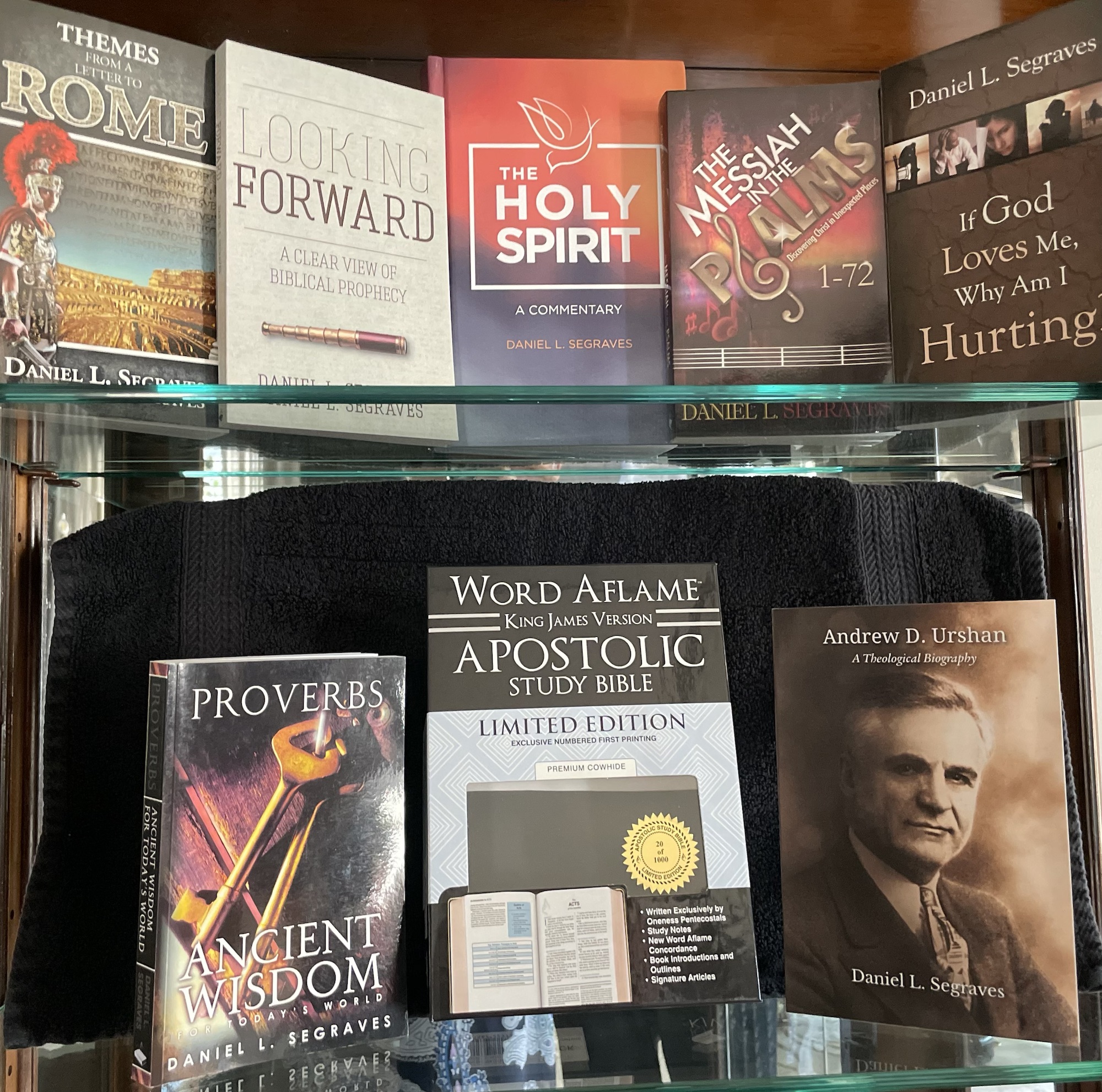
As I read his comments on the Apostolic Study Bible, I saw my name listed as a contributor to this first study Bible produced exclusively by Oneness Pentecostal scholars. I knew, of course, that I had written the study notes on Psalms, Proverbs, Hebrews, James, I Peter, II Peter and Jude as well as the signature articles on The Holy Spirit and the Gifts of the Spirit. Out of curiosity, I clicked on my name and, to my surprise, three pages opened before me displaying all forty-nine of my products available from the Pentecostal Publishing House. You may view these products by following the same instructions given above. (Click on the link below, then click on the next link that comes up.
https://pentecostalpublishing.com/search?q=Daniel+Segraves
I have twenty-one books in print. In addition, there are several digital resources including video and audio recordings on subjects including, but not limited to, “Elohim and the Plural Passages,” “Binding and Loosing: The Authority of the Church,” “The Influence of Hellenistic Philosophy on the Development of Christianity to Chalcedon.”
What’s the thing I didn’t know about myself? The Pentecostal Publishing House offers an audio file of mine titled “History of a Student.” I don’t have a clue what it’s about or when I did it. But you can buy it for $5.00.
If you decide to purchase what is apparently a talk I gave at some time and place, let me know what it’s all about. I hope you enjoy it!
[archive]
Subscribe to get access to the rest of this post and other subscriber-only content.
June 12, 2024 | Daniel L. Segraves, Ph.D.
I taught this lesson on June 12, 2024 at The Sanctuary UPC in Hazelwood, Missouri, where Mitchell Bland is our pastor. One additional lesson is scheduled to follow next Wednesday night, June 19.
June 5, 2024 | Daniel L. Segraves, Ph.D.
I taught this lesson on June 5, 2024 at The Sanctuary UPC in Hazelwood, Missouri, where the pastor is Mitchell Bland.
[archive]
May 18, 2024 | Daniel L. Segraves, Ph.D.
Tomorrow I am scheduled to teach the adult Bible class at The Sanctuary UPC in Hazelwood, Missouri, where Mitchell Bland is pastor. The class will begin at 10 A.M.
When I was asked to teach on this date, I didn’t realize it would be Pentecost Sunday. I’m happy to discover the focus of the assigned lesson, which is part of the God’s Word for Life curriculum. The title is Success in Succession, and the lesson explores the mentoring relationship between Elijah and Elisha.
I’m looking forward to this, because it will give me an opportunity to explore and share my relationship with various mentors in my life. This includes my grandfather, L. D. Segraves, who was born on October 11, 1887. He was the first apostolic preacher among my ancestors. His influence reaches down not only to me, but even to people in the congregation of The Sanctuary, the home church to which Susan and I belong.
I plan to post the video of the lesson here on my blog. I hope you will gain helpful insight from it as we explore the idea of being mentored and offering a ministry of mentorship to others.
[archive]
April 20, 2024 | Daniel L. Segraves, Ph.D.
I wrote the following article during the time I taught at Christian Life College in Stockton, California. It was required reading in one of my classes. The article is not a complete treatment of the biblical concept of holiness, and some of the statistics are dated. The information is, however, biblically sound and useful.
A Clean Temple
God cares immensely for things reserved for His purposes. Because of their sanctified purpose, He will not tolerate their abuse.
A considerable portion of the Bible’s first five books contains explicit instructions concerning the proper use of the Tabernacle. Only the priests could enter the Holy Place, and then only after cleansing at the laver in the courtyard. The Holy of Holies could be entered only by the high priest once a year on the Day of Atonement. The priests had to be appropriately dressed and consecrated, and their behavior while in service had to conform to prescribed standards. When the Philistines took possession of the Ark of the Covenant, they found themselves continually plagued with unusual and deadly diseases. When Uzzah touched the Ark, he fell dead. As Belshazzar drank from the holy vessels, he sealed his fate, and the disembodied hand wrote it on the wall for all to see.
All these facts exemplify the truth that God will not allow abuse of holy things. “Know ye not that ye are the temple of God, and that the Spirit of God dwelleth in you? If any man defile the temple of God, him shall God destroy; for the temple of God is holy, which temple ye are” (I Corinthians 3:16-17).
Temple of the Holy Ghost
Specifically, it is your body which is the temple of the Holy Ghost. We should glorify God in our bodies and in our spirits which belong to God and are reserved for His holy purposes. (See I Corinthians 6:19-20.) This truth is so serious with God that He promises to destroy any who defile His temple.
Every sincere Christian should ask himself, “In what ways is it possible to defile my body? What steps of action can I take to purify the temple?”
Is defiling the temple purely a spiritual matter, or is it possible for the temple to be defiled by physical actions?
The scope of the Apostle Paul’s words in I Corinthians six is that the temple is defiled by moral impurity. While the root of moral impurity is a spiritual matter, it is ultimately expressed by the body. Paul said that a person who commits fornication with a harlot becomes one flesh with the harlot. (See I Corinthians 6:15-20.) The principle is that while the beginning of defilement is in the spirit, its final manifestation will be in the flesh. There is filthiness of both the flesh and the spirit, and we are to cleanse ourselves from both (II Corinthians 7:1).
What should be the attitude of the Christian toward fleshly sins which include, but are not limited to, drinking, smoking, and drug abuse? Are these purely physical matters, or do spiritual sins give birth to them? (See Mark 7:20-23.)
It is clear from Scripture that sin must have a body through which to express itself. This occurs as the members of the body are yielded to sinful practices. Paul admonished the Romans concerning this truth. “Let not sin therefore reign in your moral body, that ye should obey it in the lusts thereof. Neither yield ye your members as instruments of unrighteousness unto sin: but yield yourselves unto God, as those that are alive from the dead, and your members as instruments of righteousness unto God…. Know ye not, that to whom ye yield yourselves servants to obey, his servants ye are to whom ye obey; whether of sin unto death, or of obedience unto righteousness?” (Romans 6:12-13, 16).
It is, then, possible to sin with the body. Sinning is not just a matter of wrong attitudes or thoughts, although it includes these. Sin can be committed with the eyes, ears, hands, feet, mind, mouth, or any other member of the body. Jesus recognized the devastating effects of sins accomplished by body members and boldly announced that it would be better to be deprived of a hand, a foot, or an eye than to suffer the eternal fires of hell (Mark 9:43-48).
Christians should examine their physical habits to be certain they are not engaging in sinful practices. Since it is possible to sin with the body, and since the body of the believer is the temple of God, we must cleanse ourselves from the filthiness of the flesh according to God’s command.
Drinking
“Wine is a mocker, strong drink is raging: and whosoever is deceived thereby is not wise” (Proverbs 20:1).
There are three categories of references to wine or drinking in Scripture.
Some religious movements permit or even encourage the use of intoxicants in moderation. A careful examination of Scripture will reveal, however, that alcoholic beverages are never spoken of favorably and that partaking of such beverages in any quantity is harmful to the human body. Intoxicants poison or fill the body with toxins. The intentional poisoning of our body abuses the temple of God. For these reasons, drinking is certainly a sinful practice in God’s eyes.
Those references to wine which fall under the first category previously mentioned cannot be appealed to in support of drinking. Scripture often mentions practices without condemning or endorsing them, purely as a part of a larger context of describing human actions.
The references in the second category clearly condemn the use of wine in any quantity. One of these denunciations of wine was written by Solomon, who had been blessed of God with great wisdom. He wrote, “Who hath woe? who hath sorrow? who hath contentions? who hath babbling? who hath wounds without cause? who hath redness of eyes? They that tarry long at the wine; they that go to seek mixed wine. Look not thou upon the wine when it is red, when it giveth his colour in the cup, when it moveth itself aright. At the last it biteth like a serpent, and stingeth like an adder. Thine eyes shall behold strange women, and thine heart shall utter perverse things. Yea, thou shalt be as he that lieth down upon the top of a mast. They have stricken me, shalt thou say, and I was not sick; they have beaten me, and I felt it not: when shall I awake? I will seek it yet again” (Proverbs 23:29-35).
This passage graphically describes the evils of drinking intoxicating beverages. The sure result is sorrow, woe, contention, senseless talk, and wounds. Drinking produces no good result. It breaks down moral restraints and causes people to say things they would never say otherwise. A person who drinks is in danger of immediate death due to the effects of intoxication, not to mention the long-term, addictive results of alcohol.
“Who to them that rise up early in the morning, that they may follow strong drink; that continue until night, till wine inflame them!” (Isaiah 5:11). “But they also have erred through wine, and through strong drink are out of the way; the priest and the prophet have erred through strong drink, they are swallowed up of wine, they are out of the way through strong drink; they err in vision, they stumble in judgment” (Isaiah 28:7). These verses show the addictive nature of intoxicating beverages and the fact that those who partake of them will err in matters of judgment; their senses are polluted.
It is the third category of references which prompts some to excuse alcoholic beverages, often with the hopeful intention to drink in moderation. There is no way to know how many have fallen into the treacherous trap of drunkenness by prefacing their tippling with, “After all, didn’t Paul tell Timothy to take a little wine for his stomach’s sake?”
There are two kinds of wines mentioned in Scripture.
As William Patton said in Bible Wines or Laws of Fermentation and Wines of the Ancients (reprinted by Sane Press), “There were … two kinds of wine in ancient use. The one was sweet, pleasant, refreshing, unfermented; the other was exciting, in- flaming, intoxicating. Each was called wine” (p. 132).
Patton meticulously documents the fact that unfermented beverages, called wines, existed and were commonly used by the ancients. He gives abundant proof of the generic nature of the two Hebrew words, yayin and shakar (pp. 56-58).
These two words are generic. In other words, they are used in Scripture to refer both to fermented and unfermented drink. The context determines which meaning is meant.
There are other relevant Hebrew words which always carry the same meaning. One of the most common is tirosh (translated “wine,” “new wine,” and “sweet wine”): this “wine” is an unfermented drink which generally refers to the juice of something other than the grape; for example, corn and olives.
The New Testament makes use of the generic Greek word oinos to correspond exactly to yayin in the Old Testament. It too designates the juice of the grape in all its stages. The context will determine whether fermented or unfermented beverage is meant.
The English word wine is from the Latin vinum, which is equivalent to the Greek oinos. Vinus is a generic word which refers to the juice of the grape in all its forms, as was the English wine during the era of the translation of the Authorized Version. More recent dictionaries will define wine exclusively as a fermented beverage, but we must be careful not to allow modern day usage of a word to be retroactive.
The reason for the development of the restricted meaning of wine to fermented liquid only is described by John Stuart Mill in his System of Logic: “A generic term is always liable to become limited to a single species if people have occasion to think and speak of that species oftener than of anything else contained in the genus. The tide of custom first drifts the word on the shore of a particular meaning, then retires and leaves it there.” (Quoted by Patton on pp. 63-64.)
What did Paul mean when he said to Timothy, “Drink no longer water, but use a little wine for thy stomach’s sake and thine often infirmities” (I Timothy 5:23). Did he command Timothy to indulge in fermented alcoholic beverages for the sake of a weak stomach? Such would seem precisely the wrong prescription if fermented wine was intended. Indeed, the fermented wines of that day produced “headaches, dropsy, madness, and stomach complaints” (Patton, p. 112). At the same time there were unfermented wines which were “exceedingly wholesome and useful to the body” (Patton, p. 113).
Surely Paul, who had earlier told Timothy that a bishop must not be given to wine (I Timothy 3:3), and who knew the inherent evil of fermented wine from the law (“wine is a mocker”), would not have recommended to Timothy such a forbidden, dangerous substance to drink in the place of water.
Some make their plea for moderate use of alcohol on the basis of a misunderstand- ing of Ephesians 5:18: “And be not drunk with wine, wherein is excess….” They point out that one is not to drink to excess, or until he is drunk.
The literal meaning of the Greek word translated excess is, however, “dissolution, dissipation.” In this case the word excess does not refer to quantity, but to that which is inherent in fermented wine. The phrase, “wherein is,” reveals that the “excess” is in the wine. In other words, the use of fermented wine dissipates.
It has also been pointed out by physicians that the first drink of alcohol intoxicates. After that, the drunkenness is only a matter of degree.
Twenty-five percent of the American people are directly affected by alcoholism. Ninety percent of college students and seventy percent of high school students drink. These amazing statistics contributed to nearly 22,000 alcohol related deaths in one recent year among those in the fifteen to twenty-four age group. (Statistics from Christian School Comment, Vol. 12, No. 9.)
The only consistent Christian position is total abstinence from all alcoholic beverages. Moderation is the first step toward immoderation. The person who refuses to drink will never have to concern himself with fears of drinking too much. He will never be tempted to drunkenness or, in the more polite term of our society, alcoholism. He will live his life free from the ravages of liquor.
Smoking
It is a highly documented fact that smoking contributes to cancer of the lungs, mouth, and lips. So convincing is the evidence that the Surgeon General of the United States won the fight to have a warning placed on every package of cigarettes and every advertisement for cigarettes.
Tobacco is a habit-forming narcotic. Among unbiased researchers, there is no question as to the devastating effect of smoking on the human body.
Many godly men stood against the use of tobacco for years before medical research determined its danger. How did they have the foresight to avoid this dangerous practice?
While there is no verse which says, “Thou shalt not smoke,” there are many verses of Scripture which teach a Christian to resist coming under the power of any substance. A Christian should even resist falling under the power of lawful practices. Paul said, “All things are lawful for me, but I will not be brought under the power of any” (I Corinthians 6:12). “Put a knife to thy throat,” Solomon warned, “if thou be a man given to appetite” (Proverbs 23:2).
There is no question that tobacco defiles the body, which is the temple of God. It coats the lungs with tar, promotes various ailments including cancer, and robs the smoker of vitality, alertness, and years of life.
Would God have approved of a vandal entering His Holy of Holies in the Tabernacle and painting the Ark of the Covenant with a tar brush? Of course not. Neither can He approve of His children defiling the temple of the body. God will surely judge those who defile His temple.
Drug Abuse
In many ways, all that has previously been said about alcohol and tobacco applies equally to the abuse of drugs.
There is, however, a scripturally endorsed use of medicine. (See Proverbs 17:22.) Jesus recognized the value of physicians to the sick (Matthew 9:12). Luke continued to be referred to as “the beloved physician” long after his conversion (Colossians 4:14).
It is wrong, of course, to trust solely in physicians or medicines. One’s trust must be in the Lord and He must be recognized as the source of all healing.
Many question the wisdom of the philosophy of the modern medical profession toward drugs. Ethical dilemmas may present themselves, specifically related to the frequent prescription of placebos. In fact, Dr. Sissela Bock has said that half of all prescriptions written are for placebos.
Doctors debate the ethics of charging the high prices for placebos which are demanded for drugs, but others point out that if the placebos were sold for their actual value, the patient would immediately suspect that his prescription was not real medicine and would thus have no confidence in it.
But aside from the questions of drug use as related to the medical profession, today we face the epidemic of drug abuse by people of all ages. The problem ranges, for example, from those who smoke marijuana to Valium addiction.
Christian must not allow themselves to come under the power of any habit-forming drug. It has been documented repeatedly in volumes of scientific and medical reports that drug abuse is a deadly pursuit. The only individuals who question these findings are those who for personal gain or pleasure wish to excuse the abuse of drugs. They might insist that some great, mysterious conspiracy exists to keep them from experiencing the harmless pleasures of drugs.
But where are the healthy drug addicts? There are none. As has been witnessed repeatedly, drugs kill mercilessly those who have done the most to popularize their use.
The word that is translated “witchcraft” or “sorcery” in our English Bible is pharmakeia, the same word from which we get “pharmacy.” It implies the abuse of drugs to induce altered stages of consciousness to aid in occultic practices. It is listed with the works of the flesh in Galatians 5:20, and it is one of the things which will bar one from the kingdom of God.
What effect does drug abuse have on our society?
There is no justification for the use of drugs by Christians. It is a mind-altering, violence-producing, habit-forming, disease-developing practice which must be shunned as yet another satanic attempt to defile the temple of God.
Drinking, smoking, and drug abuse are not the only ways in which a Christian can defile the holy temple of his body. But these are three of the most common and visible ways, and they must be shunned at any cost. The Christian who stands for total abstinence from alcohol, tobacco, and drugs will shine as a bright light in a dark, corrupt world.
[archive]
April 5, 2024 | Daniel L. Segraves, Ph.D.
On February 16, 2024, I presented a paper titled “Aramaic Influences on Messianic Psalms 80-81” at the UGST Symposium. This paper was part of my research for the second volume of my commentary on the Book of Psalms. The first volume is titled The Messiah in the Psalms: Discovering Christ in Unexpected Places. It covers Psalms 1-72. The second volume will cover Psalms 73-106. It will be my twenty-second book. All my books as well as digital resources are available at pentecostalpublishing.com. The books are also available at amazon.com.
[archive]
March 23, 2024 | Daniel L. Segraves, Ph.D.
After breakfast, I sometimes go to our piano. While I am playing, it is not unusual to discover that Susan has entered our music room with her iPhone. This was one such morning.