It has taken me only about 2,555 days ….

June 29, 2025 | Daniel L. Segraves, Ph.D.

On July 1, 2018 I retired from full time work at Urshan Graduate School of Theology. My stated goal was to finish my commentary on the Book of Psalms.

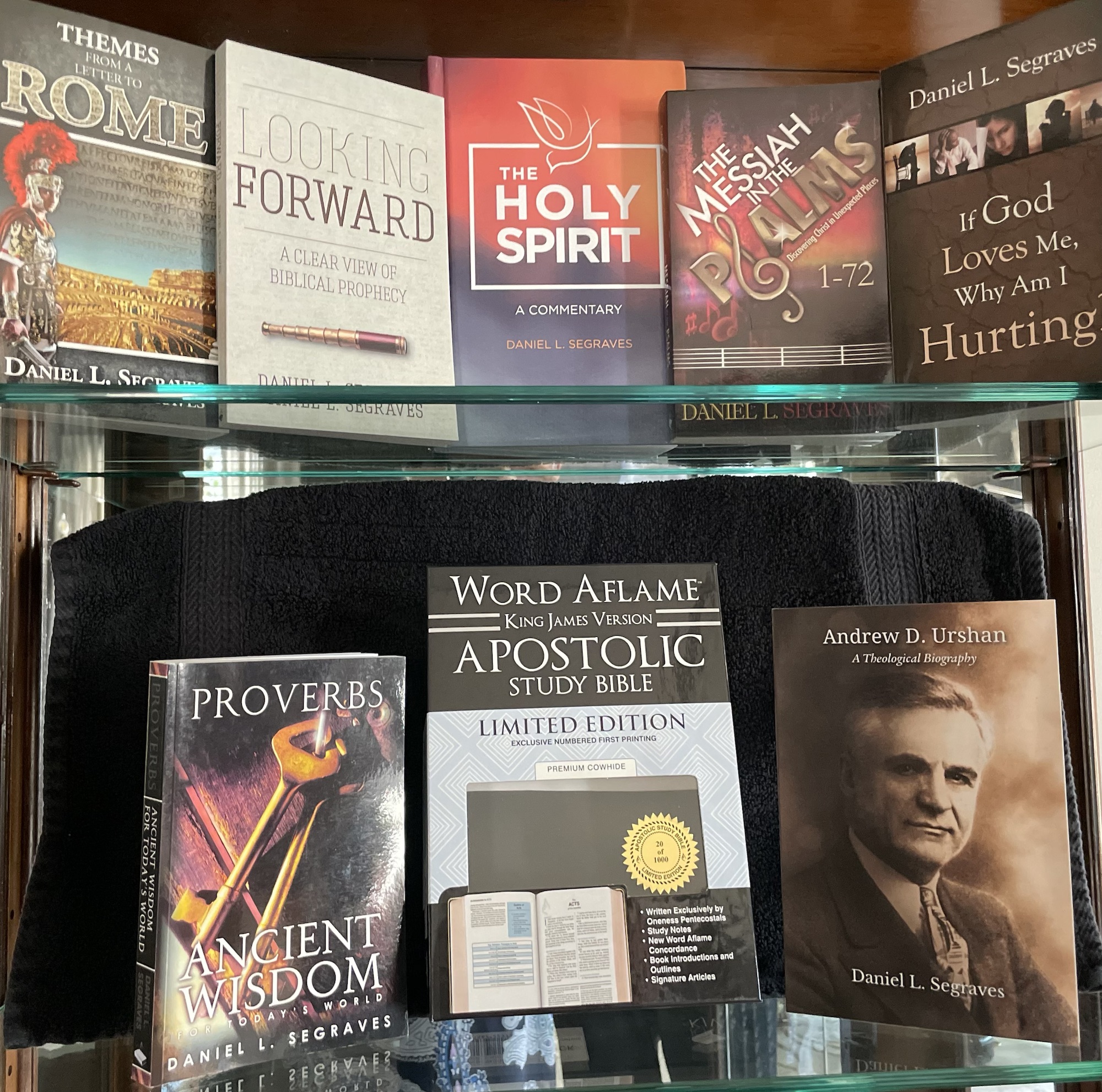
My first work on Psalms, titled The Messiah in the Psalms: Discovering Christ in Unexpected Places, was released in 2007. It covered Psalms 1-72 and was 382 pages long.

About 30 minutes ago, I finished reading the edited manuscript for my second volume on Psalms. It covers Psalms 73-106 and runs to 237 pages.

Since it will be July 1, 2025 in a couple of days, this means it has taken me 2,555 days to write this second volume, averaging about 1 page every 11 days.

Of course I’ve done a few other things since retirement, like writing a book titled The Holy Spirit, which discusses nearly every reference to the Holy Spirit from Genesis to Revelation.

And just in case you’re wondering, I have begun work on the third and last volume on the Book of Psalms!

Your greatest power.

June 19, 2025 | Daniel L. Segraves, Ph.D.

C. M. Becton served for many years as the general secretary of the United Pentecostal Church International. He signed my certificate of ordination on January 17, 1969. His keen spiritual insight was reflected in the way he opened the Scriptures as he proclaimed the gospel.

I will never forget one of his profound messages titled “Your Greatest Power.” He demonstrated from the word of God that the greatest power possessed by human beings is the power of choice.

I am currently reading a book recommended to me by David S. Norris, Professor of Theological Studies at Urshan Graduate School of Theology. The book is titled Hidden Worldviews: Eight Cultural Stories that Shape our Lives (Steve Wilkens and Mark L. Sanford [Westmont IL: IVP Academic, 2009]).

Moments ago, I came across this observation: “God’s respect for human beings runs so deep that he does not override our wills, even when we make choices that are utterly destructive.”

If you doubt this, read Genesis 2:16-17; 3.

Brother Becton was right. God has given us the freedom and ability to make our own choices.

The comedian Flip Wilson’s character Geraldine Jones was wrong when she said, “The devil made me do it!”

[archive]

The Role of Tongues in Praying in the Spirit

June 6, 2025 | Daniel L. Segraves, Ph.D.

I wrote this article about thirty years ago when some Pentecostals were questioning whether a person could continue speaking with tongues after being baptized with the Holy Spirit. Their assertion was that all who are baptized with the Holy Spirit speak with tongues as a sign of this experience, but that only those who also receive the spiritual gift of “divers kinds of tongues” (1 Corinthians 12:10) can speak with tongues after being filled with the Spirit (Acts 2:4). I have revised the original article for clarity and to include additional insight.


By definition, Pentecostals believe in speaking with tongues [the biblical practice of speaking with tongues involves speaking in a language or languages one has never learned by the enablement of the Spirit (Acts 2:4-12; 10:44-47; 19:6; 1 Corinthians 12:10, 30; 14:1, 6, 10-11, 13-19, 23, 26-28)]. Pentecostals believe speaking with tongues is the initial sign of baptism with the Holy Spirit. Many understand there is a difference between the speaking with tongues which occurs when a person is baptized with the Holy Spirit and the gift of diverse [i.e., different] kinds of tongues, which some, but not all, receive (1 Corinthians 12:10, 30).

There is, however, some confusion over the continued role of speaking with tongues on the part of the person who has been baptized with the Holy Spirit but who may not have received the gift of diverse kinds of tongues.

There are two extremes of thought on this issue. Some have been known to claim that a person must speak with tongues every day in order to maintain salvation. There is no biblical support for this idea. On the other hand, some have so de-emphasized speaking with tongues that they see no further purpose for it after initial Spirit baptism unless a person has the gift of diverse kinds of tongues [this gift is for the purpose of communicating a message from God to the church, and it must be accompanied by an interpretation (1 Corinthians 14:5]. This latter position leads to the problem of people receiving the baptism of the Holy Spirit and never speaking with tongues again.

Believers who have not spoken with tongues for many years often find it difficult to break through some unseen barrier to be able to speak with tongues again. They sometimes believe their first experience must be duplicated in every way before they can speak with tongues. Doubts may assail them as to whether their speaking is genuine tongues or whether it is just their imagination or worse, the work of the devil.

I believe that all those who are baptized with the Holy Spirit can, and should, continue to speak with tongues regularly. This is true whether or not one has the gift of diverse kinds of tongues. Indeed, this latter gift involves different (diverse) kinds of tongues [languages]. The simplest explanation of this is that a person with this gift is able to speak in more than one language unknown to him or her. The gift may also involve various purposes for the tongues, as they are related to the gift of interpretation. That is, one message in tongues may be for the purpose of edification, another for exhortation, and another for comfort (1 Corinthians 14:3-6). A person without this gift, but who has been baptized with the Holy Spirit, has the ability on a continuing basis to speak in at least one language unknown to that person.

The question under consideration here is whether the Bible teaches that a person without the gift of diverse kinds of tongues does indeed have the continuing ability to speak with tongues, whether the individual should regularly exercise that ability, and to what purpose.

A Sign Following Believers

Jesus said, “And these signs shall follow them that believe; In my name they shall cast out devils; they shall speak with new tongues; They shall take up serpents; and if they drink any deadly thing, it shall not hurt them; they shall lay hands on the sick, and they shall recover” (Mark 16:17-18).

The “new tongues” spoken of here are new or different languages. This is not a reference to a new believer “cleaning up his language.” It is a miraculous sign, as are all the others listed, involving a new language [tongue=language]. This prediction by Jesus began to be fulfilled on the Day of Pentecost and continued to be fulfilled in the lives of the early believers throughout the New Testament era (Acts 2:4; 10:44-46; 19:6; 1 Corinthians 14:18-39).

Jesus’ promise in Mark 16 clearly indicates that these sign gifts would continue to be present in the lives of believers. There is no indication that any of them would be expected to occur only once in a believer’s experience. In other words, few would interpret the phrase “they shall lay hands on the sick, and they shall recover” to refer to a one time event that never needs repeating in a believer’s life. That is, whenever the opportunity and need arises, a person who is a believer can be expected to minister to the sick through the laying on of hands. He will do this even daily, if need be.

The same is true of the prediction by Jesus that believers will “speak with new tongues.” Clearly, speaking with tongues is one of the things that will characterize believers. They will not speak with tongues just once and then cease. Speaking with tongues will be a way of life for them. Whenever the opportunity and need presents itself for them to speak with tongues, they will do so, even if it is daily.

If a believer is expected to speak with tongues only once, it seems strange that Jesus would say, “And these signs shall follow them that believe ….” This phrase indicates a continuing sign, something that follows believers throughout their lives.

The Pattern of Acts

Believers first spoke with tongues on the Day of Pentecost, as they were filled with the Holy Spirit and as “the Spirit gave them utterance” (Acts 2:4). While the mind gives utterance to speech in one’s own language, the Holy Spirit gives utterance to speaking with tongues.

And this was not gibberish. The amazed multitude said, “We do hear them speak in our tongues the wonderful works of God” (Acts 2:11). It is noteworthy that on the first occasion when people spoke with tongues, they described in languages unknown to them the wonderful things God has done. This indicates that one of the uses of tongues even by those who do not have the gift of diverse kinds of tongues is to glorify God for His mighty acts. (See Psalm 150:2.)

When the Holy Spirit was poured out at the house of Cornelius, the amazed Jewish believers “heard them speak with tongues, and magnify God” (Acts 10:46). While one could speculate that the Gentiles here first spoke with tongues, then separately and apart from that magnified God in their own language, that does not fit the model of Acts 2, nor does it fully explain the amazement of the Jewish onlookers. The visitors were amazed because they heard the Gentiles, in languages unknown to them, magnify God.

When Paul confronted the disciples of John the Baptist and declared to them that Jesus is the Messiah, they were baptized in the name of the Lord Jesus. Then Paul laid his hands on them, and “the Holy Spirit came upon them, and they spoke with tongues and prophesied” (Acts 19:6, NKJV). It is possible that the spiritual gift of prophecy was at work here (1 Corinthians 12:10; 14:3-4). Perhaps, however, they were prophesying in tongues (in languages unknown to them). By his quotation from Joel on the Day of Pentecost, Peter identified speaking with tongues as a prophetic act (Acts 2:4, 11, 16, 17-18). We should also keep in mind that interpreted tongues equal prophecy in value (1 Corinthians 14:5). For an interpretation of tongues to be prophecy, the tongue itself would have to be prophecy in another language. Some would understand 1 Corinthians 14:6 to further support this view: “But now, brethren, if I come to you speaking with tongues, what shall I profit you unless I speak to you either by revelation, by knowledge, by prophesying, or by teaching” (NKJV).

This view understands Paul as referring to tongues which, uninterpreted, do not profit or edify the church, but when interpreted, result in revelation, a word of knowledge, a prophecy, or teaching.

Whether or not the prophecies of the newly Spirit baptized believers in Acts 19 were related to their speaking with tongues, it remains that on the Day of Pentecost believers, in tongues, declared the wonderful works of God and, at Cornelius’ house, magnified God in tongues.

The only other place in Scripture where tongues are explicitly mentioned, in addition to Mark and Acts, is 1 Corinthians, in the context of Paul’s discussion of the gifts of the Spirit.

The Corinthian Letter

In 1 Corinthians 12, Paul listed nine gifts of the Spirit and compared their function with that of the various members of the human body working together for the common good. It is understood in the discussion that not everyone has each gift, but that all have at least one gift. The gift of diverse kinds of tongues is one of the nine gifts mentioned.

1 Corinthians 13 points out the emptiness of spiritual gifts not motivated by love. One bit of insight gained as to the nature of speaking with tongues is the possibility of speaking with human or angelic tongues (1 Corinthians 13:1).

Much of 1 Corinthians 14 is devoted to the proper use of the spiritual gifts, including the purpose of speaking with tongues. While Paul indicated the pointlessness of tongues without interpretation as it relates to the edification of the church, he does recognize that uninterpreted tongues have value for the person who speaks with tongues.

For the moment, let’s focus our attention only on the advantages of uninterpreted tongues:

“For he who speaks in a tongue does not speak to men but to God, for no one understands him; however, in the spirit he speaks mysteries” (1 Corinthians 14:2, NKJV).

“He who speaks in a tongue edifies himself, but he who prophesies edifies the church” (1 Corinthians 14:4, NKJV).

“For if I pray in a tongue, my spirit prays …” (1 Corinthians 14:14, NKJV).

” … when thou shalt bless with the spirit … thou verily givest thanks well …” (1 Corinthians 14:16-17).

Summary

To sum up the value of uninterpreted tongues from Acts and 1 Corinthians, we note the following:

  1. While speaking with tongues, a person may declare the wonderful works of God.
  2. While speaking with tongues, a person may magnify God.
  3. One who speaks with tongues speaks not unto people, but unto God.
  4. One who speaks with tongues speaks mysteries in the spirit.
  5. One who speaks with tongues edifies (i.e., builds up, strengthens, or encourages) himself.
  6. When a person prays with tongues, it is his or her spirit praying.
  7. One who speaks with tongues can give thanks well.

All of these are noble activities and illustrate the value of continuing to speak with tongues following the initial baptism with the Holy Spirit.

Paul defined praying in tongues as praying “with the spirit” (1 Corinthians 14:14-15). While it is true that one’s natural mind is not helped by uninterpreted tongues, whether in prayer or otherwise, it is no less true that the spirit is edified. Rather than rejecting prayer in tongues, Paul wrote, “I will pray with the spirit, and I will pray with the understanding also: I will sing with the spirit, and I will sing with the understanding also” (1 Corinthians 14:15).

This introduces another possible function of tongues: Not only can a person pray with tongues; he or she can also sing with tongues.

When a person is moved to speak with tongues, but there is no interpreter in the congregation to render the message in the language of the people, the person with the tongue is to keep silence in the church (i.e., he is not to speak aloud in the public assembly). But rather than forbidding him to speak altogether, Paul instructed this person to “speak to himself, and to God” (1 Corinthians 14:28). In other words, even if speaking in tongues in this case would have no value to the congregation at large, it could still have value to the individual speaking with tongues, because he would be speaking to God and at least he himself would be edified.

Even though Paul gave clear instructions on the proper use of tongues, emphasizing the importance of interpretation for the edification of the body, he could not be interpreted as denigrating tongues. He wrote, “I thank my God I speak with tongues more than you all” (1 Corinthians 14:18) and ” … do not forbid to speak with tongues” (1 Corinthians 14:39, NKJV).

Praying with the Spirit

For our purposes here, it is important to note that Paul equated praying in tongues with praying in the spirit (1 Corinthians 14:14-15). This gives insight into other Scriptures that discuss the role of the spirit in prayer.

“Likewise the Spirit also helps in our weaknesses. For we do not know what we should pray for as we ought, but the Spirit Himself makes intercession for us with groanings which cannot be uttered” (Romans 8:26, NKJV).

Some would disagree that this is a reference to praying in tongues. They would point out that the Spirit’s work here results in “groanings which cannot be uttered” rather than words which can be articulated, albeit in a language unknown to the speaker. Perhaps this is true, although the possibility remains that those could be groanings that cannot be uttered with the aid of the natural mind, but which can be uttered by the direction of the Spirit. The Holy Spirit did, on the Day of Pentecost, give utterance to words that otherwise would have remained unspoken. The “groanings” Paul has in mind are those arising from “the mind of the Spirit,” not the natural mind, and they are employed by the Spirit as “He makes intercession for the saints according to the will of God” (Romans 8:27, NKJV).

But whether or not this is a reference to praying with tongues, Romans 8:26 points out important features of praying in or with the Spirit:

  1. Our natural understanding is insufficient to give us direction in prayer.
  2. The Spirit compensates for this human weakness by giving us direction in prayer, even leading us to pray with “groanings.”

Paul concluded his discussion of the armor of God with these words: “[P]raying always with all prayer and supplication in the Spirit …” (Ephesians 6:18). Clearly he had reference to prayer that goes beyond that which springs from human understanding alone.

Another reference to prayer in this spiritual dimension is found in Jude 20: “But you, beloved, building yourselves up on your most holy faith, praying in the Holy Spirit” (NKJV). The word translated “building up” [epoikodomeō] is related to the word translated “edifies” [oikodomeō] in 1 Corinthians 14:4. Jude uses a participle, 1 Corinthians a verb. The sense of the word is the same in both cases: “To make nearer to fullness or completion” (Logos Bible Software). The connection between these texts indicates that Jude’s reference to “praying in the Holy Spirit” is to praying in tongues.

While praying in the Spirit includes praying in a language understood by the speaker words impressed upon him by the Holy Spirit, prayer in tongues is always — by definition — prayer in the Spirit.

Once a person’s human spirit is reborn (John 3:6), he possesses the ability to speak with tongues on a continuing basis. This is inherent in Jesus’ prediction that speaking in tongues is a sign that will follow believers and in the fact that the first sign of the indwelling Holy Spirit is the ability of believers to speak with tongues by the utterance of the Spirit.

If we see the new birth as comparable to the birth of a child, it would be unreasonable to expect any of the abilities inherent in the new birth to cease as one matures. Instead, we would expect the abilities — including the ability to speak — to increase in proficiency and effectiveness.

By praying or singing in tongues, a person can:

  1. give evidence of being a believer
  2. declare the wonderful works of God
  3. magnify God
  4. speak to God in a way that surpasses human understanding
  5. speak mysteries
  6. edify himself or herself
  7. allow the born again spirit to pray
  8. give thanks well.

A sincere believer in Jesus Christ who loves the Lord does not need to worry about the origin of the tongues he speaks. Jesus said, “If you then, being evil, know how to give good gifts to your children, how much more will your heavenly Father give the Holy Spirit to those who ask Him!” (Luke 11:13, NKJV).

No loving human father will allow an evil person to slip his children poison when they ask for food. How much more will our heavenly Father not allow Satan to deceive His beloved children by giving them a false gift! The allegation that some witch doctors or practicing Satanists may have been known to speak with counterfeit “tongues” has nothing at all to do with sincere believers in Jesus Christ who come to God on the basis of the promises of Scripture to receive a good gift from God. (See James 1:17.)

During the last years of his life, Andrew D. Urshan devoted his ministry almost exclusively to emphasizing the importance of believers continuing to speak with tongues frequently after their initial Spirit baptism. He said that if people would speak with tongues every day, they would always live in victory.

That is good counsel for our day, a day when some are de-emphasizing tongues, but a day when the need for praying in the Spirit is greater than ever before.

[archive]
How videos are produced at the UPCI headquarters.

June 4, 2025 | Daniel L. Segraves, Ph.D.

Since 1968, I have been involved in various ways in the production of Sunday school curriculum for the United Pentecostal Church International. This started with Word Aflame Publications, when I served as the editor of the Junior High literature.

As you might imagine, many changes have occurred in this process since 1968. Beginning in the 1970s and continuing to the present time, I have written materials on the adult level. Although I have lost track of how many lessons I have written, I think it is safe to say they number in the hundreds. Some years ago, I counted what I had done to that point. I believe it was 150 lessons.

More recently, with the development of new technologies, my involvement has reached beyond writing. Videos are now included in the materials produced to supplement the printed lessons. Last week, I was in the studio at the headquarters of the UPCI to film two videos, one on the significance of the change of Jacob’s name to Israel and the other on what it means to say that God hardened Pharaoh’s heart.

It occurred to me that some readers of this blog may be interested to know what kind of studio is used and how this process is accomplished. Susan, my wife, was with me, and she took some pictures with her iPhone. We were in the same studio where David K. Bernard and Jonathan Mohr film Dr. Bernard’s podcast.

L. J. Harry, Curriculum Director for the Pentecostal Resources Group, sits with his back to the camera. State-of-the-art technology is utilized, including a teleprompter that keeps pace with the reader’s voice. I wrote the scripts for the videos and emailed them to Brother Harry before the session. David Zuniga, the cameraman, is a graduate of Christian Life College in Stockton, California. I taught at Christian Life College for twenty-five years.

So that’s it! I recommend God’s Word for Life, the current name of the curriculum produced by the UPCI. Each Sunday, the lessons prepared for all grade levels explore the same biblical texts, enabling families to review what they have studied.

[archive]

Is speaking in tongues the evidence or the sign of baptism with the Holy Spirit?

June 1, 2025 | Daniel L. Segraves, Ph.D.

As Susan and I were cleaning out our garage yesterday, I discovered a DVD titled, “Daniel Segraves, Sunday Evening Session, 2014, Division of Education Summer Institute.” Perhaps I had forgotten this DVD existed. When I viewed it, I realized it was a message I delivered exploring whether speaking in tongues is the evidence a person has been baptized with the Holy Spirit or a sign of that event.

When I was doing research for my Ph.D. dissertation on the biography and theology of Andrew D. Urshan, I read one of his books titled “My Study of Modern Pentecostals.” In this book, written in 1923, Urshan explained his belief that speaking with tongues is the sign, not the evidence. The Fundamental Doctrine of the United Pentecostal Church International describes speaking with other tongues as the initial sign of the baptism of the Holy Ghost.

I wrote an article exploring this view titled “Speaking in Tongues: Evidence or Sign?” and posted it on this blog on July 19, 2018. You can read the article there.

When I realized my presentation was also preserved in video format, I decided to post it as well. Here it is:

[archive]

How consumerism redefines our values.

May 6, 2025 | Daniel L. Segraves, Ph.D

In preparation for a class I’ve been asked to teach, I’m reading Hidden Worldviews: Eight Cultural Stories That Shape Our Lives, by Steve Wilkins and Mark L. Sanford (IVP Academic).

The authors relate the story of Dominic, “a monk who founded the Dominican order, and his visit to Pope Innocent III in Rome in the thirteenth century. While giving Dominic a tour of the Vatican, in which its massive treasures were prominently displayed, the Pope said (in reference to Acts 3:6), ‘Peter [signifying the Pope] can no longer say, “Silver and gold have I none.”’ Dominic responded, ‘Neither can he say, “Rise and walk.”’ Dominic’s point is that when we value the types of power available through wealth, we also devalue power of a different, and more important, sort.”

[archive]

Jesus taught hermeneutics.

April 5, 2025 | Daniel L. Segraves, Ph.D.

This lesson was prepared for an elective class at The Sanctuary UPC in Hazelwood, Missouri, where Mitchell Bland is pastor.

            Can you imagine Jesus teaching a course in hermeneutics? If He did, would you want to enroll? Would He use a chalkboard, a whiteboard, or an overhead projector? Would He embrace today’s technology with its PowerPoint slides or perhaps even video clips? What would He use for a textbook? Do you think He would write His own as I and multitudes of today’s teachers have?[1]

            What is (or should I say “are”) hermeneutics, anyway?

            The word “hermeneutics” comes from the Greek hermeneuo, which means “to explain” or “to translate.” It is used in John 1:38, 42; 9:7 and Hebrews 7:2. Another form of the word, hermeneia, appears in I Corinthians 12:10 and 14:26, in a discussion of the gift of the interpretation of tongues. Luke 24:27 records Jesus’ encounter with the two disciples on the road to Emmaus: “And beginning at Moses and all the prophets, he expounded unto them in all the scriptures the things concerning himself.” The word “expounded” is the Greek diermeneuo, a compound word composed of the preposition dia, meaning “through” (making the word an intensive), and hermeneuo, meaning “to interpret.” The word thus means “to interpret fully.” This same Greek word is also used in Acts 9:36 and I Corinthians 12:30; 14:5, 13, 27.

            The word “hermeneutics” itself can refer to any kind of interpretation; it has no specific theological reference. It could, for example, refer to the interpretation of Shakespeare, Homer, Aristotle, or any piece of literature. When referring to the interpretation of Scripture, the proper term to use is “biblical hermeneutics.”

Biblical hermeneutics is the science of interpreting the holy Scriptures.

            The fact is that Jesus did teach hermeneutics. In about eighty quotations from the Old Testament, Jesus taught His disciples (i.e., learners) how to understand the Hebrew Scriptures. He even went so far as to teach from a translation, the Septuagint (a Greek translation of the Scriptures). His disciples found these events to be profound learning experiences. Although they believed on Jesus, there were many Scriptures they did not understand. For example, after Jesus visited with the two disciples He met on the road to Emmaus, they said to one another, “Did not our heart burn within us while He opened the Scriptures to us” (Luke 24:32). Later, after eating with a larger group of disciples and shortly before His ascension, Jesus said to them, “These are the words which I spoke to you while I was still with you, that all things must be fulfilled which were written in the Law of Moses and the Prophets and the Psalms concerning Me.” Then, “He opened their understanding, that they might comprehend the Scriptures” (Luke 24:44).

            In his book Asking the Right Questions, Matthew S. Harmon discusses these ideas. He concludes that there are “four key principles that help us read and understand the Bible the way Jesus tells us to.”[2] His insights are helpful. Let’s think about them.

            Responding to Jewish leaders who persecuted and sought to kill Him, Jesus said, “You search the Scriptures, for in them you think you have eternal life; and these are they which testify of Me. But you are not willing to come to me that you may have life” (John 5:39).

            Reflecting on this verse, Harmon writes, “Stop for a minute to realize what Jesus is saying. These Jewish leaders, who have been considered the leading experts on the Old Testament, have missed the main point of the Scriptures—Jesus himself! The very people who should have most readily recognized who Jesus is based on their knowledge of the Bible not only have failed to recognize him as Messiah but also are actively opposing him.[3]

“Jesus concludes this encounter with sobering words for these Jewish leaders. On the last day, when these leaders appear before God, Jesus says:

Do not think that I will accuse you to the Father. There is one who accuses you: Moses, on whom you have set your hope. For if you believed Moses, you would believe me; for he wrote of me. But if you do not believe his writings, how will you believe my words? (John 5:45–47)

“The very words of Moses that these Jewish leaders cherish will be the basis for their condemnation by God on the last day. And Moses will be one of the prosecuting attorneys.[4]

“From this passage we can draw at least two conclusions. First, Jesus believes that Scripture points to him in such a clear way that those who read Scripture should see him in its pages. In fact, he holds people responsible for not doing so, with eternal consequences.

“Second, there are ways of reading Scripture that miss the main point of the Bible. That danger remains just as real today. So as followers of Jesus we must be sure we are reading the Bible the right way. Jesus addresses this issue even more directly in Luke 24.”[5]

Turning next to Luke 24, Harmon explains how Jesus’ post-resurrection appearances provided direction on how the Scriptures should be interpreted.

“Luke gives the most extended account of the day Jesus rose from the dead. After the discovery of the empty tomb by the women (24:1–12), the scene shifts to two of Jesus’s followers walking on the road to Emmaus (24:13–35). As they discuss the events of the weekend, Jesus joins their conversation. Not realizing that it is Jesus (24:16 says, “Their eyes were kept from recognizing him”), the men begin to explain to him all that has happened. They describe Jesus as ‘a prophet mighty in deed and word before God and all the people’ (24:19) who was condemned by the religious leaders and handed over to be crucified (24:20). Before these events they ‘had hoped that he was the one to redeem Israel’ (24:21). But then the unexpected happened: some women discovered that Jesus’s tomb was empty and were told by angels that he had risen from the dead (24:22–23). This seemingly unbelievable news was even confirmed by some of his male followers (24:24).[6]

“Rather than marvel at the events the men describe, Jesus sternly rebukes them: ‘O foolish ones, and slow of heart to believe all that the prophets have spoken! Was it not necessary that the Christ should suffer these things and enter into his glory?’ (24:25–26). Far from being a tragic turn of events, all that happened in Jerusalem was absolutely necessary, Jesus insists. But he does not leave the two men wondering what he means by this; notice what he does next: ‘And beginning with Moses and all the Prophets, he interpreted to them in all the Scriptures the things concerning himself’ (24:27).”[7]

Can you imagine being in on that “Bible study”? Jesus starts with the first five books of the Bible (written by Moses) and continues on through “all the Prophets.” By “all the Prophets,” Jesus means not just the books that today we call the prophetic books (Isaiah, Jeremiah, Ezekiel, Daniel, the twelve “Minor” Prophets) but also what we call the Historical Books (basically Joshua through 2 Kings). Jesus works his way through these books of the Bible, interpreting them so that these two men can understand how they point to him. The way Luke describes this event strongly suggests that Jesus is not merely highlighting individual verses or passages, but explaining how the whole storyline of the Old Testament points toward him.[8]

“Given how much space Luke devotes to this encounter, it is clear that he wants to emphasize the risen Jesus explaining how to read the Old Testament. And when Luke returns to this same subject later in this same chapter, any remaining doubt is removed. But first we need to set the stage.[9]

“It is later that night. The two men Jesus met on the road to Emmaus have returned to Jerusalem and told the small band of Jesus’s followers what happened to them when he appeared to them (Luke 24:33–35). As they are talking about this, Jesus appears in their midst (24:36). Despite their initial fear, Jesus reassures them of who he is, even going so far as to eat a piece of fish in front of them (24:37–43)![10]

“With their fears now relieved, Jesus begins to piece together what happened, starting at the same place where he began with the two men on the road earlier that day: ‘These are my words that I spoke to you while I was still with you, that everything written about me in the Law of Moses and the Prophets and the Psalms must be fulfilled’ (Luke 24:44). What Jesus has said to the two men on the road to Emmaus he now repeats to the larger group of disciples. In addition to mentioning again Moses and the Prophets, here Jesus also refers to the Psalms. By doing so Jesus is reinforcing his claim that the whole Old Testament finds its fulfillment in who he is and what he has done.[11]

“But without what happens next, Jesus’s disciples will not get it. So, Luke says, Jesus ‘opened their minds to understand the Scriptures’ (24:45). While this is no doubt a supernatural act, Jesus opens their minds by means of the explanation of the Scriptures that follows. Jesus says, ‘Thus it is written, that the Christ should suffer and on the third day rise from the dead, and that repentance and forgiveness of sins should be proclaimed in his name to all nations, beginning from Jerusalem’ (24:46–47).”[12]

Thus Jesus “provides a summary of the message of the Old Testament. According to Jesus, the basic message of the Old Testament has two main points: (1) the Christ would suffer and then rise from the dead, and (2) repentance and forgiveness would be proclaimed to all the nations.”[13]

“So what do we learn about reading the Bible from this passage? First, Jesus rebukes his followers for failing to recognize that the main message of Scripture is focused on him. Jesus expects his people to understand the Bible in a certain way. So if we read the Bible in a way that doesn’t see Jesus and what he has done through the gospel as central, we are not reading the Bible the way Jesus tells us to read it.[14]

“Second, reading and understanding the Bible the way Jesus commands requires help from God.[15]

“Third, all of Scripture points in some way to Christ and what he has done for us. It’s not just certain obvious passages that point to Christ and the gospel. Every single passage in some way points to the need for Christ, anticipates/describes who he is, anticipates/describes what he does, or indicates how we should live as his people. God is bringing to fulfillment all that he has promised to do in and through Jesus Christ.[16]

“Fourth, the basic story of Scripture centers on the death and resurrection of Jesus, the announcement of that good news to all the nations, and the call for people to turn from their sins and trust in Christ.”[17]

Now, Harmon offers the “four key principles that help us read and understand the Bible the way Jesus tells us to.”[18]

“First, since Christ is the fulfillment of God’s promises in the Old Testament and the focal point of what he is doing in this world, every passage of Scripture connects to Christ and his work in some way. Paul writes that ‘all the promises of God find their Yes in him. That is why it is through him that we utter our Amen to God for his glory’ (2 Cor. 1:20). In other words, every promise of God depends in some way on the person and work of Jesus for its fulfillment.[19]

“Second, despite all its diversity, the Bible tells an overarching story of God establishing his kingdom by saving his people through Jesus Christ and sending out his saved people to proclaim his glory to the ends of the earth.[20]

“Third, because God is sovereign, he has ordered human history so that earlier events, people, and institutions correspond to later events, people, and institutions.[21]

“Fourth, as we read the Bible and grow in our understanding of who Christ is and what he has done, we should constantly deepen our understanding of both the Bible and Jesus Christ. The earliest followers of Jesus were continually going back to the Bible with their understanding of who Jesus is and seeing fresh things in Scripture about him. In turn those new insights into Scripture further deepened their understanding of who Jesus is and what he has done.”[22]

As he comes to the conclusion of this section of his book, Harmon says, “[W]hen the early Christians looked at Jesus, they did so through the lenses of the Old Testament, and when they looked at the Old Testament, they did so through the lenses of redemption in Christ.”[23]

Finally, he writes, “If we approach every passage of Scripture with the expectation that it will somehow point us toward Christ, we will begin to see Scripture in a fresh way.”[24]

So what do you think? Have you learned something from Jesus’ hermeneutics class that will help you understand the Scriptures more clearly?

© 2025 by Daniel L. Segraves


[1] My hermeneutics textbook is You Can Understand the Bible: Guidelines for Interpreting Scripture. It is available at pentecostalpublishing.com and Amazon.com.

[2] Matthew S. Harmon, Asking the Right Questions: A Practical Guide to Understanding and Applying the Bible (Wheaton, IL: Crossway, 2017), 51.

[3] Harmon, 44–45.

[4] Harmon, 44–47.

[5] Harmon, 47.

[6] Harmon, 47–48.

[7] Harmon, 48.

[8] Harmon, 48.

[9] Harmon, 48.

[10] Harmon, 48–49.

[11] Harmon, 49.

[12] Harmon, 49.

[13] Harmon, 49–50.

[14] Harmon, 50.

[15] Harmon, 50.

[16] Harmon, 50.

[17] Harmon, 50.

[18] Harmon, 51.

[19] Harmon, 51.

[20] Harmon, 51.

[21] Harmon, 52.

[22] Harmon, 52.

[23] Harmon, 52.

[24] Harmon, 52–53.

[archive]

Pneumatology at Urshan Graduate School of Theology

April 4, 2025 | Daniel L. Segraves, Ph.D.

img_5539-1

Yesterday, I enjoyed an afternoon of teaching a session on the Holy Spirit in the Systematic Theology course taught by Jeffrey Brickle, Professor of Biblical Studies. Dr. Brickle, a long-time friend of mine, invited me to lecture on this topic.

Dr. Brickle treated us to lunch at Urshan University. The empty plate belongs to Susan, my wife, who is also my personal photographer and videographer. Susan and I had visited the campus several times, but we were once again so impressed by the beauty of the 60+ acre campus. You can see an on-campus lake and dormitory from the spacious dining room, where delicious meals are served daily by professional chefs Steve and Ellen Hall. Steve and Ellen catered our wedding almost twelve years ago, and they also catered my mother’s 90th birthday party in our home.

We entered the campus by turning from East Pitman Avenue in Wentzville, Missouri onto Bernard Drive. From Bernard Drive, we turned onto Apostolic Way, then onto Urshan Way. We had arrived early in the morning to attend the thesis defense of L. J. Harry, a graduating student. His presentation was excellent and we were enriched by the fellowship we enjoyed. Brother Harry is the curriculum director for the Pentecostal Resources Group. Thus, he is responsible for the production of God’s Word for Life, the Sunday school curriculum available from the Pentecostal Publishing House. In the picture below, Brother Harry is seen presenting his thesis on the topic of the identity of the twenty-four elders in the Book of Revelation. His diligent research and clear analysis resulted in a thought provoking conclusion.

img_5530

I was happy to introduce my newest book, titled The Holy Spirit, to the students. Of course I couldn’t cover all 314 pages in one afternoon of teaching, but I was able to explain the major themes and some of the key biblical texts about the Holy Spirit. The fact that the Spirit of God appears first in the second verse of the Holy Bible and also in the fifth verse from the end of the Bible demonstrates the high profile of the Spirit in the inspired Scriptures. Altogether, there are more than 330 references to the Holy Spirit in Scripture. In the Old Testament, the Spirit is referred to about once every 11.6 chapters. In the New Testament, on average, about once per chapter. My book is available at pentecostalpublishing.com as well as on Amazon.com.

I recommend Urshan University and Urshan Graduate School of Theology to apostolic students who wish to earn regionally and professionally accredited degrees from the undergraduate level to the doctoral level. You can access all information at http://www.urshan.edu.

[archive]

Purpose Institute and Bible Project

March 29, 2025 | Daniel L. Segraves, Ph.D.

Today I taught the third session in a four lesson series on the Pentateuch for Purpose Institute, a Bible training program endorsed by the United Pentecostal Church International.

I have taught many times for Purpose Institute on three different campuses, but this was the first time I have incorporated any videos produced by the BibleProject.

If you are not familiar with BibleProject, I recommend you check out this free resource. [bibleproject.com] In the simplest of terms, I would describe the project’s program as providing professionally produced videos on every book of the Bible in addition to topical Bible studies.

My interest in this was kindled when I read an article in Christianity Today describing the project, identifying the scholars involved, and tracing their academic backgrounds.

When I discovered that those who founded BibleProject were once students of John H. Sailhamer and Ray Lubeck of Western Seminary, I knew I wanted to investigate what they were doing. Sailhamer and Lubeck were two of my favorite professors when I was studying for the Th.M. at Western. One of the BibleProject developers was enrolled in Lubeck’s course on the TaNaK at the same time as I was. I remember an intriguing paper he presented in class on what we commonly call the Minor Prophets.

I studied the Torah and Psalms under Sailhamer, whose reputation was that of a world class Old Testament scholar. The insights I gained transformed my perspectives on these Scriptures, leading to my first commentary on Psalms. The second volume is now with the publisher, and I am at work on the third volume.

[archive]

Israel and Paul’s great sorrow and continual grief.

February 27, 2025 | Daniel L. Segraves, Ph.D.

After our breakfast and Bible reading this morning, Susan and I sat at the kitchen table for a while to discuss some of Paul’s writings about Israel in Romans 9-11.

Like many others, we are concerned about the suffering reported in the daily news, and we pray for the peace of Jerusalem.

Some years ago, Dr. David K. Bernard, the general superintendent of the United Pentecostal Church International, invited me to submit a document examining the major themes of the Book of Romans. This document, covering these seven themes, was published by Word Aflame Press under the title Themes from a Letter to Rome.

Chapter 6 is titled “Jews: Showing the Favor of God to His National People.” Among other topics, this chapter explores Romans 9 (Israel’s past), Romans 10 (Israel’s present), and Romans 11 (Israel’s future).

Many verses from this section of Romans grip our imagination because of what we have seen in world history and what we continue to observe now. For example:

“I have great sorrow and continual grief in my heart. For I could wish myself accursed from Christ for my brethren, my countrymen according to the flesh. … For they are not all Israel who are of Israel” (Romans 9:2-3).

“My heart’s desire and prayer to God for Israel is that they may be saved” (Romans 10:1).

“God has not cast away His people whom He foreknew. … Blindness in part has happened to Israel until the fullness of the Gentiles has come in. And so all Israel will be saved” (Romans 11:2, 25, 26).

Verses like these are just a few of those demanding careful and prayerful reading in Paul’s letter to the church at Rome. If you are concerned about what you see in today’s world, I encourage you to obtain a copy of this book. It is available at pentecostalpublishing.com in both paperback and eBook formats and from Amazon.com in the Kindle Edition.

[archive]