I post papers I have written, some during my graduate and post-graduate studies, some in response to other papers, and some written for other purposes like Sunday school classes or Bible studies. I also post observations on whatever comes to my mind and videos from teaching sessions.
Today, I was back on the Urshan University campus to serve as a guest professor for Urshan Graduate School of Theology.
As suggested by this photo, which was selected by Susan, I started the three hour session fresh and ready to go work.
I enjoyed opening the Word.I kept enjoying it.But by the time the class was over, I was exhausted.I may be retired, but that doesn’t keep me from teaching, whether on campus or via ZOOM, as portrayed here, for Apostolic Bible Institute in St. Paul, MN.
The Urshan campus is about fifteen minutes from our home … ABI is about 500 miles away. But I told the Lord at a recent Sunday morning service that I would go through any door He opened. 🙏🏻
The Pentecostal Resources Group has invited me to participate in an Author Signing Event at the World Headquarters of the United Pentecostal Church International on December 3, 2025. Other authors who have released books in 2025 will also be present.
The book signing is scheduled from 10 a.m. to 11 a.m. and will be followed by an author Q&A.
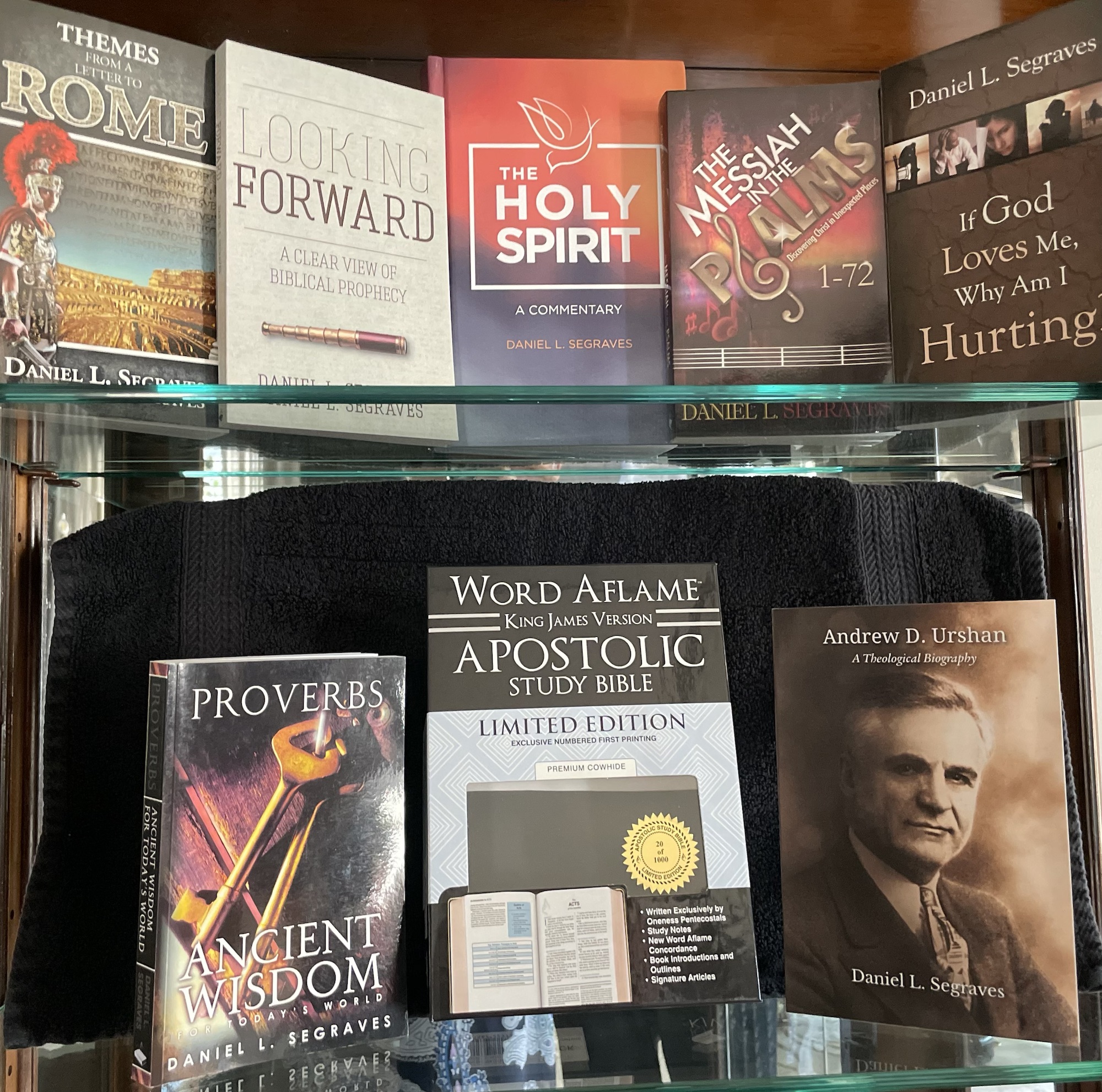
I look forward to meeting those who are interested in my most recent project, The Messiah in the Psalms, volume 2. Released at the Eightieth Anniversary of the General Conference of the United Pentecostal Church International, this 256 page book covers Psalms 73-106.
This event will take place at 36 Research Park Court, Weldon Spring, Missouri 63304. For additional information, call (636) 229-7900 or (636) 229-7822.
To all who came to tonight’s book signing for my twenty-third book, the second volume of Messiah in the Psalms: Discovering Christ in Unexpected Places, thank you!
It was a joy to visit with long-time friends, to make new friends, and to chat with former students who are doing amazing things in the Kingdom of God.
Thanks also to Everett Gossard, book editor for Pentecostal Resources, who edited the book and arranged the signing. I appreciate his excellent work.
May the blessings of our Lord rest upon all of you!
Once again, it’s a joy to greet friends and former students at general conference!
I will be at the Pentecostal Publishing House display at 9:15 p.m. Thursday to sign copies of my newest book, the second volume of my commentary on the book of Psalms: The Messiah in the Psalms: Discovering Christ in Unexpected Places. This book covers Psalms 73-106 in 252 pages.
Today I discovered that my newest book, The Messiah in the Psalms, volume 2, is available both in paperback ($18.99) and eBook ($9.99) formats at pentecostalpublishing.com.
I appreciate all who are interested in this, my twenty-third book, and I look forward to meeting those who come to my booksigning next Thursday at 9:15 p.m. at the 80th anniversary of the United Pentecostal Church International in St. Louis, Missouri.
I was pleased this morning to see my new book listed among “Newest Releases” at pentecostalpublishing.com. This 256-page work includes 384 endnotes (see below) and explores in depth the witness to Jesus Christ in Psalms 73-106. I have agreed to be available for book signings at the upcoming eightieth general conference of the United Pentecostal Church International. Next Thursday, September 25, at 9:15 p.m. I plan to be at the Pentecostal Publishing House display to meet and sign books for “all who yearn to discover how the Scriptures testify of Jesus.”
Who wants to read footnotes?
Some readers have no interest in wading through footnotes. When they appear at the bottom of a page, they see this as a sign that the book is not for them! Others love the notes and head to them first, figuring that’s where the vital information is found.
Recognizing the aversion some people have to notes, many publishers place them in the back of the book as endnotes. This way, the information is preserved for those who want it, but others who fear getting bogged down can nevertheless enjoy and profit from the book’s major content.
My book follows this approach. If you’re not interested in notes, you’ll never see them. But if you love them, as I do, head to page 225, and you can savor thirty-one more pages of insight.
For instance, at the end of eleven pages that examine Psalm 81, the final paragraph reads: It would be impossible to describe the miraculous mystery of the Incarnation more fittingly than in Paul’s words in I Timothy 3:16: “And without controversy great is the mystery of godliness: God was manifested in the flesh, justified in the Spirit, seen by angels, preached among the Gentiles, believed on in the world, received up in glory” (NKJV). In knowing Jesus, we know the Creator Himself. This wondrous truth is rooted in the very first verse of the Bible.
But wait. This paragraph points to two endnotes offering more information on I Timothy 3:16. Here they are: Footnote 151: “Instead of ‘God,’ some English translations read ‘He,’ ‘He Who,’ ‘Who,’ or ‘which.’ This is because these translations follow a Greek variant that appears only in a few manuscripts. One translation even reads ‘Christ’ instead of God. No Greek manuscript includes ‘Christ’ in I Timothy 3:16. The great majority of Greek copies have ‘God,’ which is seen in the KJV, NKJV, and other translations.”
And finally, Footnote 152: “The Greek text of I Timothy 3:16 could be legitimately read as follows: ‘God was manifested in the flesh, [God was] justified in the Spirit, [God was] seen by angels, [God was preached (i.e., proclaimed)] among the Gentiles, [God was] believed on in the world, [God was] received up in glory.” This is because each of these verbs (i.e., manifested, justified, seen, preached, believed on, and received up) is in the aorist passive indicative form. ‘God’ is the noun subject to which each of these verbs refers.
So what do you think? Is it worth it to look a bit further?
Since July 1, 2018, I’ve been working on the second volume of my commentary on the Book of Psalms. The first volume, titled The Messiah in the Psalms: Discovering Christ in Unexpected Places, was released in 2007. It covered Psalms 1-72, which comprise Books One and Two of the Psalter.
What took me so long to finish the second volume? Well, I put my work on Psalms on the back burner for a while to write another book titled The Holy Spirit: A Commentary, which in 314 pages explores nearly every reference to the Holy Spirit from Genesis 1:2 through Revelation 22:17. This book was published in 2020.
I contributed a chapter to Oneness Pentecostalism: Race, Gender, and Culture, a book published by The Pennsylvania State University Press in 2023. This book was edited by Lloyd D. Barba, Andrea Shan Johnson, and Daniel Ramirez. My chapter is titled “Andrew D. Urshan: An Eastern Voice in Early Oneness Pentecostalism.”
I also wrote a chapter titled “James and First Century Jewish Christology,” which is scheduled to be published in an early high Christology project together with research by other contributors. Jeffrey Brickle, Ph.D., is the editor of this pending volume.
I’m not immediately certain how many articles I have written since July 1, 2018, for the Pentecostal Herald and Pentecostal Life, along with lesson material for God’s Word for Life. In quite another dimension of ministry, I taught a professional development session for interested members of the general board of the United Pentecostal Church International at the request of Dr. Brent Coltharp, president of Urshan University and Urshan Graduate School of Theology.
There was also the course I taught to students of the French Bible Institute at the invitation of missionary John Nowacki. This required a flight to Paris together with my wife, Susan. An event that occurred during this trip inspired me to write the book The Holy Spirit. I have explained that in another post.
So I have probably provided a sufficient explanation of why volume two of The Messiah in the Psalms: Discovering Christ in Unexpected Places has taken so long to arrive. I would like to make some comments about the new book.
The second volume of my work on Psalms covers the section of the Psalms known as Books Three and Four. Book 3 comprises Psalms 73 through 89, and Book 4 comprises Psalms 90 through 106. There are at least eighteen references to these psalms by those who wrote the New Testament. Numbers of these references are understood by the New Testament to be specifically about the Messiah.
Significantly, the Aramaic word Memra (i.e., “Word”) appears fifty times in these psalms. In at least fifteen cases, the Targums use Memra as a surrogate for the Hebrew Yahweh, which is usually rendered LORD in English translations. This is given considerable examination in view of the use of Logos (i.e., Word) in John 1:1.
I am scheduled to be available for a book signing on Thursday night of the upcoming eightieth general conference of the UPCI in the Pentecostal Publishing House booth at 9:15 p.m.
I look forward to meeting many of you there!
By the way, I have already begun work on volume three, which will explore the messianic significance of Psalms 107 through 150.
I’ve been keeping you updated on the journey of my second volume on the Book of Psalms from my initial thoughts to the printing press. Now, the press and its digital counterparts are on the horizon.
But there’s a bit more to it than this.
Like all believers, I had long had a certain level of interest in the Psalms. The book was, after all, inspired Scripture. Some of its contents, like Psalm 23, are part of the vocabulary of many of us.
But the day when the enormous significance of this book began to dawn on me was when I sat in a class taught by John H. Sailhamer, a professor widely regarded as a world class Old Testament scholar.
I could hardly believe my ears. According to Jesus, the Psalms are rich with messianic significance (Luke 24:44). From beginning to the end, they point ahead to the coming Messiah. In the New Testament, more than 200 references recall the Psalter.
My fingers flew over the keys of my laptop. I was in the midst of an academic journey, but an academic journey turned spiritual, to earn the Master of Theology degree at Western Seminary. This degree would prepare me for acceptance into the Ph.D. program at Regent University.
Another professor at Western saw the copious notes I was taking and asked if I would be willing to share them.
I had already earned the Master of Arts in Exegetical Theology degree from Western. That degree required a thesis, but so did this second degree.
After sitting in two of Dr. Sailhamer’s courses, I knew my second thesis would be influenced by what I had learned from the Book of Psalms.
The title of my 156 page thesis was “An Application of Canonical-Compositional Hermeneutics to Psalms 14 and 53.”
After graduating with the Th.M., I began work on my first verse-by-verse commentary on Psalms. Its 382 pages examined Psalms 1-72 and were published in 2007 under the title The Messiah in the Psalms: Discovering Christ in Unexpected Places.
But I knew I needed to finish the commentary on all 150 psalms. In addition to the academic component of this task, I have been praying that God would help me to “rightly divide the word of truth” and to understand how the Scriptures testify of Him.
This has led to the second volume which consumes about 250 pages in its examination of Psalms 73-106.
Although I can’t promise it at this moment, it seems very possible this volume will be available at the upcoming general conference of the United Pentecostal Church International. If so, I plan to be on hand to sign copies for those who may be interested.