The Addiction of Sin: Lesson 11

In our previous ten lessons, we have considered the possibility that sin can be characterized as an addiction. Some may at first reject this idea, thinking that somehow if we use this language it could soften our view of sin and make it more acceptable. In the final analysis, however, what matters is how sin is described in Scripture. If there is a biblical warrant for thinking of sin in a certain way, regardless of the vocabulary we use, that inspired insight should help us deal with habitual sin.

I recall seeing a billboard in Modesto, California that read as follows: “O Lord, please give me hatred for the sin I love.” I don’t know who was responsible for that message, nor do I know the specific sin that person loved. But I do know all sin is destructive and serves to separate us from fellowship with God. Whatever we can do to find freedom from sin, we must. As John wrote, “My little children, these things I write to you, so that you may not sin” (I John 2:1a, NKJV). But that is not the end of the verse. He continued to write, “And if anyone sins, we have an Advocate with the Father, Jesus Christ the righteous” (I John 2:1b, NKJV).

Later in the same chapter, John tells us not to love the world or the things in the world. The reason for this is that if we love the world, the love of the Father is not in us (I John 2:15). But what does it mean to love the world or the things in it? This is summed up in the next verse in three brief terms:

For all that is in the world — the lust of the flesh, the lust of the eyes, and the pride of life — is not of the Father but is of the world (I John 2:16, NKJV).

The word translated “lust” refers to strong desires. Although we can’t work out all the details of this in a brief blog, it would be accurate to say the three statements of concern to John describe pride, greed, and moral impurity. These sins may be manifested in many ways, but when reduced to their essence, they are “all that is in the world.” The world has nothing lasting to offer, but there is something that does:

And the world is passing away, and the lust of it; but he who does the will of God abides forever (I John 2:17, NKJV).

In future lessons, we will look at Keith Miller’s proposed adaptation of the Twelve Step program developed by Alcoholics Anonymous. This will not be a substitute for biblical insight. As we consider each step, we will compare it to what Scripture says in relation to that idea to see if rings true. If so, it may open our eyes to practical ways we can apply powerful truths to struggles that have long frustrated us spiritually.

[archive]

Thoughts about the Use of the King James Version

Thoughts about the Use of the King James Version

Daniel L. Segraves

Many English translations of the Holy Bible have been produced since the Authorized Version of 1611, and it is not unusual for readers to choose favorites.[1] From time to time, people ask for my opinion.

This paper is not a thorough, scholarly work on the translation of the Bible from the original Hebrew, Aramaic, and Greek languages. It is simply some observations to be considered by those who think the KJV is the only trustworthy English translation and that it is wrong to use others.

I do not intend to belittle the KJV. It is a beautiful and classic literary work that has endured more than four centuries for a reason. Its phrases continue to influence the English language to this day. It is not unusual to hear them in secular literature and popular expressions.

I hold a conservative view of Scripture. As an instructor in schools endorsed by the United Pentecostal Church International, I have for decades affirmed in writing each year that I “believe in the divine inspiration of the whole Bible, the infallibility of the original writings and that the Bible is truth without any error and is inspired even to the very words and is therefore the in scripted Word of God.” This statement does not address any specific English translation; it affirms the inspiration and infallibility of Scripture as originally written (i.e., the autographs).

The Original “King James Version” 

In 1603, King James VI of Scotland ascended to the throne of England as James I. He was presented with a petition signed by clergymen, including Puritans, requesting that steps be taken to “purify” the Church of England from vestiges of Roman Catholic influence. John Reynolds, a Puritan leader and president of Corpus Christi College, Oxford, requested the king to authorize a new, more accurate translation. Since the Bishop’s Bible, a 1568 revision of the Great Bible, had not succeeded in replacing the people’s love for the Geneva Bible and since James disapproved of the marginal notes in the Geneva Bible, he approved the translation.

More than fifty scholars trained in Hebrew and Greek began the work of translation in 1607. They were instructed to follow the Bishop’s Bible as long as it was faithful to the original text and to consult the translations of Tyndale, Matthew, Coverdale, the Great Bible, and the Geneva Bible.

In 1611, the KJV was finished. Corrected editions began to be released almost immediately. Two editions were published in 1611, with one correcting several printer’s errors in the other. In 1612, another reprint corrected mistakes in the second 1611 edition. In 1613, another revision was released correcting still more mistakes in the 1611 edition. Considerable revision was done in a 1616 reprint and fewer corrections in a 1617 edition.

The greatest revision of the KJV to that time occurred in 1629 when the first edition without the Apocrypha was released. This was the first time the KJV was published by someone other than the king’s printers. Thomas and John Buck, Cambridge University printers, released the 1629 edition, and Thomas Buck and Roger Daniel published another edition in 1638. These two revisions of the KJV involved revision of the text, of the use of italics, and of marginal notes. In the meantime, other editions were being released by the king’s printers in 1630 and 1634.

In 1640, the king’s printers released an edition of the KJV which came to be known as the “Wicked Bible” because it inadvertently left out the word “not” in the seventh of the Ten Commandments. The printer was given a substantial fine. Other editions were released in 1653, 1655, 1656, and 1657.

The first edition of the KJV to contain dates in the margin was published in 1701 in three volumes.

Thomas and Robert Baskett released two editions in 1744 and 1756 which were known for their beautiful typography and comparative freedom from misprints.

In 1762, Dr. Paris of Trinity College, Cambridge, released a substantially revised edition of the KJV. His work was followed by Dr. Blayney’s revision of 1769. The KJV in use today is largely the edition that resulted from the efforts of these two scholars in revising the text, the italics, and the marginal notes.[2]

I have on my computer a PDF copy of the first edition of the 1611 KJV. On my desk before me, I have a hardback reprint of the first edition, printed in 1982 by Thomas Nelson Publishers. The first thing to strike the eye of the reader is the sixteenth-century type font. Next is what is to us the unusual spelling of many words. For instance, what I would call the title page reads,

“The Holy Bible, Conteyning the Old Teftament, and the new: Newly Tranflated out of the Originall tongues: & with the former Tranflations diligently compared and reuifed, by his Maiesties fpeciall Comandement. Appointed to be read in Churches. Imprinted at London by Robert Barker, Printer to the Kings moft Excellent Maiestie. Anno Dom. 1611.[3]

            On the next pages begins the dedication to King James I. The heading reads,

“to the most high and mightie prince, Iames by the grace of God King of Great Britaine, France and Ireland, Defender of the Faith, &c. the translators of the bible, wifh Grace, Mercie, and Peace, through Iesvs[4] Christ our Lord.”

After the two and one-half page dedication comes an eleven page section titled “The translators to the reader.” Here the translators explain the reason for their work and respond to their critics. This section is dense and difficult to read. It is not usually found in American printings of the KJV. This is to be regretted because this section answers questions often asked and corrects assumptions made by American readers.

The “Vulgar” Tongue

One of the things noted in “To the Reader” is the necessity of the translation being rendered in the “vulgar tongue”:

“Indeede without tranflation [translation] into the vulgar tongue, the vnlearned [unlearned] are but like children at Iacobs (Jacob’s) well (which was deepe) without a bucket or fome [some] thing to draw with.”

In 1611, the word “vulgar” meant “common.” The point here is that the translators recognized the necessity of translating into the common language of those who spoke English at that time. This has been the undergirding idea of most translations into any language, and it is a challenge to those who assume the language spoken four centuries ago is clearly understood by those who read and speak English in the twenty-first century.

The translators of the KJV returned to this idea repeatedly. For instance:

“But how fhall [shall] men meditate in that, which they cannot vnderfstand [understand]? How fhall [shall] they vnderftand [understand] that which is kept clofe [close] in an vnknowen [unknown] tongue? . . . all of vs [us] in thofe [those] tongues which wee [we] doe [do] not vnderftand [understand], are plainely [plainly] deafe [deaf].”

That today’s English calls for today’s translation is demonstrated by The King James Bible Word Book, “A contemporary dictionary of curious and archaic words found in the King James Version of the Bible.” Before we assume the words in the KJV simply mean what they say and say what they mean, we should note that even this resource of 422 pages does not exhaust the need to define words whose definitions have changed since 1611. For instance, the word “vulgar” does not appear in the list of words needing redefinition.[5]

The word “vulgar” is not the only term used by the translators to express the necessity of translating into the common language. For instance,

“Now what can bee [be] more auaileable [available] thereto, then [than] to deliuer [deliver] Gods [God’s] booke [book] vnto [unto] Gods [God’s] people in a tongue which they vnderftand [understand]?”

An amusing analogy explains the translators’ desire to improve previous English translations:

A man had rather be with his dog then [than] with a ftranger [stranger] (whofe [whose] tongue is ftrange [strange] vnto [unto] him.) Yet for all that, as nothing is begun and perfited [perfected] at the fame [same] time, and the later thoughts are thought to be the wifer [wiser]: fo [so], if we building vpon [upon] their foundation that went before vs [us], and being holpen [helped] by their labours, doe [do] endeuour [endeavor] to make that better which they left fo [so] good; no man, we are fure [sure], hath caufe [cause] to miflike [mislike] vs [us]; they, we perfwade [persuade] our felues [selves], if they were aliue [alive], would thanke [thank] vs [us].”

The translators did not see themselves as making new translation. They did not see themselves even as making a bad translation into a good one.

Truly (good Chriftian [Christian] Reader) wee [we] neuer [never] thought from the beginning, that we fhould [should] need to make a new Tranflation [Translation], nor yet to make of a bad one a good one. . . . but to make a good one better, or out of many good ones, one principall [principal] good one, not iuftly [justly] to be excepted againft [against]; that hath bene [been] our indeauour [endeavor], that our marke [mark].

Missing Books

Perhaps one of the most surprising things to be discovered by those who think we must read the KJV only is that the current printings of the KJV lack fourteen books that were included in the 1611 edition. These books are known as the Apocrypha. When they were deleted in 1629, the text of the Bible was shortened by 212 pages.

This is not to say the Apocrypha should have been retained. Perhaps it would be better to ask why it was included in the first place.

Missing Verses? 

Are verses missing from today’s Bible translations? This notion is often raised as a point of concern by those who believe the KJV is the only reliable translation. There are, indeed, verses found in the KJV that are not included in more recent translations. Is this a violation of the warning in Revelation 22:19: “If any man shall take away from the words of the book of this prophecy, God shall take away his part out of the book of life, and out of the holy city, and from the things which are written in this book.” Does this mean salvation depends on reading the KJV only?

Those who think this way are apparently not aware that the reason for variants in the biblical text is that there are variants among the more than 5,000 Greek manuscripts upon which our New Testaments are based. This need not strike a note of fear that we do not have a trustworthy New Testament. What is amazing is not that there are a few textual variants among the manuscripts. The thing that is amazing is that there are so few, since all the manuscripts were copied by hand until the invention of the printing press in the fifteenth century. There are questions concerning only about two percent of the New Testament. The variants are usually matters of spelling, arrangement of words, words or verses copied twice, and such like. No biblical doctrine is compromised by the miniscule number of variants; no doctrine rests on a single testimony only.

But there are cases where verses found in some manuscripts are simply not present in others. This gives rise to textual criticism. This is not a negative term. In this case, the word “criticism” simply refers to analysis. Textual criticism is the practice of comparing manuscripts to determine the reading of the original text.

The two most commonly used theories of textual criticism are these: (1) The oldest (i.e., earliest) manuscripts are most likely to represent the original text; (2) the largest number of manuscripts (i.e., the majority) are more likely to represent the original text.

Here is an interesting example: In the KJV, I John 5:7-8 reads: “For there are three that bear record in heaven, the Father, the Word, and the Holy Ghost: and these three are one. And there are three that bear witness in earth, the spirit, and the water, and the blood: and these three agree in one.”

In the English Standard Version, these verses read: “For there are three that testify: the Spirit and the water and the blood; and these three agree.”

The reason for this variant is that the earliest (i.e., oldest) Greek manuscript that includes in its text the reading found in the KJV is from the twelfth century, some 1100 years after the writing of the New Testament.

There are various nuances in the practice of textual criticism, but they need not concern us here. Textual variants are not a sign of some dangerous conspiracy to corrupt the Holy Bible.

Those who reject today’s English translations because of the warning of Revelation 22:19 should also note the warning of Revelation 22:18: “If any man shall add unto these things, God shall add unto him the plagues that are written in this book.” Both of these warnings are valid, but they are not about textual criticism with its attempt to construct as closely as possible the original text of the New Testament.

Go into all the World 

When Jesus said, “Go into all the world and preach the gospel to every creature” (Mark 16:15, NKJV), it was a command to translate the gospel into every language of the world. Translations into English are part of the fulfillment of that command, but the KJV exists in English only. Missionaries preaching among those who do not speak English must use a translation into the language of their hearers.

For those who wish to use the KJV, they may want to use the latest revision of this revered work, The New King James Version. I have been preaching and teaching from the NKJV for the entire twenty-first century. This is not due to a conviction that it is the only reliable English translation. It is because I recognize that most of the people I address still use the KJV, and they will have little problem following the reading of the NKJV.

I do not hesitate to consult the Hebrew and Greek texts when I feel a need to do so. I will say, however, something I have often told my college and seminary students: If you have not studied the original languages in classes taught by academically qualified instructors, stay away from them. Otherwise, you will no doubt misinterpret Scripture and perhaps convince yourself of some spiritually dangerous error.

I want to be clear on this point. Even Strong’s Concordance, with its number system and minimal definitions, will mislead those who have no skill in Hebrew and Greek grammar and syntax. I have often used an analogy to make this point: If you gave me a Bible in the Japanese language along with a Japanese-English dictionary and asked me to use the dictionary to understand the Bible, I would be unable to do so, for I have no skill in the Japanese language.[6]

[1] In the United States of America, the so-called “Authorized Version” of England is widely known as the King James Version (KJV). This translation was never actually officially authorized.

[2] The information under the heading “The Original ‘King James Version’” is drawn from Daniel L. Segraves, You Can Understand the Bible (NP; np, 11th printing, 2011), Kindle edition.

[3] I am unable to reproduce accurately all of the letters, but notice the spelling of the word “containing” [Conteyning], the frequent use of what looks to us like an “f” to represent “s,” the “i” to represent “j,” and the “u” to represent “v.”

[4] It will be noted here that “Jesus” is represented by “Iesvs.” Later, in the section titled “The Translators To the Reader,” the name “Jesus” is represented by “Iefus.”

[5] Ronald Bridges and Luther A Weigle, The King James Bible Word Book (Nashville, TN: Thomas Nelson Publishers, 1994).

[6] For those who would like to further explore the history and today’s use of the King James Version, I recommend the following books: D. A. Carson, The King James Version Debate: A Plea for Realism (Grand Rapids, MI: Baker Book House, 1979) and Mark Ward, Authorized: The Use and Misuse of the King James Bible (Bellingham, WA: Lexham Press, 2018), Kindle edition.

[archive]

My Seventy-Sixth Birthday: October 29, 2022

My wife, Susan, wishes to acknowledge my seventy-sixth birthday, and she has spent a lot of time gathering information about each decade of my life. This post is to make that information available to those who may be interested. Susan and I have been married now for nine years, and I deeply love and appreciate her. She is a priceless gift to me from God.

76 Years Lived for the Lord


The First Decade

  • Daniel Lee Segraves was born on October 29, 1946, the first and only child of Glen and Agnes Segraves. He was born in their home at 4318 N. Broadway, St. Louis, Missouri.
  • The family moved to Wood River, Illinois, where Agnes attended a United Pentecostal Church. She had been baptized at age 13 by L. D. Segraves in Hornersville, MO. At this time, Glen was not serving the Lord although he had been raised in church. His father, L. D. Segraves, had pastored the Apostolic Assembly of Jesus Christ in Kennett, MO since 1943. It was a thriving church that witnessed many miracles, signs, and wonders. In a 9-week revival in 1948, 223 were baptized and 150 were filled with the Holy Ghost. Among those were Billy and Bobby McCool, Norman and Mac Luna, and Carl and Ola Denny.
  • The family moved to Clarkton, MO when Dan was 5 years old. Here Glen Segraves surrendered his life to the Lord. He expressed his appreciation to George Arnold for helping him to make this life changing decision. This was also where Dan began his formal education in the first grade. He then attended the second and one half of the third grade in Holcomb, MO.
  • In 1953, Glen Segraves was elected as the pastor of First Pentecostal Church in Rector, Arkansas. Dan attended school there through the seventh grade.
  • Chuck Gray (Sunnyside Gospel Singers) gave the family an old upright piano and showed Dan some basic cords. This ignited his amazing talent as a pianist.
  • Dan was baptized and filled with the Holy Ghost there when he was 10 years old.

The Second Decade 

  • In 1959, the family moved to Kennett, Missouri. Glen Segraves had been elected to pastor the church there after his father, L. D. Segraves had passed away on June 1, 1959. Years later, Dan was told by Mary Lou Myrick that his grandpa referred to him as “my little preacher.”
  • In 1963, at the age of 16, Dan received his call to preach during a 24-hour prayer chain. He had selected the 2:00-3:00 am hour of prayer.
  • Dan first saw Judy Miller in Rector, Arkansas, when she was singing in a trio at a fellowship meeting. He was only 12 years old, but it was love at first sight. They were married on June 14, 1964, two weeks after their high school graduation. Dan was 17 years old.
  • In September 1964, Dan enrolled in Western Apostolic Bible College, and they moved to Stockton, California. Their daughter, Sharon was born there on November 13, 1966.
  • Dan graduated from WABC in 1967 and they returned to Kennett, Missouri, where he was elected as Co-Pastor with his father. While serving in this capacity, he was tasked with renovating the Sunday School Department. It was completed using the Center of Interest concept introduced by Mary Wallace. 

The Third Decade

  • In March 1968, Dan was appointed as the first Director of Promotions and Publications for the UPCI Sunday School Division, and their young family moved to St. Louis, Missouri. Their son Mark was born there on March 13, 1970.
  • During his tenure, Word Aflame Sunday School Curriculum was created. Dan was the Junior High editor.
  • From 1971 to 1974, he served as Minister of Education at The First Pentecostal Church in Maplewood, Missouri, pastored by Ron Simmons.
  • The Watchmen Trio, which included Dan, Gary Gleason and Ron Simmons was formed during this time and they recorded two long play albums. They also recorded four additional songs on another two albums produced by the Home Missions Division of the United Pentecostal Church, Inc. Dan sang lead and played the bass for the trio.
  • During this decade, he took piano lessons from Tim Ayers and Lanny Wolfe. Lanny also taught him to play the organ.
  • Dan was the Radio Host for Hymns of Praise, a weekly radio program on KSLQ in St. Louis for 3 years.
  • In the fall of 1974, W. C. Parkey invited him to become the Director of Christian Education at Gateway College. It was not a long tenure, because he left to begin pastoring.
  • In 1975, he accepted the pastorate of First Pentecostal Church of Dupo, Illinois and served there for 7 ½ years.
  • During his pastorate, the St. Clair Christian Academy, and the Bi-State Convention (later known as the Acts Convention) were established.
  • Dan’s radio ministry expanded to include a daily broadcast on WCBW hosting gospel music and programming.

The Fourth Decade

  • In 1982, Dan accepted an invitation from Kenneth Haney to serve as Executive Vice President and Chairman of the Department of Theology at Christian Life College. Once again, their family moved to Stockton, California.
  • During these years, he wrote several books which are still in print today. You Can Understand the Bible, written during this time, is used as a textbook in our UPCI endorsed colleges.
  • The Adult Sunday School lessons which he taught at Christian Life Center were broadcast daily on KYCC for many years.

The Fifth Decade

  • In 1992, Dan completed a Doctor of Education degree from California Coast University and in 1993 he completed a Master of Arts in Exegetical Theology from Western Seminary.
  • Dan also played the organ at Christian Life Center for many years when Terry Gunn was the Music Director. 

The Sixth Decade 

  • In 2001, Kenneth Haney was elected as the General Superintendent of the UPCI. Dan was then appointed as the President of Christian Life College.
  • He completed a Master of Theology degree from Western Seminary in 2004 and then began working on a PhD at Regent University in Virginia Beach, VA.
  • Dan served as an adjunct professor at Urshan Graduate School of Theology from its beginning in 2001.

The Seventh Decade 

  • After 25 years of ministry at Christian Life College, Dan and Judy returned to St. Louis to enjoy semi-retirement so he could pursue research and writing on a full-time basis.
  • UGST President, David Bernard, requested that he would serve as Chief Academic Officer beginning with the 2009 school year. In 2010, he also served as Dean of Administration along with his duties as the Academic Dean and Assistant Professor.
  • In the spring of 2009, Judy was diagnosed with cancer, which took her life on January 16, 2011.
  • Though grieving the loss of his wife, Dan continued his work of teaching, writing, and research. He completed his PhD at Regent University in May of 2011, just a few months after Judy’s promotion to Heaven. Daniel’s dissertation, titled “Andrew D. Urshan: A Theological Biography,” was granted “passed with distinction.”
  • During March of 2012, Daniel ministered in Cabot, Arkansas at the invitation of Pastor Tim Gaddy
  • In the spring of 2013, Dan completed study notes in the Apostolic Study Bible for Psalms, Proverbs, Hebrews, James, First Peter, Second Peter and Jude. In addition, he also contributed the signature articles on the Holy Spirit and The Gifts of the Spirit.
  • On June 13, 2013, through a text message that we believe was directed by the Lord, our lives came together, and we were married on September 28, 2013. We spent a brief honeymoon at the Ritz Carlton Hotel in Clayton, MO.
  • After this brief honeymoon, we attended the annual general conference of the United Pentecostal Church International in St. Louis, MO. During the Christmas season following the general conference, we celebrated a more extended honeymoon by enjoying a seven-day cruise around each of the seven Hawaiian Islands. When they left St. Louis, MO for this cruise, Payne Family Homes began digging the basement for their new home, located at 240 Dogwood Meadow Ct, St. Peters, MO. They moved into the finished home during April 2014. In May of the same year, we took our second cruise, this one to Alaska on the Norwegian Jewel.

The Eighth Decade 

  • On July 1, 2018, Dan retired from teaching at UGST as Professor Emeritus. He had enjoyed 17 years of ministry there.
  • He currently contributes to God’s Word for Life, a spiritual growth program for the home and church.
  • During these 60 years of ministry, he has authored 21 books.
  • He blogs at danielsegraves.com.
  • In 2019, an article written by Daniel titled “Yahweh, Jehovah, and Jesus,” was printed in the Pentecostal Life magazine. In October of the same year, another of his articles titled “The Seven Motivators” was printed in the same magazine.
  • On July 21, 2021, Daniel taught the Wednesday night Bible study at The Sanctuary UPC in Hazelwood, Missouri. The text was Ephesians 4:7-16. This is Daniel and Susan’s home church. Their pastor is Mitchell Bland.
  • During August–November, 2022, Daniel taught the New Birth course for Purpose Institute via Zoom.
  • During the Fall of 2021, Daniel wrote segments 1-13 of Biblical Insight and Overview for God’s Word for Life.
  • He contributed lessons 1-13 for the 2021-2022 Daily Devotional Guides for God’s Word for Life.
  • During the Spring months of 2021, he wrote lessons 1-13 of the Daily Devotional Guide for God’s Word for Life.
  • During the month of July, 2021, Daniel taught the Bible class at the Massachusetts – Rhode Island Summer Summit (i.e., camp meeting). This was his eighteenth camp meeting to serve as the Bible teacher.
  • On October 27, 2022 he submitted the first lesson in a four lesson series titled “Worshiping Our Sovereign God” for God’s Word for Life.
  • On October 3-8, 2022, Daniel and Susan attended the annual general conference of the United Pentecostal Church International, Inc. in Orlando, Florida.
  • On October 9, 2022 Daniel submitted a chapter titled “Andrew D. Urshan: An Eastern Voice in Early Oneness Pentecostalism” for publication in a book titled Oneness Pentecostalism: Race, Gender, and Culture, scheduled for publication in 2023 by the Pennsylvania State University Press. The editors of this volume are Lloyd D. Barba, Andrea Shan Johnson, and Daniel Ramirez. The foreword is written by Grant Wacker.
  • Daniel wrote lesson ten, titled “Unmoved by God’s Word,” for the Summer 2022 God’s Word for Life curriculum. The lesson was scheduled to be taught on August 7, 2022.
  • On April 19, 2022, Daniel taught the men’s Bible study at The Sanctuary UPC. By request, he taught on the subject of Signs and Wonders.
  • On September 18, 2022, Daniel taught the Adult Bible Class at The Sanctuary UPC. He taught from God’s Word for Life on the subject of the Ten Commandments. The video of this lesson is posted at danielsegraves.com.
  • Daniel is scheduled to teach the Adult Bible Class at The Sanctuary UPC on October 30, 2022. This is All Nations Sunday.
  • Daniel’s article “You Shall be Baptized with the Holy Spirit” is included on pages 34-35 of  the October 2021 issue of Pentecostal Life, published by the United Pentecostal Church International.
  • Daniel’s article “Preach Recovery of Sight to the Blind” is included on pages 34-35 of the December 2021 issue of Pentecostal Life, published by the United Pentecostal Church International.
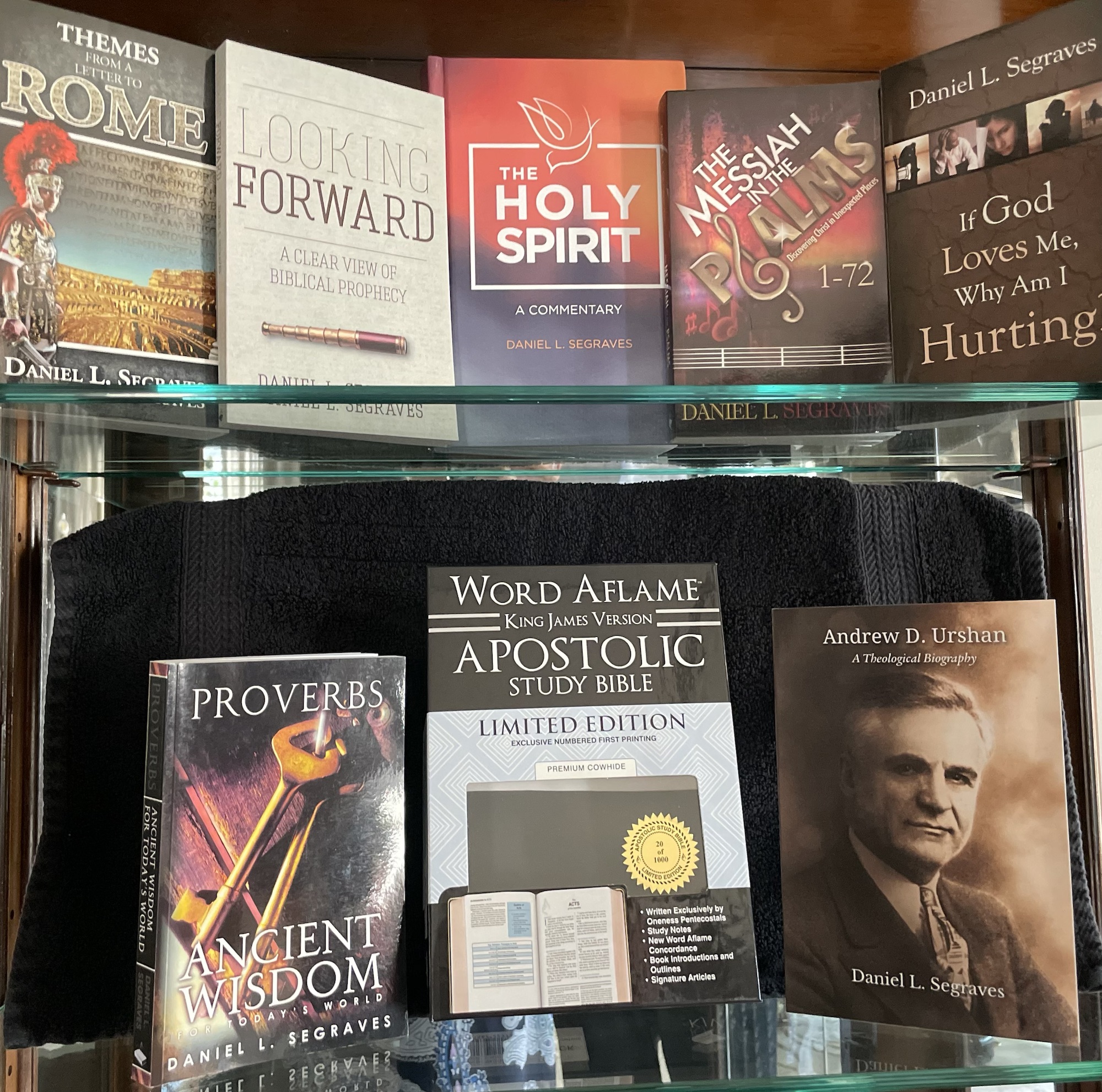
  • Daniel continues to research and write toward the completion of the second volume of his commentary on Psalms, titled The Messiah in the PsalmsDiscovering Christ in Unexpected Places.

[archive]


Answering questions from a member of the Church of Christ

About five weeks ago I received an email from a member of the Church of Christ. The writer said he had heard I would be “apt to answer some questions” he had about Oneness Pentecostal doctrine. The document attached to the email included questions calling for “true” or “false” responses and lists with possible answers to circle. I could not answer by these means, because the questions asked and the possible answers listed did not always allow for what I would consider correct answers. I found several questions to be repetitive (e.g., I responded to the questions in points H, I, J, K, and L in point F), and some questions assume views I don’t hold.

I responded to the document one month ago today, informing the person who sent the email of my plan to post the original document and my responses here on my website. The document and my responses appear below.


Questions 

  1. True or False (T/F)
  • There is relationship in the one Godhead.
  • There is no relationship in the one Godhead.

Response

This question requires defining what is meant by “Godhead.” The King James Version and related English translations render the Greek θεότητος and related words as “Godhead” three times (Acts 17:29; Romans 1:20; Colossians 2:9). Most English translations follow more closely to the essential meaning of these words, which includes “divinity,” “divine,” “divine nature,” or “deity.”[1] There is nothing in θεότητος to suggest more than one “person” or any kind of relationship in the divine nature. Colossians 2:9 points out that everything that makes God, God dwells bodily in Christ.

In the Incarnation, God added human existence to His unmitigated deity: “And without controversy great is the mystery of godliness: ‘God was manifested in the flesh, justified in the Spirit, seen by angels, preached among the Gentiles, believed on in the world, received up in glory” (I Timothy 3:16).[2] To understand this more fully, we can accurately paraphrase as follows: “God was manifested in the flesh, [God was] justified in the Spirit, [God was] seen by angels, [God was] preached (i.e., proclaimed) among the Gentiles, [God was] believed on in the world, [God was] received up in glory” (NKJV).

Although there is no indication of relationship in the word θεότητος, the manifestation of God in flesh (σαρκί [as a complete and authentic human being])[3] introduced relationship. This is a mystery, as Paul indicated. It is a mystery because the Incarnation is a miracle. By definition, miracles are mysterious. None can be explained by human reasoning. Anything that can be accurately comprehended and explained by the human intellect is no miracle.[4] The answer to our questions about miracles is, “For with God nothing will be impossible” (Luke 1:37).

The fullness of the Incarnation means God was manifest completely in all that is inherent to human existence, materially and immaterially (e.g., body, soul, spirit, mind, will, emotions, etc.). Whatever humans need to do, Jesus needed to do. Thus, He prayed, He ate, He slept, He grew weary, He rested, He fellowshipped with other people, and so forth. As any person can relate to God, Jesus related to God. In the miracle of the Incarnation, He did all that is intrinsic to human existence even while God was manifest in His body, soul, spirit, mind, will, emotions, and so forth. How this could be is beyond human comprehension; it is something, like any miracle, that must be accepted by faith. Attempts to explain how this worked will always err and result in compromises to Christ’s humanity and/or deity. Any discussion of relationship must take into consideration that Jesus was both God and man. He was not two persons. He is one person who at once is both fully God and fully human. His deity did not overwhelm or limit His humanity. His humanity did not compromise His deity.[5]

  1. In the light of: (1)  Bible teaching that Jesus is the Son of God (Matt 16:16; John 20:30-31) and (2) Your contention that the Godhead is comprised of only one person, answer true or false T/F below.
  • Jesus is the Father of the Father.
  • Jesus is the Father of the Son.
  • Jesus is the Father of the Holy Spirit.
  • The Son is the Father of the Father.
  • The Son is the Father of Jesus.
  • The Son is the Father of the Holy Spirit.
  • The Holy Spirit is the Father of the Father
  • The Holy Spirit is the Father of Jesus.
  • The Holy Spirit is the Father of the Son.
  • The Father and the Son are not distinct persons.
  • The Father is the Father of Jesus.

Response

Two things must be noted before discussion of the word “Father” as it pertains to the Messiah. First, my understanding of the English word “Godhead,” translated from θεότητος, is seen above. Qεότητος is about deity, not “persons.” Second, when discussing the word “person” in the context of trinitarian or binitarian assumptions, the word must be defined. Are we to think of “person” as the word is used in today’s English, or as it was used in the third century? Alister E. McGrath addresses this question as follows:

The word “person” has changed its meaning since the third century when it began to be used in connection with the “threefoldness of God”. When we talk about God as a person, we naturally think of God as being one person. But theologians such as Tertullian, writing in the third century, used the word “person” with a different meaning. The word “person” originally derives from the Latin word persona, meaning an actor’s face-mask – and, by extension, the role which he takes in a play.

            By stating that there were three persons but only one God, Tertullian was asserting that all three major roles in the great drama of human redemption are played by the one and the same God. The three great roles in this drama are all played by the same actor: God. Each of these roles may reveal God in a somewhat different way, but it is the same God in every case. So when we talk about God as one person, we mean one person in the modern sense of the word, and when we talk about God as three persons, we mean three persons in the ancient sense of the word. . . . Confusing these two senses of the word “person” inevitably leads to the idea that God is actually a committee . . . .[6]

Richard A. Muller points out that in theological usage, persona does not

have the connotation of emotional individuality or unique consciousness that clearly belongs to the term in contemporary usage. It is quite certain that the Trinitarian use of persona does not point to three wills, three emotionally unique beings or . . . three centers of consciousness; such implication would be tritheistic. . . . [T]he patristic, medieval, Reformation, and Protestant scholastic definitions of the term persona are united in their distinction from colloquial modern usage.[7]

As we have seen in our first response above, Jesus is God manifested in a human person.

None of the eleven propositions above reflect the biblical use of the word “Father” as it relates to the Messiah. These propositions assume that the “Godhead” consists of three “persons.” Instead, messianic prophecy uses “Father” of the Messiah in Isaiah 9:6: “For unto us a Child is born, unto us a Son is given; and the government will be upon His shoulder. And His name will be called Wonderful, Counselor, Mighty God, Everlasting Father, Prince of Peace.” The name theology of the Hebrew Scriptures means these names identify the Messiah. If we reject “Everlasting Father,” we shall also have to reject “Mighty God,” and so forth.

Isaiah had no trinitarian concept in view. He was not thinking of any notion expressed in the eleven propositions above.

James 1:17 may also refer to Jesus as the “Father of lights,” as discussed in my paper “James and First Century Jewish Christology.”

  1. When Jesus uses “I”, “Me”, “My”, and “Mine”, He refers to: (Circle the number)
  • The human nature (of Jesus) only.
  • The divine nature (of Jesus) only.
  • Both the human nature and the divine nature (of Jesus).
  • The human nature (of the Father) only.
  • The divine nature (of the Father) only.
  • Both the human nature and the divine nature (of the Father).

Response

As is always the case with language, words are defined by the context in which they are used. None of the six suggestions above is adequate to capture Jesus’ use of personal pronouns in every case, for Jesus was both God and human. He was God manifested in human existence, as declared by Paul in I Timothy 3:16 and discussed above.

Jesus did everything He did and said every word He spoke as who He was: God manifested in flesh. His deity and humanity cannot be fragmented so as to say or do some things as God only and other things as only a human being. For example, when Jesus said to Philip, “Have I been with you so long, and yet you have not known Me, Philip? He who has seen Me has seen the Father; so how can you say, ‘Show us the Father,” (John 14:9) He spoke as God manifested in a human being; when He said, “I thirst” (John 19:28), He spoke as God manifested in a human being.

In His incarnation, Jesus fully embraced all the consequences of His human existence; He shirked none.[8] (See Philippians 2:5-11.)

  1. According to John 1:1, 14 (Circle the number of each true statement)
  • The Word became flesh.
  • The Father became flesh.
  • The Holy Spirit became flesh.
  • Jesus became flesh.
  • God became flesh.
  • Deity became flesh.

Response

So far as it concerns the precise words of the six statements above, it is, of course, only the first that includes “Word became flesh” (John 1:14). John 1:1 tells us, “In the beginning was the Word, and the Word was with God, and the Word was God.” In I John 1:1-3, in an apparent response to first century Docetism, John wrote, “That which was from the beginning, which we have heard, which we have seen with our eyes, which we have looked upon, and our hands have handled, concerning the Word of life— the life was manifested, and we have seen, and bear witness, and declare to you, that eternal life which was with the Father and was manifested to us— that which we have seen and heard we declare to you, that you also may have fellowship with us; and truly our fellowship is with the Father and with His Son Jesus Christ.” In John and I John, logos is translated “word,” as in Revelation 19:13, also written by John.

In his first letter, John further developed “Word.” The “Word” of John is the “Word of life” of I John. The “Word” that was “with God” in John is the “eternal life which was with the Father” in I John. The “Word” that “became flesh” in John is the “eternal life” that “was manifested to us” in I John.

John warned, “Whoever denies the Son does not have the Father either; he who acknowledges the Son has the Father also” (I John 2:23). As already mentioned, John’s concern is with the error of Docetism, an error that denied the Incarnation. He wrote, “By this you know the Spirit of God: Every spirit that confesses that Jesus Christ has come in the flesh is of God, and every spirit that does not confess that Jesus Christ has come in the flesh is not of God” (I John 4:2-3).

Statement five above (i.e., God became flesh) is quite close to Paul’s “God was manifested in the flesh” (I Timothy 3:16), but the rest of the statements call for further definition (i.e., Deity became flesh), reflect trinitarian assumptions (i.e., The Father became flesh and The Holy Spirit became flesh), or assume the preexistence of the Messiah, Jesus, in a way other than that found in Philippians 2:5-11 (i.e., Jesus became flesh).[9]

A more fruitful treatment of John’s use of logos is to explore the use of the Aramaic Targums. Aramaic was the conversational language of first century Israel. The Targums were Aramaic translations of the Hebrew Scriptures. As John Ronning points out,

John’s decision to call Jesus “the Word,” the Logos (ὁ λόγος), was influenced by the Targums . . . many or most of which were prepared for recitation in the synagogue after the reading of the Hebrew text. In hundreds of cases in these Targums, where the MT refers to God, the corresponding Targum passage refers to the divine Word. Considered against this background, calling Jesus “the Word” is a way of identifying him with the God of Israel.[10]

The Targums make no contribution to the development of Trinitarian speculations over the centuries leading up to Chalcedon.

  1. According to John 5:31,32 and John 8:16-18 (Circle the number of each true statement)
  • There was only one witness.
  • Jesus was the only witness.
  • There were two witnesses.
  • One witness was sufficient.
  • Jesus was one witness and the Father was another witness.
  • Jesus was not alone.
  • The law required two witnesses.
  • According to the law one witness was sufficient.

Response

“If I bear witness of Myself, My witness is not true. There is another who bears witness of Me, and I know that the witness which He witnesses of Me is true” (John 5:31-32).

And yet if I do judge, My judgment is true; for I am not alone, but I am with the Father who sent Me. It is also written in your law that the testimony of two men is true. I am One who bears witness of Myself, and the Father who sent Me bears witness of Me” (John 8:16-18).

John 5:31-32, 36-37 and John 8:13-19 do not indicate more than one divine Person in the Godhead.  The point of the requirement in the law for two or three witnesses was that they had to be independent witnesses with the potential of giving conflicting testimony.  This was for the protection of an innocent person falsely accused.  There would be no possibility of “Persons” in the Godhead giving independent testimony.  Had this been possible, and if the Son were an eternally distinct “Person” from the Father, each could give independent testimony at any time before and after the Incarnation.

The idea of coinherence in the historic doctrine of the Trinity,[11] which means that all three “Persons” mutually interpenetrate each other and participate in the actions of any one “Person,”[12] prohibits the possibility that the Son could be a witness distinct from the Father.[13]  Also, we would ask why the Holy Spirit is not mentioned as a third witness. The meaning of these texts is that Jesus, due to His humanity, was one witness.  His Father was another witness.  But, as John 8:19 indicates, to know Jesus is to know the Father, because God was manifest in the Son (see also John 14:5-11).

If the Son were separate and distinct from the Father so as to be able to give independent and at least theoretically conflicting testimony from the Father, we shall have to abandon monotheism and take up ditheism. If the Holy Spirit is a third separate and distinct “Person,” who could also give independent testimony, it will be tritheism we must embrace.

When Scripture speaks of God as Father, it speaks of God in His transcendence, above and beyond the realm of creation. When it speaks of the Son of God, it has in view God as He is manifested in human existence. When it speaks of the Holy Spirit, it refers to God in His immanence, omnipresence, with us, among us, and in us. But there is only one God. The God we know as Father is the same God who is manifested in flesh and who dwells within us. There are not three Gods. Since Jesus was a human being, He spoke as a human being, but as a human being who was God manifested in human existence, with all of the consequences we can understand and those we cannot comprehend. The Incarnation retains the mystery of which Paul wrote.

  1. In light of your contention as to the obligatory nature of a formula to be stated in connection with water baptism, in regard to the passages stated below, please indicate (Circle the correct answer) whether we are told: What to do or What to say.
  • Acts 2:38 What to do.                        What to say.
  • Acts 8:16 What to do.                        What to say.
  • Mark 9:39 What to do.                        What to say.
  • Matt 18:5 What to do.                        What to say.
  • Mark 9:41 What to do.                       What to say.
  • Acts 19:5 What to do.                       What to say.
  • Acts 10:48 What to do.                       What to say.
  • Col 3:17      What to do.                       What to say.

Response

I have no “contention” as to the obligatory nature of a precise formula to be stated in connection with water baptism.” I do contend, however, that throughout the Book of Acts and the epistles, water baptism is always seen as identifying the believer with Jesus Christ. This is also true of Matthew 28:19. Anything that falls short of this is not in harmony with New Testament doctrine and practice.

On the Day of Pentecost, Peter responded to the question, “What shall we do” with these words: “Repent, and let every one of you be baptized in the name of Jesus Christ for the remission of sins; and you shall receive the gift of the Holy Spirit” (Acts 2:38). In Samaria, the believers had “been baptized in the name of the Lord Jesus.” When speaking to Cornelius, his family, and his close friends, Peter “commanded them to be baptized in the name of the Lord” (Acts 10:48). This is the reading of the NKJV, but the older manuscripts read “in the name of Jesus Christ.” At Ephesus, the disciples of John, after hearing Paul, “were baptized in the name of the Lord Jesus” (Acts 19:5).

To the church at Rome, Paul wrote, “Or do you not know that as many of us as were baptized into Christ Jesus were baptized into His death? Therefore we were buried with Him through baptism into death, that just as Christ was raised from the dead by the glory of the Father, even so we also should walk in newness of life” (Romans 6:3-4).

In his letter to the Galatians, Paul wrote, “For as many of you as were baptized into Christ have put on Christ” (Galatians 3:37).

In his rebuke for the favoritism shown by the Corinthians, Paul wrote, “Is Christ divided? Was Paul crucified for you? Or were you baptized in the name of Paul? I thank God that I baptized none of you except Crispus and Gaius, lest anyone should say that I had baptized in my own name” (I Corinthians 1:13-15). Paul’s point is that we are baptized in the name of the One who was crucified for us.

Baptism in the name of Jesus is called for even in Matthew 28:19: “Go therefore and make disciples of all the nations, baptizing them in the name of the Father and of the Son and of the Holy Spirit.” The grammar of the text reveals that it is a singular name into which we are to be baptized. Jesus did not say, “Into the names.”

Jesus’ Jewish disciples knew that the name by which God revealed Himself in the Old Testament was Yahweh [rendered Lord in many English translations], the third person singular form of hayah, the Hebrew “to be” verb. They also knew that the Holy Spirit is referred to as the Spirit of Yahweh in the Hebrew Scriptures. And they knew that the name “Jesus” was a transliteration of “Yahweh-Savior” or “Yahweh will save.”[14]

Baptism does involve the invocation of the name of Jesus. It is indispensable to Christian initiation. Murray J. Harris discusses the various prepositions used with baptizō. Concerning the use of eis in the phrase εἰς ἄφεσιν τῶν ἁμαρτιῶν, he remarks,

            From the book of Acts we may deduce that there are five components in the brief or prolonged process of Christian initiation—repentance, faith, baptism, forgiveness of sins, and receipt of the Spirit. Each element is an essential ingredient in the whole, which forms a single conceptual unity. Accordingly, when any one or two elements are mentioned in Scripture, apparently in isolation, the others are presupposed. For example, in Ac 16:31, 33 (“Believe in the Lord Jesus, and you will be saved—you and your household . . . he and all his family were baptized”), the Philippian jailer’s repentance is presupposed and presumably his being “saved” involved forgiveness and receipt of the Spirit. Similarly, in 1 Peter 3:21 (“baptism now saves you”) the readers are assumed to have experienced the other four aspects of Christian initiation.

            In seeking to formulate the relation between the five elements, we are probably wiser to speak in terms of concomitance rather than causation . . . since salvation from first to last results from God’s action. But whereas repentance and faith are prerequisites for receiving forgiveness and the Spirit (cf. Ac 20:21), baptism seems to be a natural and necessary concomitant of repentance and faith and therefore of the receipt of forgiveness and the Spirit.[15]

In a further discussion of the phrase εἰς τὸ ὄνομa, Harris says, “Since the salvific work of Jesus is inextricably linked to his name, ‘to baptize into the name of the Lord Jesus’ means to endow a person through baptism with the benefits of the salvation accomplished by Jesus Christ.”[16] In addition, he notes, “It is a remarkable fact that the NT records no case of baptism in the triune name, only of baptism ‘into the name of the Lord Jesus’ (Ac 8:16; 19:5) or ‘in the name of Jesus Christ’ (2:38; 10:48).”[17] This “may reflect the fact that in the baptismal ceremony, ‘the name of Christ is pronounced, invoked and confessed by the one who baptises or the one baptised (Acts 22:16) or both” (A. Oepke, TDNT 1:539-40).[18]

Finally, in a discussion of the use of the function of the prepositions in the phrase en/epi tō onomati, Harris concludes, “when these two expressions are used with βαπτίζω in the NT, no distinction between them should be pressed: both mean “in the name of” = “with use of the name of”/“while naming the name of” (cf. BDAG 713a, 713d—14a), referring to the baptismal candidate’s calling on the name of Jesus Christ in a confession of faith and also on the administrant’s invocation of Jesus as the authenticating authority for and witness to the rite.”[19]

Any of the baptismal events conducted by first century believers and recorded in their acts (as in the Book of Acts) provide trustworthy examples of how baptism should be accomplished, both as to the practice of immersion and appropriate words to be spoken. James wrote in what may well be a reference to baptism, “Do they not blaspheme that noble name by which you are called?” (James 2:7).  The aorist passive form of ἐπικληθὲν (called) is recognized by many English translations to mean a specific name had been called over the believers to whom James wrote. For example: “that was invoked over you” (NAB; NRS); “which has been pronounced over you” (NJB); “which was invoked over you” (RSV); “that was called upon you” (YLT); “spoken over you at your baptism” (CEB).

We are to do all things, whether “in word or deed,” in the name of the Lord Jesus, giving thanks to God the Father through Him (Colossians 3:17). This does not suggest that we vocalize the words “in the name of the Lord Jesus” before or after every word we speak or every deed we do.

One of the most important matters in biblical interpretation is context. Context influences meaning. In the case of Mark 9:39, 41; Matthew 18:5, and Colossians 3:17, baptism is not near in the context. The phrase “in the name of” someone can have a variety of meanings, included, but not limited to, “on behalf of” that person, “by the authority of” that person, “resting on” that person, “devoted to” that person, “into the possession and protection of” that person, “in according with the character” of that person, “in accord with the mind” of that person, “in according with the purpose” of that person.[20]

The context of Acts 2, however, is influenced by Joel 2:32: “And it shall come to pass that whoever calls on the name of the Lord shall be saved.” (See Acts 2:21.) After quoting from Joel and Psalm 16 to proclaim the resurrection of Jesus, Peter said, “God has made this Jesus, whom you crucified, both Lord and Christ” (Acts 2:36). This profound proclamation, identifying the One upon whose name a person must call, provoked Peter’s hearers to say, “Men and brethren, what shall we do?” (Acts 2:38).

There is no biblical record of the precise words each of the some 3,000 believers prayed in their repentance, but we can be sure their repentant prayers included calling on the name of the Lord just revealed to them in the person of Jesus Christ. As Ananias later said to the newly converted Saul, “Arise and be baptized, and wash away your sins, calling on the name of the Lord” (Acts 22:16). The name of the Lord upon whom Saul called was the same as the name of the Lord upon whom the new believers called in Acts 2. Indeed, when Saul was struck to the earth on the road to Damascus, he said, “Who are You, Lord?” The Lord answered, “I am Jesus” (Acts 9:5).

Paul himself linked Joel 2:32 with the experience of salvation in Romans 10:13: “Whoever calls on the name of the Lord shall be saved.” In this context, he wrote, “If you confess with your mouth the Lord Jesus and believe in your heart that God has raised Him from the dead, you will be saved.” Paul does not exclude baptism from Christian initiation. He was himself baptized, and he baptized many. (See Acts 9:18; 16:33; 18:8; 19:1-5; 22:16.)

But it is not only the new believer who must call on the name of the Lord, so must the prophetic person who speaks on God’s behalf to accomplish the act of baptism. Again, we must keep in mind the fact that those upon whom the Spirit came on the Day of Pentecost were enabled to prophesy (Acts 2:17-18). To prophesy, by definition, is speak on behalf of God. (See, e.g., Acts 2:20-31.) Those who heard Peter’s sermon recognized him and the others present as prophetic people who could, on God’s behalf, tell them what to do.

Peter’s perspective was the perspective of the Hebrew Scriptures, as seen in his use of the Scriptures in his sermon. The phrase “in the name of” recalls one of the earliest biblical prophets, Moses, who, in prayer, said to the Lord, “I came to Pharaoh to speak in Your name” (Exodus 5:23). When commissioned, the Lord had told Moses, “You shall say to Pharaoh, ‘Thus says the Lord: “Israel is My son, My firstborn” (Exodus 4:22). To speak in the name of the Lord requires vocalizing the Lord’s name. Thus, when Moses (or Moses’ brother Aaron, who spoke on Moses’s behalf [Exodus 4:15-16]) spoke to Pharaoh in the name of the Lord, he said, “Thus says the Lord” (Exodus 4:22).

The point is that, in the Septuagint translation of the Hebrew Scriptures, the phrase translated “in Your name” is ἐπὶ τῷ σῷ ὀνόματι. In Acts 2:38, Peter similarly said, “ἐπὶ τῷ ὀνόματι Ἰησοῦ Χριστοῦ [in the name of Jesus Christ].” In Moses’s encounter with Pharaoh, to do something in the name of the Lord involved speaking the name of the Lord. Likewise, to baptize someone in the name of the Jesus involves speaking the name of Jesus Christ. There is biblical evidence of this in both the Old and New Testaments, and there is no suggestion in the Book of Acts that baptism was performed without calling on the name of Jesus. There is no testimony of a silent baptism.

For example, when Peter and John ministered healing to a certain lame man at the gate Beautiful, Peter said, “In the name of Jesus Christ of Nazareth,” rise up and walk (Acts 3:6). This event, following shortly after the Day of Pentecost, demonstrates what Peter meant when he said, “Be baptized in the name of Jesus Christ.”

  1. The formula which the administrator of baptism must say when he is baptizing (immersing) someone in water is _________________________________________________________ _________________________________________________________________________________________

And that formula is stated exactly in (Circle the correct answers)

Matt 28:18-20                                 Acts 2:38                              Acts 8:16

Acts 10:48                                        Acts 19:5                              Some other passage _____________________

Response

See the response to point F above. Any of the words spoken in the Book of Acts in Christian baptism are acceptable. There we see “Jesus Christ” and “Lord Jesus.” As pointed out above, translations that follow the tradition of the KJV have “Lord” in Acts 10:48,” but the more ancient manuscripts read, “Lord Jesus.” There is no biblical evidence for Christian baptism that does not call on the name of Jesus. Even in the reading “Lord” in later manuscripts of Acts 10:48, it is understood contextually from Peter’s sermon that the Lord is Jesus (Acts 10:36).

As it relates to my personal practice, I have always baptized believers “in the name of the Lord Jesus Christ.”

  1. The expression “in the name of” (Circle the number of all true statements)
  • Always demands the recitation of a formula.
  • Demands the recitation of a formula on some occasions, but not on other occasions.
  • Never demands the recitation of a formula.

Response

See the response to point F above.

  1. Circle the numbers of the correct statements below
  • To be saved one must repent in the name of Jesus Christ.
  • To be saved it is not necessary to repent in the name of Jesus Christ.

Response

See the response to point F above.

  1. The formula which must be spoken by the administrator when baptizing someone is ( Circle the correct answer(s) )
  • “….in the name of Jesus Christ”
  • “….in the name of the Lord Jesus”
  • “….in the name of the Lord”
  • “….in the name of the Lord Jesus Christ”

Response

See the response to point F above.

  1. Of the 4 following passages that mention baptizing “in the name of….” (Acts 2:38, Acts 8:16, Acts 10:48, Acts 19:5) who baptized correctly? (Circle the number)
  • Peter on Pentecost
  • Philip in Samaria
  • Peter in Caesarea
  • Paul in Ephesus

Response

See the response to point F above.

  1. Based on Acts 2:38, “…repent and be baptized every one of you in the name of Jesus Christ…” are the following statements true? (Circle the number of the true statements)
  • The command to repent and the command to be baptized are joined by the conjunction “and”.
  • This conjunction demands that both repentance and baptism be in the name of Jesus Christ.
  • Therefore, if to be baptized “in the name of Jesus Christ” means reciting a formula, then a formula must be recited when one repents “in the name of Jesus Christ”.

Response

See the response to point F above.


[1] In Colossians 2:9, the NET, NIB, NIV, NRS, RSV, and CEB translate θεότητος as “deity,” the NIRV as “nature,” the NJB as “divinity,” and the NLT as “God.”

[2] Unless otherwise noted, all translations quoted in this paper are from the New King James Version (NKJV).

[3] See Louw-Nida Lexicon, 8.1-8.8. The sin “nature” is not inherent in human existence. Both Adam and Eve were humans before their fall into sin. Jesus was spared this mar on human existence by virtue of His conception by the Holy Spirit in the womb of the virgin Mary. Although Jesus partook “of flesh and blood” (Hebrews 2:14) and was tempted, He was without sin (Hebrews 4:15). He “knew no sin” (II Corinthians 5:21). The genuineness of His humanity was not compromised in any way.

[4] Mary had her own question about this. When Gabriel told her she would conceive in her womb and bring forth a Son, she asked, “How can this be, since I do not know a man?” Gabriel answered, “The Holy Spirit will come upon you, and the power of the Highest will overshadow you; therefore, also, that Holy One who is to be born will be called the Son of God . . . . For with God nothing will be impossible” (Luke 1:31-37).

[5] A more complete discussion of this is seen in my paper, “Philippians 2:5-11: Greek Exegesis.”

[6] Alister E. McGrath, Understanding the Trinity (Grand Rapids, MI: Zondervan, 1988), 130-31.

[7] Richard A. Muller, Dictionary of Latin and Greek Theological Terms (Grand Rapids, MI: Baker, 1985), 226.

[8] A more complete discussion of this is seen in my paper, “Philippians 2:5-11: Greek Exegesis.”

[9] A more complete discussion of this is seen in my paper, “Philippians 2:5-11: Greek Exegesis.”

[10] John Ronning, The Jewish Targums and John’s Logos Theology (Grand Rapids, MI: Baker Academic, 2010), 1.

[11] Other theological terms expressing the same idea as “coinherence” include “circuminsession,” “perichoresis,” and “interpenetration.”

[12] As the concept of perichoresis pertains to Christology, Jürgen Moltmann, for instance, “contends that because of the perichoresis of the divine in the human it can and must be affirmed that God suffered in the death of Christ” (Walter A. Elwell, ed., Evangelical Dictionary of Theology [Grand Rapids, MI: Baker, 1984], s.v., “Perichoresis”).

[13] For example, Karl Barth said, “The divine modes of being mutually condition and permeate one another so completely that one is always in the other two” (quoted by S. M. Smith in Walter A. Elwell, ed., Evangelical Dictionary of Theology [Grand Rapids, MI: Baker, 1984], s.v., “Perichoresis”.) See also Millard J. Erickson, Christian Theology (Grand Rapids: Baker, 1985), 335-36 and Donald K. McKim, The Westminster Dictionary of Theological Terms, Second Edition, Revised and Expanded. (Louisville, KY: Westminster John Knox Press, 2014), 234.

[14] This is explained in Daniel L. Segraves, The Messiah’s Name: JESUS, Not Yahshua (N.P.

[15] Murray J. Harris, Prepositions and Theology in the Greek New Testament (Grand Rapids, MI: Zondervan, 2012), 227-28.

[16] Harris, Prepositions and Theology, 229.

[17] Harris, Prepositions and Theology, 229.

[18] Harris, Prepositions and Theology, 229.

[19] Harris, Prepositions and Theology, 232.

[20] See R. Youngblood, “Significance of Names in Bible Times,” Evangelical Dictionary of Theology, Walter A.  Elwell, ed. (Grand Rapids, MI: Baker), 750) and Harris, Prepositions and Theology, 232.

(c) 2019 by Daniel L. Segraves[archive]
A delightful conversation with Bishop Billy McCool

This morning I remembered an oral family tradition passed down to me concerning my grandfather, L. D. [Lewis Dudley] Segraves. The story included my grandfather’s role in the life of Billy and Bobby McCool in 1948, when they were eleven year old twins in Southeast Missouri.

I had heard that grandpa baptized Billy and Bobby in Jesus’ name and that he personally picked them up for Sunday school when he was serving as pastor at what was then known as the Apostolic Assembly of Jesus Christ in Kennett, Missouri. Today, I had an impression that I needed to do what I could to verify this tradition, and I needed to do it now.

I know Pastor Mark McCool of the First Apostolic Church in Knoxville, Tennessee, a church planted in 1957 by his father, Billy. Mark is the First Assistant General Superintendent of the Assemblies of the Lord Jesus Christ and a member of the board of directors of Urshan College and Urshan Graduate School of Theology, from which I recently retired. I was able to reach him as he was traveling, and he offered to ask his father to call me.

What a joy it was to hear Bishop McCool, now 82 years old, recount his history and my grandfather’s role in it! 

As young boys, Billy and Bobby lived with their family off of Missouri Route 84 between Haiti and Kennett. Their home was about fifteen miles east of Kennett. Their father was a sharecropper, and they were quite poor. They had no automobile, and the boys hitchhiked to church services. They had no “dress up” clothes, wearing overalls and inserting cardboard into their shoes to cover up the holes in the soles. 

Their mother and grandmother had embraced Oneness Pentecostalism with its attendant practice of baptism in Jesus’ name, but they knew of no Oneness church near them. Billy was baptized with the Holy Spirit at a Trinitarian Pentecostal church in Pascola, a small village in Pemiscot County, Missouri. He felt God had called him to preach, and he delivered his first sermon at a Trinitarian Pentecostal church in Braggadocio, Missouri, also in Pemiscot County, dressed in his overalls, a red flannel shirt, and one of his father’s neckties.

In 1948, the church in Kennett pastored by my grandfather began a tent revival that lasted for nine weeks. C. R. Young was the evangelist. The tent was erected in the 1000 block of First Street, and attendance averaged from 500 to 2,000 people nightly, with the highest attendance for a single service at approximately 4,000. Word spread far and wide of this event as people were healed of deafness, blindness, cancer, and goiter, to mention but some of the miracles that occurred. About 223 people were baptized in water in the name of Jesus, and some 150 were baptized with the Holy Spirit.

Among the 223 baptized were Billy and Bobby McCool. They heard of the revival and wanted to go to be baptized. Their mother was reluctant to let them go, because she felt they did not have appropriate clothing. The boys responded, “Unless you forbid us, we want to go!” They hitchhiked to Kennett and were baptized on the same day as Norman Luna. C. R. Young personally baptized them, but Bishop McCool emphasized to me that this was under the pastoral direction of my grandfather Segraves.

My grandpa took a keen interest in Billy and Bobby, recognizing God’s call on their lives. Observing their dress, he collected an offering to buy new shoes for them. When the boys returned home that night, they learned that their parents had no money to buy fuel for their kerosene stove. They had not told their parents about the money for shoes, but they gave the funds to their mother and father for the purchase of the needed fuel.

The next night, when Billy and Bobby arrived for the tent meeting, wrapped packages were waiting for them on the platform. My grandfather called them up and presented the packages to them, which included new khaki pants and shirts to match. They were also given more money to buy the shoes they needed. Up until this point they had worn only overalls.

Others baptized during this remarkable revival included Billy’s and Bobby’s sister, Ola, and her husband, Carl Denny. My grandfather baptized Carl and Ola on the night of their wedding. Carl and Ola had been playing and singing in a bluegrass band called “Chuck Gray and the Mountaineers.” The band had a radio program on KBOA, a station located in Kennett. Mac and Norman Luna, a talented husband and wife team, also played guitar and mandolin and sang in the band. Chuck, who played the banjo,  was suffering from bleeding ulcers.  When his life was transformed during the revival, he renamed the band “Chuck Gray and the Sunnyside Gospel Singers.”

Bishop McCool has had a long and fruitful ministry. He has been preaching for seventy-one years and still believes as he did when he began proclaiming the gospel at the age of eleven. He credits my grandfather with giving him and his brother their first exposure as young preachers of the gospel. Remembering that grandpa drove a Studebaker and had a gold front tooth, he said grandpa was “like Moses” to them, and that he probably picked them up and brought them to Sunday school. He affectionately referred to grandpa as “Uncle Dudley, a dear patriarch and man of God in our lives.”

My heart rejoices to hear of grandpa’s role in helping two young preachers get their start in ministries that have positively influenced many thousands of people.[archive]

The Messiah in the Psalms Lesson 4

Psalms

September 24, 2017

The Sanctuary | Hazelwood, Missouri

By Daniel L. Segraves[1]

The placement of Psalm 1 makes it an obvious introduction to the entire Psalter. It pronounces a blessing on “the man who walks not in the counsel of the ungodly, nor stands in the path of sinners, nor sits in the seat of the scornful” (Psalm 1:1), imply­ing that walking in the counsel to be found in the Book of Psalms is the source of blessing.

Psalm 1 is known as a Torah, or law, psalm, because it describes the blessed man as one who delights “in the law of the Lord” and who meditates “in His law . . . day and night” (Psalm 1:2). The word torah means “instruction,” and it is used (as is its New Testament equivalent, nomos) with a variety of mean­ings. Here, it is apparently not a reference to the Law of Moses, but to the psalms themselves. In other words, Psalm 1:2 does not mean that the reader would be better off meditating on the law of Moses than in the psalms! The psalms offer wise instruction and godly counsel.

Psalm 1, a Torah psalm, is connected conceptually with Psalm 2, a royal, messianic psalm. This is a pattern in the Psalter. Psalm 19, another Torah psalm (see Psalm 19:7-8), is connected with Psalms 20-21, royal, messianic psalms (see Psalm 20:6). Psalm 119, a Torah psalm (see Psalm 119:1 [the word “law” appears in Psalm 119 twenty-five times]), is connected to the section of psalms known as Songs of Ascents (Psalms 120-134), with their royal, messianic focus (see Psalm 132:10-18). For the Torah psalms to be attached to royal, messianic psalms in this way follows an ancient method of interpretation by attachment. In other words, to attach the messianic psalm to the Torah psalm serves to provide interpretation for the Torah psalm. The concept of law must be interpreted in connection with the concept of the Messiah.

Psalm 1 begins by pronouncing a blessing upon the person who delights in the law (torah, “instruction,” a reference here to Scripture) of the Lord (Psalm 1:2); Psalm 2 ends by pronouncing a blessing on all who put their trust in the Son, the Messiah (Psalm 2:12b). The idea presented here is that meditation upon the Scripture leads to trust in the Messiah. The word translated “trust” (chasah) is used in the Old Testament with the same essen­tial meaning as the New Testament words “faith” and “believe.” The meaning of chasah is “to take refuge.” This helps us under­stand the New Testament pistis (“faith”) and pisteuo (“I believe”), which are used essentially as synonyms for the Old Testament “trust.” Both New Testament words have to do with trust.

Contrary to a view that arose during the twentieth century, biblical faith is not about some kind of mental perspective, manipulation, or gymnastics by which one cajoles God into ful­filling one’s desires. Faith is not, in the strictest sense, a way of thinking. It is trust in God in the sense of taking refuge in Him in time of trouble and believing Him to be who He claims to be and to do what He promises to do.

The “counsel of the ungodly . . . the path of sinners . . . the seat of the scornful” (Psalm 1:1) is a series of terms further described in Psalm 2:1 as plotting “a vain thing.” The “counsel of the ungodly” is seen in Psalm 2:2 as “the rulers take counsel together, against the LORD and against His Anointed [the Messiah].” It is ungodly counsel that leads kings and rulers to say, “Let us break Their bonds in pieces and cast away Their cords from us” (Psalm 2:3).

Psalm 1 declares of the ungodly that they are “like the chaff which the wind drives away. Therefore the ungodly shall not stand in the judgment, nor sinners in the congregation of the righteous. . . . the way of the ungodly shall perish” (Psalm 1:4-6). According to Psalm 2, this happens because “He who sits in the heavens shall laugh; the LORD shall hold them in deri­sion. Then He shall speak to them in His wrath, and distress them in His deep displeasure” (Psalm 2:4-5). The Messiah will “break them [the nations that follow ungodly counsel] with a rod of iron . . . [and] dash them to pieces like a potter’s vessel” (Psalm 2:9). The Son will be angry with those who do not kiss Him—as an act of respect and homage—and they will “perish in the way, when His wrath is kindled but a little” (Psalm 2:12).

The person who rejects the ungodly counsel that encourages people to cast off loyalty to the Lord and His Messiah and who instead delights and meditates in the Scripture will, in contrast to the fate of those who rebel, “be like a tree planted by the rivers of water, that brings forth its fruit in its season, whose leaf also shall not wither” (Psalm 1:3). The wise man is like a healthy, fruitful, enduring tree. The man who follows ungodly counsel is like chaff. The wind will drive him away; he will perish. (See Psalm 1:6; 2:12.)

The response of the Lord to those who follow ungodly coun­sel is to laugh and to hold them in derision (Psalm 2:4). In wrath, He will speak to them and distress them. The distressing proclama­tion the Lord makes to those who seek to rebel is this: “Yet I have set My King on My holy hill of Zion” (Psalm 2:6). In their desire to cast off the authority of the Lord and His Messiah, the people are plotting “a vain thing” (Psalm 2:1). It is vain because God has set His king, the Messiah, on Zion. The plotting of the ungodly will do nothing to change that. He will not neglect the covenant He made with David. (See II Samuel 7:8-17; Psalm 89:34-37.)

The Messiah says, “I will declare the decree: The LORD has said to Me, ‘You are My Son, today I have begotten You. Ask of Me, and I will give You the nations for Your inheritance, and the ends of the earth for Your possession. You shall break them with a rod of iron; You shall dash them to pieces like a potter’s vessel’ ” (Psalm 2:7-9).

The idea of the Messiah as the “begotten Son” is an important theme in the New Testament. In some cases, the New Testament quotes Psalm 2:7 directly (Acts 13:33; Hebrews 1:5; 5:5), but there are allusions to Psalm 2:7 as well (John 1:14, 18; 3:16, 18; I John 4:9). If the words of Psalm 2 were ever used in conjunction with the ascension of one of David’s descendants to the throne, that merely human king would have, in that context, been considered “the anointed” and the “begotten son.” But the purpose for the place­ment of this psalm in the Psalter was not to preserve ascension for­mulas, but to point to the ultimate anointed One, the Son of God.

The only wise response for the rulers of the earth was to “be instructed . . . serve the LORD with fear, and rejoice with trem­bling” and to “kiss the Son” (Psalm 2:10-12). They should aban­don their vain attempt to rebel and should rather put their trust in the Messiah. If they would abandon their ungodly counsel and meditate in Scripture, this was what they would do.

Psalms 1-2 introduce the contrast between the “righteous” (tsaddiq) and the “ungodly” (rasha) that continues throughout the Psalter.

The early church saw Psalm 2 as being fulfilled in the actions of Herod, Pontius Pilate, and the unbelieving Gentiles and Jews. (See Acts 4:24-28.)

[1] The content of this lesson is from Daniel L. Segraves, The Messiah in the Psalms: Discovering Christ in Unexpected Places (Hazelwood, MO: WAP Academic, 2007), 25-28.