I post papers I have written, some during my graduate and post-graduate studies, some in response to other papers, and some written for other purposes like Sunday school classes or Bible studies. I also post observations on whatever comes to my mind and videos from teaching sessions.
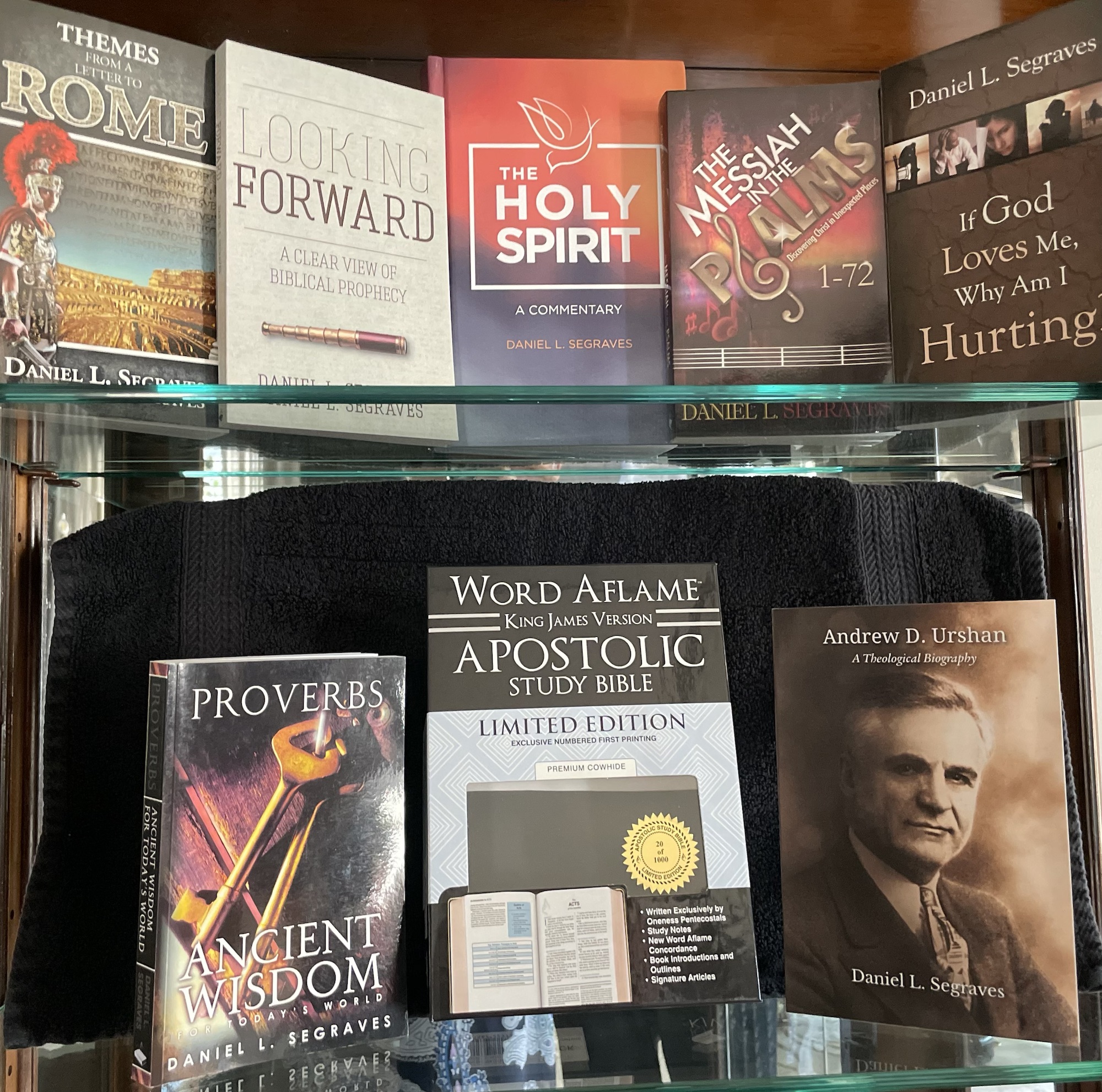
Today I discovered that my newest book, The Messiah in the Psalms, volume 2, is available both in paperback ($18.99) and eBook ($9.99) formats at pentecostalpublishing.com.
I appreciate all who are interested in this, my twenty-third book, and I look forward to meeting those who come to my booksigning next Thursday at 9:15 p.m. at the 80th anniversary of the United Pentecostal Church International in St. Louis, Missouri.
I was pleased this morning to see my new book listed among “Newest Releases” at pentecostalpublishing.com. This 256-page work includes 384 endnotes (see below) and explores in depth the witness to Jesus Christ in Psalms 73-106. I have agreed to be available for book signings at the upcoming eightieth general conference of the United Pentecostal Church International. Next Thursday, September 25, at 9:15 p.m. I plan to be at the Pentecostal Publishing House display to meet and sign books for “all who yearn to discover how the Scriptures testify of Jesus.”
Who wants to read footnotes?
Some readers have no interest in wading through footnotes. When they appear at the bottom of a page, they see this as a sign that the book is not for them! Others love the notes and head to them first, figuring that’s where the vital information is found.
Recognizing the aversion some people have to notes, many publishers place them in the back of the book as endnotes. This way, the information is preserved for those who want it, but others who fear getting bogged down can nevertheless enjoy and profit from the book’s major content.
My book follows this approach. If you’re not interested in notes, you’ll never see them. But if you love them, as I do, head to page 225, and you can savor thirty-one more pages of insight.
For instance, at the end of eleven pages that examine Psalm 81, the final paragraph reads: It would be impossible to describe the miraculous mystery of the Incarnation more fittingly than in Paul’s words in I Timothy 3:16: “And without controversy great is the mystery of godliness: God was manifested in the flesh, justified in the Spirit, seen by angels, preached among the Gentiles, believed on in the world, received up in glory” (NKJV). In knowing Jesus, we know the Creator Himself. This wondrous truth is rooted in the very first verse of the Bible.
But wait. This paragraph points to two endnotes offering more information on I Timothy 3:16. Here they are: Footnote 151: “Instead of ‘God,’ some English translations read ‘He,’ ‘He Who,’ ‘Who,’ or ‘which.’ This is because these translations follow a Greek variant that appears only in a few manuscripts. One translation even reads ‘Christ’ instead of God. No Greek manuscript includes ‘Christ’ in I Timothy 3:16. The great majority of Greek copies have ‘God,’ which is seen in the KJV, NKJV, and other translations.”
And finally, Footnote 152: “The Greek text of I Timothy 3:16 could be legitimately read as follows: ‘God was manifested in the flesh, [God was] justified in the Spirit, [God was] seen by angels, [God was preached (i.e., proclaimed)] among the Gentiles, [God was] believed on in the world, [God was] received up in glory.” This is because each of these verbs (i.e., manifested, justified, seen, preached, believed on, and received up) is in the aorist passive indicative form. ‘God’ is the noun subject to which each of these verbs refers.
So what do you think? Is it worth it to look a bit further?
Since July 1, 2018, I’ve been working on the second volume of my commentary on the Book of Psalms. The first volume, titled The Messiah in the Psalms: Discovering Christ in Unexpected Places, was released in 2007. It covered Psalms 1-72, which comprise Books One and Two of the Psalter.
What took me so long to finish the second volume? Well, I put my work on Psalms on the back burner for a while to write another book titled The Holy Spirit: A Commentary, which in 314 pages explores nearly every reference to the Holy Spirit from Genesis 1:2 through Revelation 22:17. This book was published in 2020.
I contributed a chapter to Oneness Pentecostalism: Race, Gender, and Culture, a book published by The Pennsylvania State University Press in 2023. This book was edited by Lloyd D. Barba, Andrea Shan Johnson, and Daniel Ramirez. My chapter is titled “Andrew D. Urshan: An Eastern Voice in Early Oneness Pentecostalism.”
I also wrote a chapter titled “James and First Century Jewish Christology,” which is scheduled to be published in an early high Christology project together with research by other contributors. Jeffrey Brickle, Ph.D., is the editor of this pending volume.
I’m not immediately certain how many articles I have written since July 1, 2018, for the Pentecostal Herald and Pentecostal Life, along with lesson material for God’s Word for Life. In quite another dimension of ministry, I taught a professional development session for interested members of the general board of the United Pentecostal Church International at the request of Dr. Brent Coltharp, president of Urshan University and Urshan Graduate School of Theology.
There was also the course I taught to students of the French Bible Institute at the invitation of missionary John Nowacki. This required a flight to Paris together with my wife, Susan. An event that occurred during this trip inspired me to write the book The Holy Spirit. I have explained that in another post.
So I have probably provided a sufficient explanation of why volume two of The Messiah in the Psalms: Discovering Christ in Unexpected Places has taken so long to arrive. I would like to make some comments about the new book.
The second volume of my work on Psalms covers the section of the Psalms known as Books Three and Four. Book 3 comprises Psalms 73 through 89, and Book 4 comprises Psalms 90 through 106. There are at least eighteen references to these psalms by those who wrote the New Testament. Numbers of these references are understood by the New Testament to be specifically about the Messiah.
Significantly, the Aramaic word Memra (i.e., “Word”) appears fifty times in these psalms. In at least fifteen cases, the Targums use Memra as a surrogate for the Hebrew Yahweh, which is usually rendered LORD in English translations. This is given considerable examination in view of the use of Logos (i.e., Word) in John 1:1.
I am scheduled to be available for a book signing on Thursday night of the upcoming eightieth general conference of the UPCI in the Pentecostal Publishing House booth at 9:15 p.m.
I look forward to meeting many of you there!
By the way, I have already begun work on volume three, which will explore the messianic significance of Psalms 107 through 150.
A couple of days ago I contacted the hotel where Susan and I will stay during the upcoming eightieth general conference of the United Pentecostal Church International. The conference will convene in downtown St. Louis, Missouri. Our hotel will be nearby.
The UPCI came into existence in 1945. I was born the next year.
As I thought about the location of our hotel and the fact that I was born in a home in St. Lous, I wondered how far my birth place is from our hotel.
I checked it out. Eight minutes. I took my first breath on the first floor of a house within minutes of the site of the eightieth general conference of the UPCI.
To borrow some lyrics from Andrae Crouch, “I’ve been a lot of places, and I’ve seen a lot of faces ….”
I have lived in Missouri, Arkansas, Illinois, and California. I have declared the gospel of Jesus Christ in each of these states and in Australia, France, and Germany. I have taught the Scriptures for eighteen camp meetings and visited Israel (twice), Jordan, Belgium, Holland, Quebec, Italy, the Vatican (twice), St. Martin, Canada, and Mexico. There may be some other places I’ve fogotten about.
But I keep coming home.
I will be 79 years old in three months, and I have spent about half of my life in or just minutes away from the city of St. Louis.
This is something of a parable for me. It’s not just the city, it’s my spiritual home.
The UPCI is where I want to be. It was in a UPCI church that I was baptized in water in the name of the Lord Jesus Christ and filled with the Holy Spirit. It is where I have developed deep lifelong friendships.
I have been a credentialed minister with the UPCI for sixty years. My ordination occurred on November 29, 1968.
St. Louis is my natural home.
The United Penteostal Church International is my spiritual home.
At about 12:15 this morning, I finished my work on Psalm 90, the first psalm in Book 4 of the Psalter. I had told my wife Susan that I thought I could finish it yesterday, and I almost made it.
The superscription of Psalm 90 informs us it is “A Prayer of Moses the man of God.” It is the only psalm written by Moses, which makes it the oldest in the Book of Psalms. We can’t be sure when it was written, but we can be certain he wrote it before he died! Since I wasn’t able to come up with anything that resembled a close date, I consulted Logos Bible Software’s new AI feature, which assured me that Moses wrote it “by the year 1440 BC.” I’ll go with that.
Since I’m living in 2024, that means Moses wrote the psalm somewhere around 3,464 years ago. That’s why I say it is “a very old psalm.”
When I study the psalms, I always keep in mind that Jesus, just before His ascension, told His disciples, “These are the words which I spoke to you while I was still with you, that all things must be fulfilled which were written in the Law of Moses and the Prophets and the Psalms concerning Me” (Luke 24:44, NKJV). He told the Jewish leaders who did not believe on Him, “There is one who accuses you–Moses, in whom you trust. For if you believed Moses, you would believe Me; for he wrote about Me. But if you do not believe his writings, how will you believe My words?” (John 5:45-47, NKJV).
I discovered some interesting things in Psalm 90 that point toward the future. Here’s a hint: They involve servants and children. See if you can figure this out. I’ll tell you what I think in the second volume of my commentary, The Messiah in the Psalms. I hope to finish this up and submit it to the editor by the end of this year. I would be happy to see it published before the 2025 general conference of the United Pentecostal Church International, which will convene in St. Louis, Missouri, my home town!
Now, on to Psalm 91, the psalm from which Satan quoted in his attempt to convince Jesus to throw Himself down from the pinnacle of the temple.
Tonight, after Susan and I finished viewing the powerful General Conference message delivered by David Bernard, the General Superintendent of the United Pentecostal Church International, I concluded my work on Psalm 88.
This psalm, a personal lament of Heman, a singer and musician appointed by King David, is challenging because of its persistent sense of hopelessness. The themes of the psalm include crying, troubles, thoughts of death, weakness, darkness, wrath, afflictions, isolation, mourning and more.
As I seek to complete my work on Books 3 and 4 of the Psalter, I pray God will help me understand how the Scriptures testify of Jesus, the Messiah. I am thankful to have discovered that there is good news, even in this Psalm of lament.
I am happy to report that I have finished my work on Psalm 87! As with my study of Psalm 86, I was once again delighted to discover new insights. In this case, my convinction was strengthened that Psalm 86:9-10 provides a profound link to Psalm 87:4-6 and points ahead to Acts 2.
I can’t describe the results of my study in this post. They will be included in the second volume of my commentary titled The Messiah in the Psalms: Discovering Christ in Unexpected Places. The first volume is available both in hard copy and ebook formats at pentecostalpublishing.com and amazon.com. My goal is to finish this second volume, which will include Psalms 73-106 and submit it to the editor by the end of this year.
Here is a paragraph from my comments on Psalm 87. As you read it, keep in mind that people from Egypt were included among those who gathered in Jerusalem on the Day of Pentecost. (See Acts 2:9-10.)
Psalm 86:9 suggests a link between Psalm 86 and Psalm 87 and perhaps even a prophetic connection between these psalms and the events of the Day of Pentecost as recorded in Acts 2. This idea begins as follows: “All nations whom thou hast made shall come and worship before thee, O Lord; and shall glorify thy name” (Psalm 86:9). The nations mentioned in Psalm 87 include “Rahab,” an “emblematic name of Egypt,”[1] Bratcher and Reyburn explain that Egypt “translates Rahab, a poetic name for the country (see Isa 30:7).”[2] This can be seen in the Hebrew text of Isaiah 30:7, where the helpless Egyptians are identified as “Their strength is to sit still” (KJV). The NKJV renders the final three words in this verse “Rahab-Hem-Shebeth.” The Hebrew text here transliterates as rahab hēm šābet [רַ֥הַב הֵ֖ם שָֽׁבֶת]. In this context, the reason Rahab is used to represent Egypt is to call attention to Egypt’s history of arrogance and violence. Psalm 87, however, anticipates an event that will transform the nations mentioned in verse 4, an event that will be characterized by these nations coming to worship the Lord and glorify His name (Psalm 86:9). This will be connected with these nations coming to understand that the Lord alone is God (Psalm 86:10).
Six days ago, on September 3, 2024, I announced the completion of my work on Psalm 85. Now, I am pleased to say my research and comments on Psalm 86 were finished yesterday, and I have begun work on Psalm 87. [Please understand the word “finished” in this endeavor must be defined to allow for revisions or editorial work at some future point!]
I enjoyed studying Psalm 86. I frequently ask our Lord in prayer to help me rightly interpret the Scriptures and to understand how they testify of Him (Luke 24:44). I genuinely believe He opened my eyes to messianic themes I had not seen before in this psalm. I will share a bit of that with you in this post.
But first, I want to express my appreciation to my wife, Susan, for her work in redesigning the masthead of my blog. She has a great sense of design and works hard to get everything just right. Thank you, Susan!
Now, here are some of my comments on Psalm 86:16:
Psalm 86:16 indicates there is a son of someone who is the handmaid of the Lord, but the verse does not identify this son’s father. There is a clue to his identity, however, within the verse and in Psalm 89:26: “He shall cry unto me, Thou art my father, my God ….” If the person whose prayer is recorded in Psalm 86 is the same as the one whose prayer is found in Psalm 89:26, we know that the “son” of Psalm 86:16 is the Messiah, Jesus Christ.
Who, then, is His mother, the handmaid of the Lord? After her encounter with the angel Gabriel, who announced to Mary, “And, behold, thou shalt conceive in thy womb, and bring forth a son, and shalt call his name JESUS,” Mary responded with these words: “Behold the handmaid of the Lord: be it unto me according to thy word” (Luke 1:31, 38). After her visit with Elisabeth, Mary said, “My soul doth magnify the Lord, and my spirit hath rejoiced in God my Saviour. For he hath regarded the low estate of his handmaiden: for, behold, from henceforth all generations shall call me blessed” (Luke 1:46-48).
I remember when Garth Hatheway, at that time the chairman of the board of directors at Urshan Graduate School of Theology, came into my office and talked about the possibility of Urshan becoming a university. I was a professor of biblical theology and also carried administrative responsibilities.
A university? It seemed a dream that the time could ever come that UGST would acquire Gateway College of Evangelism with the result being a fully accredited university offering undergraduate and graduate level education on a beautiful and modern campus in Wentzville, Missouri.
But God-given dreams have a way of being fulfilled! At last night’s commencement, with 121 undergraduate degrees conferred in addition to 20 graduate degrees, we learned that the Urshan System has now been granted university status.
The university is regionally accredited by the Higher Learning Commission to offer both undergraduate and graduate degrees, including the new Doctor of Ministry degree, available for the first time this Fall.
UGST has been an accredited member of the Association of Theological Schools (ATS) since 2010. It has received reaffirmation of accreditation that extends until March 31, 2033. ATS has a membership of over 270 graduate schools of theology in the United States and Canada. The mission of ATS is to promote the improvement and enhancement of theological schools to benefit communities of faith and the broader public.