Sixty years of ministry.

May 7, 2025 | Daniel L. Segraves, Ph.D.

I am so thankful for the privilege of being involved in various aspects of ministry in the United Pentecostal Church International for the past sixty years. This has included pastoring, teaching, and writing.

It all began when I was sixteen years old. As I participated in a prayer meeting at about one or two o’clock in the morning, the Lord gave me a desire to proclaim the gospel of Jesus Christ. My early training came from men like Clyde J. Haney, Paul Dugas, and other faculty members at Western Apostolic Bible College in Stockton, California.

In 1968, the year after graduation from WABC, I accepted an invitation from J. O. Wallace to work with him as the first Director of Promotions and Publications for the General Sunday School Department of the UPC. At that time, the headquarters of the organization were located at 3645 South Grand Avenue in Saint Louis, Missouri. This is the city where I was born.

During the time I served in this capacity, the UPC began publishing the first full-scale Oneness Pentecostal Sunday school curriculum under the banner of Word Aflame Publications. My responsibility was to function as the editor of the Junior High materials.

From 1970 until 1975, I worked as the Minister of Christian Education for a local church in Maplewood, Missouri, while at the same time developing promotional materials for various departments of the UPC. Then I accepted the pastorate of the First Pentecostal Church in Dupo, Illinois, staying in this role until 1982.

During the spring of 1982, Kenneth F. Haney invited me to become the Executive Vice-President of Christian Life College. I accepted, returning to Stockton as the administrator and chairman of the department of theology for the same school where I had been trained when it was known as WABC. When Brother Haney was elected as the general superintendent of the UPCI, he asked me to assume the role of president for CLC. I served in this office until 2007, when I returned to St. Louis to teach at Urshan Graduate School of Theology.

I retired from full-time work at UGST on July 1, 2018, becoming professor emeritus.

This is a kind of “bare bones” description of my life in ministry to this point. Along the way, I have written twenty-two books, and I am now working on the twenty-third. I have been the Bible teacher at eighteen camp meetings, and I had the privilege of preaching for the general conference of the United Pentecostal Church in Australia.

As the days of my life have progressed, I have had the opportunity to complete further education, earning the Master of Arts in Exegetical Theology and the Master of Theology degrees at Western Seminary as well as the Ph.D. in Renewal Studies with dual emphases in Christian History and Christian Theology at Regent University School of Divinity.

None of us knows the future. But if the day should come when I receive a Ministry Milestone for seventy years of service, I will be approaching ninety years of age!

[archive]

How consumerism redefines our values.

May 6, 2025 | Daniel L. Segraves, Ph.D

In preparation for a class I’ve been asked to teach, I’m reading Hidden Worldviews: Eight Cultural Stories That Shape Our Lives, by Steve Wilkins and Mark L. Sanford (IVP Academic).

The authors relate the story of Dominic, “a monk who founded the Dominican order, and his visit to Pope Innocent III in Rome in the thirteenth century. While giving Dominic a tour of the Vatican, in which its massive treasures were prominently displayed, the Pope said (in reference to Acts 3:6), ‘Peter [signifying the Pope] can no longer say, “Silver and gold have I none.”’ Dominic responded, ‘Neither can he say, “Rise and walk.”’ Dominic’s point is that when we value the types of power available through wealth, we also devalue power of a different, and more important, sort.”

[archive]

Jesus taught hermeneutics.

April 5, 2025 | Daniel L. Segraves, Ph.D.

This lesson was prepared for an elective class at The Sanctuary UPC in Hazelwood, Missouri, where Mitchell Bland is pastor.

            Can you imagine Jesus teaching a course in hermeneutics? If He did, would you want to enroll? Would He use a chalkboard, a whiteboard, or an overhead projector? Would He embrace today’s technology with its PowerPoint slides or perhaps even video clips? What would He use for a textbook? Do you think He would write His own as I and multitudes of today’s teachers have?[1]

            What is (or should I say “are”) hermeneutics, anyway?

            The word “hermeneutics” comes from the Greek hermeneuo, which means “to explain” or “to translate.” It is used in John 1:38, 42; 9:7 and Hebrews 7:2. Another form of the word, hermeneia, appears in I Corinthians 12:10 and 14:26, in a discussion of the gift of the interpretation of tongues. Luke 24:27 records Jesus’ encounter with the two disciples on the road to Emmaus: “And beginning at Moses and all the prophets, he expounded unto them in all the scriptures the things concerning himself.” The word “expounded” is the Greek diermeneuo, a compound word composed of the preposition dia, meaning “through” (making the word an intensive), and hermeneuo, meaning “to interpret.” The word thus means “to interpret fully.” This same Greek word is also used in Acts 9:36 and I Corinthians 12:30; 14:5, 13, 27.

            The word “hermeneutics” itself can refer to any kind of interpretation; it has no specific theological reference. It could, for example, refer to the interpretation of Shakespeare, Homer, Aristotle, or any piece of literature. When referring to the interpretation of Scripture, the proper term to use is “biblical hermeneutics.”

Biblical hermeneutics is the science of interpreting the holy Scriptures.

            The fact is that Jesus did teach hermeneutics. In about eighty quotations from the Old Testament, Jesus taught His disciples (i.e., learners) how to understand the Hebrew Scriptures. He even went so far as to teach from a translation, the Septuagint (a Greek translation of the Scriptures). His disciples found these events to be profound learning experiences. Although they believed on Jesus, there were many Scriptures they did not understand. For example, after Jesus visited with the two disciples He met on the road to Emmaus, they said to one another, “Did not our heart burn within us while He opened the Scriptures to us” (Luke 24:32). Later, after eating with a larger group of disciples and shortly before His ascension, Jesus said to them, “These are the words which I spoke to you while I was still with you, that all things must be fulfilled which were written in the Law of Moses and the Prophets and the Psalms concerning Me.” Then, “He opened their understanding, that they might comprehend the Scriptures” (Luke 24:44).

            In his book Asking the Right Questions, Matthew S. Harmon discusses these ideas. He concludes that there are “four key principles that help us read and understand the Bible the way Jesus tells us to.”[2] His insights are helpful. Let’s think about them.

            Responding to Jewish leaders who persecuted and sought to kill Him, Jesus said, “You search the Scriptures, for in them you think you have eternal life; and these are they which testify of Me. But you are not willing to come to me that you may have life” (John 5:39).

            Reflecting on this verse, Harmon writes, “Stop for a minute to realize what Jesus is saying. These Jewish leaders, who have been considered the leading experts on the Old Testament, have missed the main point of the Scriptures—Jesus himself! The very people who should have most readily recognized who Jesus is based on their knowledge of the Bible not only have failed to recognize him as Messiah but also are actively opposing him.[3]

“Jesus concludes this encounter with sobering words for these Jewish leaders. On the last day, when these leaders appear before God, Jesus says:

Do not think that I will accuse you to the Father. There is one who accuses you: Moses, on whom you have set your hope. For if you believed Moses, you would believe me; for he wrote of me. But if you do not believe his writings, how will you believe my words? (John 5:45–47)

“The very words of Moses that these Jewish leaders cherish will be the basis for their condemnation by God on the last day. And Moses will be one of the prosecuting attorneys.[4]

“From this passage we can draw at least two conclusions. First, Jesus believes that Scripture points to him in such a clear way that those who read Scripture should see him in its pages. In fact, he holds people responsible for not doing so, with eternal consequences.

“Second, there are ways of reading Scripture that miss the main point of the Bible. That danger remains just as real today. So as followers of Jesus we must be sure we are reading the Bible the right way. Jesus addresses this issue even more directly in Luke 24.”[5]

Turning next to Luke 24, Harmon explains how Jesus’ post-resurrection appearances provided direction on how the Scriptures should be interpreted.

“Luke gives the most extended account of the day Jesus rose from the dead. After the discovery of the empty tomb by the women (24:1–12), the scene shifts to two of Jesus’s followers walking on the road to Emmaus (24:13–35). As they discuss the events of the weekend, Jesus joins their conversation. Not realizing that it is Jesus (24:16 says, “Their eyes were kept from recognizing him”), the men begin to explain to him all that has happened. They describe Jesus as ‘a prophet mighty in deed and word before God and all the people’ (24:19) who was condemned by the religious leaders and handed over to be crucified (24:20). Before these events they ‘had hoped that he was the one to redeem Israel’ (24:21). But then the unexpected happened: some women discovered that Jesus’s tomb was empty and were told by angels that he had risen from the dead (24:22–23). This seemingly unbelievable news was even confirmed by some of his male followers (24:24).[6]

“Rather than marvel at the events the men describe, Jesus sternly rebukes them: ‘O foolish ones, and slow of heart to believe all that the prophets have spoken! Was it not necessary that the Christ should suffer these things and enter into his glory?’ (24:25–26). Far from being a tragic turn of events, all that happened in Jerusalem was absolutely necessary, Jesus insists. But he does not leave the two men wondering what he means by this; notice what he does next: ‘And beginning with Moses and all the Prophets, he interpreted to them in all the Scriptures the things concerning himself’ (24:27).”[7]

Can you imagine being in on that “Bible study”? Jesus starts with the first five books of the Bible (written by Moses) and continues on through “all the Prophets.” By “all the Prophets,” Jesus means not just the books that today we call the prophetic books (Isaiah, Jeremiah, Ezekiel, Daniel, the twelve “Minor” Prophets) but also what we call the Historical Books (basically Joshua through 2 Kings). Jesus works his way through these books of the Bible, interpreting them so that these two men can understand how they point to him. The way Luke describes this event strongly suggests that Jesus is not merely highlighting individual verses or passages, but explaining how the whole storyline of the Old Testament points toward him.[8]

“Given how much space Luke devotes to this encounter, it is clear that he wants to emphasize the risen Jesus explaining how to read the Old Testament. And when Luke returns to this same subject later in this same chapter, any remaining doubt is removed. But first we need to set the stage.[9]

“It is later that night. The two men Jesus met on the road to Emmaus have returned to Jerusalem and told the small band of Jesus’s followers what happened to them when he appeared to them (Luke 24:33–35). As they are talking about this, Jesus appears in their midst (24:36). Despite their initial fear, Jesus reassures them of who he is, even going so far as to eat a piece of fish in front of them (24:37–43)![10]

“With their fears now relieved, Jesus begins to piece together what happened, starting at the same place where he began with the two men on the road earlier that day: ‘These are my words that I spoke to you while I was still with you, that everything written about me in the Law of Moses and the Prophets and the Psalms must be fulfilled’ (Luke 24:44). What Jesus has said to the two men on the road to Emmaus he now repeats to the larger group of disciples. In addition to mentioning again Moses and the Prophets, here Jesus also refers to the Psalms. By doing so Jesus is reinforcing his claim that the whole Old Testament finds its fulfillment in who he is and what he has done.[11]

“But without what happens next, Jesus’s disciples will not get it. So, Luke says, Jesus ‘opened their minds to understand the Scriptures’ (24:45). While this is no doubt a supernatural act, Jesus opens their minds by means of the explanation of the Scriptures that follows. Jesus says, ‘Thus it is written, that the Christ should suffer and on the third day rise from the dead, and that repentance and forgiveness of sins should be proclaimed in his name to all nations, beginning from Jerusalem’ (24:46–47).”[12]

Thus Jesus “provides a summary of the message of the Old Testament. According to Jesus, the basic message of the Old Testament has two main points: (1) the Christ would suffer and then rise from the dead, and (2) repentance and forgiveness would be proclaimed to all the nations.”[13]

“So what do we learn about reading the Bible from this passage? First, Jesus rebukes his followers for failing to recognize that the main message of Scripture is focused on him. Jesus expects his people to understand the Bible in a certain way. So if we read the Bible in a way that doesn’t see Jesus and what he has done through the gospel as central, we are not reading the Bible the way Jesus tells us to read it.[14]

“Second, reading and understanding the Bible the way Jesus commands requires help from God.[15]

“Third, all of Scripture points in some way to Christ and what he has done for us. It’s not just certain obvious passages that point to Christ and the gospel. Every single passage in some way points to the need for Christ, anticipates/describes who he is, anticipates/describes what he does, or indicates how we should live as his people. God is bringing to fulfillment all that he has promised to do in and through Jesus Christ.[16]

“Fourth, the basic story of Scripture centers on the death and resurrection of Jesus, the announcement of that good news to all the nations, and the call for people to turn from their sins and trust in Christ.”[17]

Now, Harmon offers the “four key principles that help us read and understand the Bible the way Jesus tells us to.”[18]

“First, since Christ is the fulfillment of God’s promises in the Old Testament and the focal point of what he is doing in this world, every passage of Scripture connects to Christ and his work in some way. Paul writes that ‘all the promises of God find their Yes in him. That is why it is through him that we utter our Amen to God for his glory’ (2 Cor. 1:20). In other words, every promise of God depends in some way on the person and work of Jesus for its fulfillment.[19]

“Second, despite all its diversity, the Bible tells an overarching story of God establishing his kingdom by saving his people through Jesus Christ and sending out his saved people to proclaim his glory to the ends of the earth.[20]

“Third, because God is sovereign, he has ordered human history so that earlier events, people, and institutions correspond to later events, people, and institutions.[21]

“Fourth, as we read the Bible and grow in our understanding of who Christ is and what he has done, we should constantly deepen our understanding of both the Bible and Jesus Christ. The earliest followers of Jesus were continually going back to the Bible with their understanding of who Jesus is and seeing fresh things in Scripture about him. In turn those new insights into Scripture further deepened their understanding of who Jesus is and what he has done.”[22]

As he comes to the conclusion of this section of his book, Harmon says, “[W]hen the early Christians looked at Jesus, they did so through the lenses of the Old Testament, and when they looked at the Old Testament, they did so through the lenses of redemption in Christ.”[23]

Finally, he writes, “If we approach every passage of Scripture with the expectation that it will somehow point us toward Christ, we will begin to see Scripture in a fresh way.”[24]

So what do you think? Have you learned something from Jesus’ hermeneutics class that will help you understand the Scriptures more clearly?

© 2025 by Daniel L. Segraves


[1] My hermeneutics textbook is You Can Understand the Bible: Guidelines for Interpreting Scripture. It is available at pentecostalpublishing.com and Amazon.com.

[2] Matthew S. Harmon, Asking the Right Questions: A Practical Guide to Understanding and Applying the Bible (Wheaton, IL: Crossway, 2017), 51.

[3] Harmon, 44–45.

[4] Harmon, 44–47.

[5] Harmon, 47.

[6] Harmon, 47–48.

[7] Harmon, 48.

[8] Harmon, 48.

[9] Harmon, 48.

[10] Harmon, 48–49.

[11] Harmon, 49.

[12] Harmon, 49.

[13] Harmon, 49–50.

[14] Harmon, 50.

[15] Harmon, 50.

[16] Harmon, 50.

[17] Harmon, 50.

[18] Harmon, 51.

[19] Harmon, 51.

[20] Harmon, 51.

[21] Harmon, 52.

[22] Harmon, 52.

[23] Harmon, 52.

[24] Harmon, 52–53.

[archive]
Pneumatology at Urshan Graduate School of Theology

April 4, 2025 | Daniel L. Segraves, Ph.D.

img_5539-1

Yesterday, I enjoyed an afternoon of teaching a session on the Holy Spirit in the Systematic Theology course taught by Jeffrey Brickle, Professor of Biblical Studies. Dr. Brickle, a long-time friend of mine, invited me to lecture on this topic.

Dr. Brickle treated us to lunch at Urshan University. The empty plate belongs to Susan, my wife, who is also my personal photographer and videographer. Susan and I had visited the campus several times, but we were once again so impressed by the beauty of the 60+ acre campus. You can see an on-campus lake and dormitory from the spacious dining room, where delicious meals are served daily by professional chefs Steve and Ellen Hall. Steve and Ellen catered our wedding almost twelve years ago, and they also catered my mother’s 90th birthday party in our home.

We entered the campus by turning from East Pitman Avenue in Wentzville, Missouri onto Bernard Drive. From Bernard Drive, we turned onto Apostolic Way, then onto Urshan Way. We had arrived early in the morning to attend the thesis defense of L. J. Harry, a graduating student. His presentation was excellent and we were enriched by the fellowship we enjoyed. Brother Harry is the curriculum director for the Pentecostal Resources Group. Thus, he is responsible for the production of God’s Word for Life, the Sunday school curriculum available from the Pentecostal Publishing House. In the picture below, Brother Harry is seen presenting his thesis on the topic of the identity of the twenty-four elders in the Book of Revelation. His diligent research and clear analysis resulted in a thought provoking conclusion.

img_5530

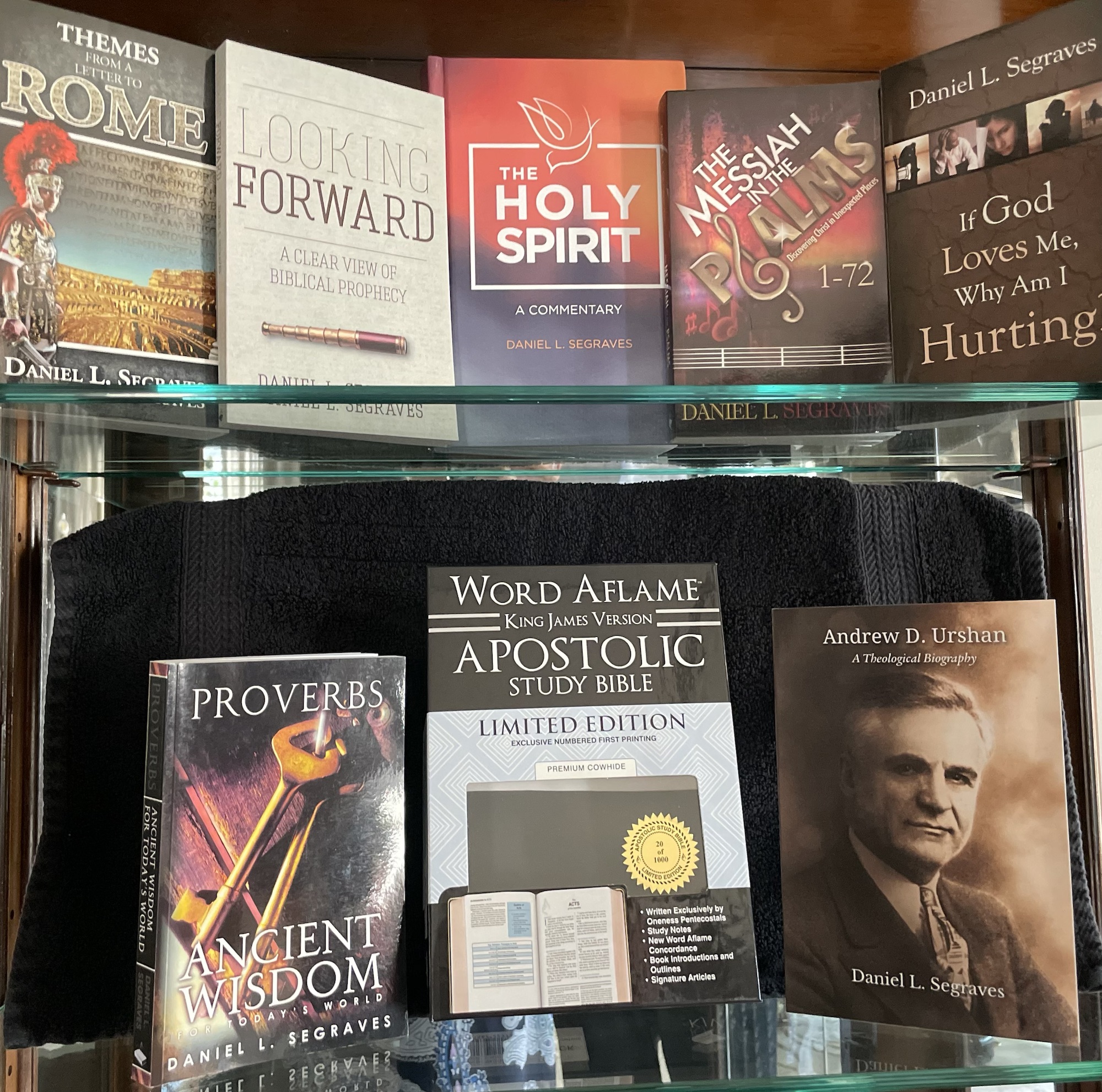
I was happy to introduce my newest book, titled The Holy Spirit, to the students. Of course I couldn’t cover all 314 pages in one afternoon of teaching, but I was able to explain the major themes and some of the key biblical texts about the Holy Spirit. The fact that the Spirit of God appears first in the second verse of the Holy Bible and also in the fifth verse from the end of the Bible demonstrates the high profile of the Spirit in the inspired Scriptures. Altogether, there are more than 330 references to the Holy Spirit in Scripture. In the Old Testament, the Spirit is referred to about once every 11.6 chapters. In the New Testament, on average, about once per chapter. My book is available at pentecostalpublishing.com as well as on Amazon.com.

I recommend Urshan University and Urshan Graduate School of Theology to apostolic students who wish to earn regionally and professionally accredited degrees from the undergraduate level to the doctoral level. You can access all information at http://www.urshan.edu.

[archive]

Purpose Institute and Bible Project

March 29, 2025 | Daniel L. Segraves, Ph.D.

Today I taught the third session in a four lesson series on the Pentateuch for Purpose Institute, a Bible training program endorsed by the United Pentecostal Church International.

I have taught many times for Purpose Institute on three different campuses, but this was the first time I have incorporated any videos produced by the BibleProject.

If you are not familiar with BibleProject, I recommend you check out this free resource. [bibleproject.com] In the simplest of terms, I would describe the project’s program as providing professionally produced videos on every book of the Bible in addition to topical Bible studies.

My interest in this was kindled when I read an article in Christianity Today describing the project, identifying the scholars involved, and tracing their academic backgrounds.

When I discovered that those who founded BibleProject were once students of John H. Sailhamer and Ray Lubeck of Western Seminary, I knew I wanted to investigate what they were doing. Sailhamer and Lubeck were two of my favorite professors when I was studying for the Th.M. at Western. One of the BibleProject developers was enrolled in Lubeck’s course on the TaNaK at the same time as I was. I remember an intriguing paper he presented in class on what we commonly call the Minor Prophets.

I studied the Torah and Psalms under Sailhamer, whose reputation was that of a world class Old Testament scholar. The insights I gained transformed my perspectives on these Scriptures, leading to my first commentary on Psalms. The second volume is now with the publisher, and I am at work on the third volume.

[archive]

Israel and Paul’s great sorrow and continual grief.

February 27, 2025 | Daniel L. Segraves, Ph.D.

After our breakfast and Bible reading this morning, Susan and I sat at the kitchen table for a while to discuss some of Paul’s writings about Israel in Romans 9-11.

Like many others, we are concerned about the suffering reported in the daily news, and we pray for the peace of Jerusalem.

Some years ago, Dr. David K. Bernard, the general superintendent of the United Pentecostal Church International, invited me to submit a document examining the major themes of the Book of Romans. This document, covering these seven themes, was published by Word Aflame Press under the title Themes from a Letter to Rome.

Chapter 6 is titled “Jews: Showing the Favor of God to His National People.” Among other topics, this chapter explores Romans 9 (Israel’s past), Romans 10 (Israel’s present), and Romans 11 (Israel’s future).

Many verses from this section of Romans grip our imagination because of what we have seen in world history and what we continue to observe now. For example:

“I have great sorrow and continual grief in my heart. For I could wish myself accursed from Christ for my brethren, my countrymen according to the flesh. … For they are not all Israel who are of Israel” (Romans 9:2-3).

“My heart’s desire and prayer to God for Israel is that they may be saved” (Romans 10:1).

“God has not cast away His people whom He foreknew. … Blindness in part has happened to Israel until the fullness of the Gentiles has come in. And so all Israel will be saved” (Romans 11:2, 25, 26).

Verses like these are just a few of those demanding careful and prayerful reading in Paul’s letter to the church at Rome. If you are concerned about what you see in today’s world, I encourage you to obtain a copy of this book. It is available at pentecostalpublishing.com in both paperback and eBook formats and from Amazon.com in the Kindle Edition.

[archive]

Goodbye World, Goodbye!

February 19, 2025 | Daniel L. Segraves, Ph.D.

“For the Lord Himself will descend from heaven with a shout, with the voice of an archangel, and with the trumpet of God. And the dead in Christ will rise first. Then we who are alive and remain shall be caught up together with them in the clouds to meet the Lord in the air. And thus we shall always be with the Lord” (I Thessalonians 4:16-17, NKJV).

[archive]

The first purchase for our new home.

February 18, 2025 | Daniel L. Segraves, Ph.D.

Eleven years ago today, Susan and I made the first purchase for our new home.

We married on September 28, 2013 and lived for six months in a two bedroom suite at the Residence Inn by Marriott in Earth City, Missouri while our home was being built. We moved in to our new home on April 23, 2014.

What a day that was! At the beginning of the day we had no grass. Not a blade. But throughout the day thirteen men were on site, laying sod, carrying our furniture in from the Bekins truck parked out front, and two men were hanging wallpaper in different rooms.

As I passed by one of the paperhangers, I heard him say on his cellphone, “This place is a madhouse!”

But by the end of the day we had a full, lush lawn, front and back. All the furniture was in the house. All the paper was hung.

We were home.

About one month after our marriage, Susan and I visited a local Lacefield Music Store. There we viewed the beautiful Kawai pianos on display. On such occasions I always enjoy experimenting with the pianos. We really did not plan to buy one that day, but the store manager assured us we could still purchase a K. Kawai for the Black Friday price even though we were past that day. We took the bait, but we could not take delivery until our house was built.

In the meantime, Lacefield had a top of the line Shigeru Kawai on display. I took advantage of playing this astounding concert grand while we were in the store. If you wish, you can view the video below.

Two days after we moved in, two men arrived with our new K. Kawai, seen below. I have enjoyed playing this piano now for eleven years. It is less than ten feet from the desk where I spend a lot of time doing research and writing my new books.

Susan and I are so grateful to God for His lovingkindness. He brought us together, He has met all our needs, and His presence dwells in the home He has given us.

[archive]

Good News!

February 5, 2025 | Daniel L. Segraves, Ph.D.

I am so happy to report that at 3:43 PM today I received an email from Everett Gossard, Book Editor for the Pentecostal Resources Group informing me that my manuscript for the second volume of The Messiah in the Psalms: Discovering Christ in Unexpected Places has been accepted for publication.

By 4:56 PM I had the contract signed, scanned, and emailed.

I’m thankful for Brother Gossard’s guidance in this project, and I’m already at work on volume 3, which will consist of Book 5 of the Psalter. This consists of Psalms 107-150.

Right away, I have noticed that in this section of the Book of Psalms the Aramaic Targums are replete with the use of Memra, as are Books 3 and 4. The word Memra appears 35 times between Psalm 107 and Psalm 148. My interest is in how Memra is used in the Targums as a kind of interpretative paraphrase for Yahweh, usually rendered LORD in English translations.

I am especially interested to note the use of Memra in Psalm 110:1. This is a significant verse for Christology. It is quoted, paraphrased, or alluded to in the New Testament more than any other Old Testament verse. It is, in fact, the last full verse of the Old Testament quoted by Peter before Acts 2:38, playing a significant role in convicting them and prompting them to ask, “Men and brethren, what shall we do?”

Indeed, the word “Memra” appears in the Targum of Psalm 110:1, giving us guidance to grasp how first century believers may have understood this verse.

When Jesus asked the Pharisees, “What do you think about the Christ? Whose Son is He?” they answered, “The Son of David.” Jesus responded, “How then does David in the Spirit call Him ‘Lord,’ saying, ‘The LORD said to my Lord, “Sit at My right hand, Till I make Your enemies Your footstool” ‘? “If David then calls Him ‘Lord,’ how is He his son?”

The Pharisees were unable to answer a word. From that day, no one dared question Jesus. (See Matthew 22:41-46.)

I will keep you updated on my progress as I work toward Psalm 150.

[archive]

With gratitude ….

January 27, 2025 | Daniel L. Segraves, Ph.D.

PDF Embedder requires a url attribute

I am grateful for the privilege of ministering for sixty years within the fellowship of the United Pentecostal Church International. In my prayers, I frequently express my gratitude to God for those He has brought into my life who have had a good influence on me.

I cannot list all those who have pointed me in the right direction, but they certainly include my parents, Glen and Agnes Segraves. My father was my first pastor. My grandfather, L. D. Segraves, was the first apostolic preacher in my family.

Other pastors and teachers whose voices I can still hear include Clyde J. Haney, my pastor and one of my teachers at what was then known as the Western Apostolic Bible College. Another influential teacher at that time was Paul Dugas, whose son Timothy later became my pastor.

Since my calling in life focused not only on pastoring but on teaching, I sat under a wide variety of teachers in the process of earning various degrees required to qualify for professorial duties in accredited schools. Since the UPCI did not yet have accredited schools where such degrees could be earned, many of my teachers were not identified with the apostolic movement. Nevertheless, the learning experience was valuable and helpful, enabling me to participate in preparing our own graduate school for accreditation.

God is still at work in my life today through the influence of my pastor, Mitchell Bland, my friends in ministry, and my peers who understand the call into the world of academia.

Thank you, United Pentecostal Church. This is my home. This is my church. I love you.

[archive]