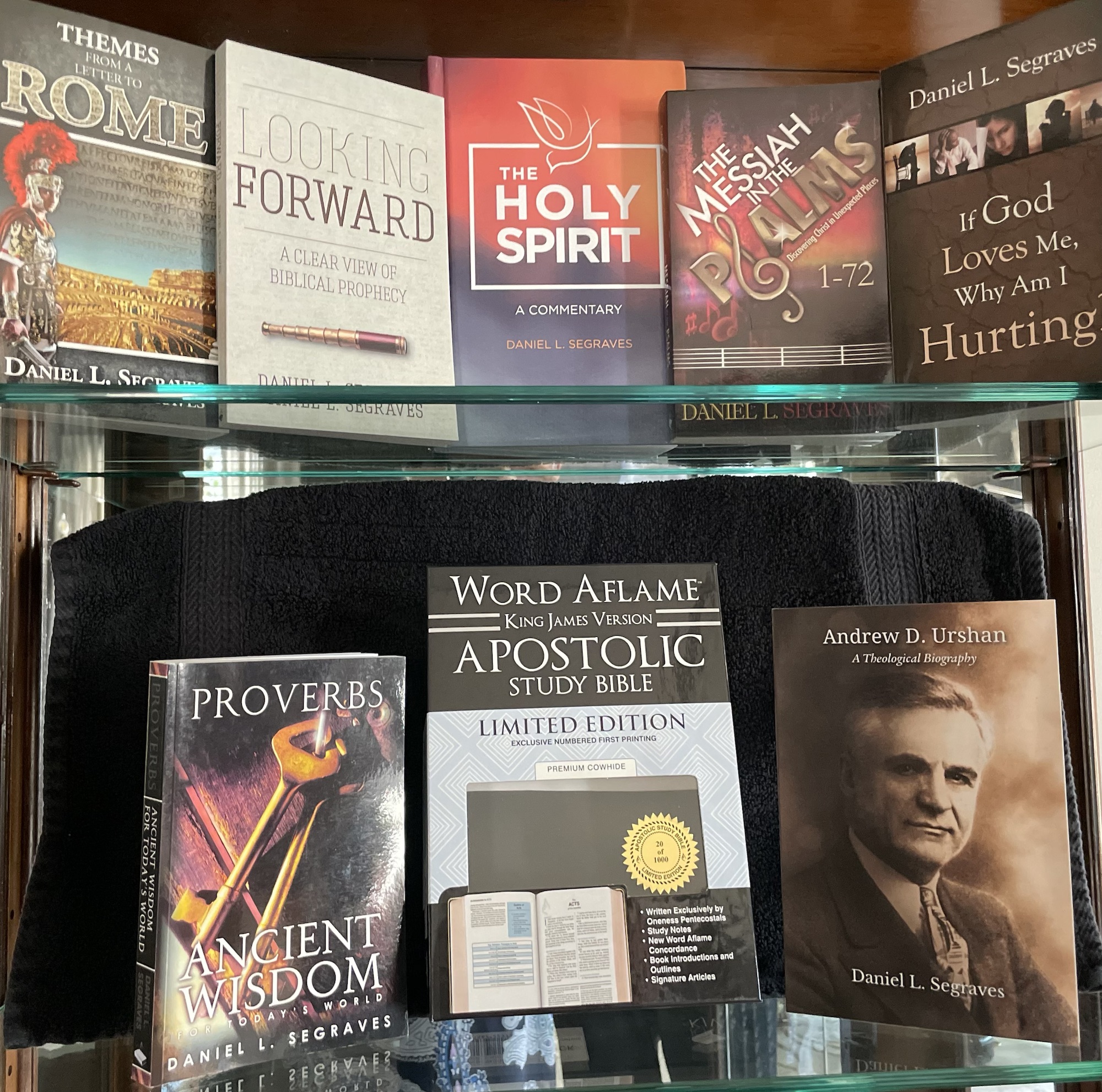
April 5, 2025 | Daniel L. Segraves, Ph.D.
This lesson was prepared for an elective class at The Sanctuary UPC in Hazelwood, Missouri, where Mitchell Bland is pastor.
Can you imagine Jesus teaching a course in hermeneutics? If He did, would you want to enroll? Would He use a chalkboard, a whiteboard, or an overhead projector? Would He embrace today’s technology with its PowerPoint slides or perhaps even video clips? What would He use for a textbook? Do you think He would write His own as I and multitudes of today’s teachers have?[1]
What is (or should I say “are”) hermeneutics, anyway?
The word “hermeneutics” comes from the Greek hermeneuo, which means “to explain” or “to translate.” It is used in John 1:38, 42; 9:7 and Hebrews 7:2. Another form of the word, hermeneia, appears in I Corinthians 12:10 and 14:26, in a discussion of the gift of the interpretation of tongues. Luke 24:27 records Jesus’ encounter with the two disciples on the road to Emmaus: “And beginning at Moses and all the prophets, he expounded unto them in all the scriptures the things concerning himself.” The word “expounded” is the Greek diermeneuo, a compound word composed of the preposition dia, meaning “through” (making the word an intensive), and hermeneuo, meaning “to interpret.” The word thus means “to interpret fully.” This same Greek word is also used in Acts 9:36 and I Corinthians 12:30; 14:5, 13, 27.
The word “hermeneutics” itself can refer to any kind of interpretation; it has no specific theological reference. It could, for example, refer to the interpretation of Shakespeare, Homer, Aristotle, or any piece of literature. When referring to the interpretation of Scripture, the proper term to use is “biblical hermeneutics.”
Biblical hermeneutics is the science of interpreting the holy Scriptures.
The fact is that Jesus did teach hermeneutics. In about eighty quotations from the Old Testament, Jesus taught His disciples (i.e., learners) how to understand the Hebrew Scriptures. He even went so far as to teach from a translation, the Septuagint (a Greek translation of the Scriptures). His disciples found these events to be profound learning experiences. Although they believed on Jesus, there were many Scriptures they did not understand. For example, after Jesus visited with the two disciples He met on the road to Emmaus, they said to one another, “Did not our heart burn within us while He opened the Scriptures to us” (Luke 24:32). Later, after eating with a larger group of disciples and shortly before His ascension, Jesus said to them, “These are the words which I spoke to you while I was still with you, that all things must be fulfilled which were written in the Law of Moses and the Prophets and the Psalms concerning Me.” Then, “He opened their understanding, that they might comprehend the Scriptures” (Luke 24:44).
In his book Asking the Right Questions, Matthew S. Harmon discusses these ideas. He concludes that there are “four key principles that help us read and understand the Bible the way Jesus tells us to.”[2] His insights are helpful. Let’s think about them.
Responding to Jewish leaders who persecuted and sought to kill Him, Jesus said, “You search the Scriptures, for in them you think you have eternal life; and these are they which testify of Me. But you are not willing to come to me that you may have life” (John 5:39).
Reflecting on this verse, Harmon writes, “Stop for a minute to realize what Jesus is saying. These Jewish leaders, who have been considered the leading experts on the Old Testament, have missed the main point of the Scriptures—Jesus himself! The very people who should have most readily recognized who Jesus is based on their knowledge of the Bible not only have failed to recognize him as Messiah but also are actively opposing him.[3]
“Jesus concludes this encounter with sobering words for these Jewish leaders. On the last day, when these leaders appear before God, Jesus says:
Do not think that I will accuse you to the Father. There is one who accuses you: Moses, on whom you have set your hope. For if you believed Moses, you would believe me; for he wrote of me. But if you do not believe his writings, how will you believe my words? (John 5:45–47)
“The very words of Moses that these Jewish leaders cherish will be the basis for their condemnation by God on the last day. And Moses will be one of the prosecuting attorneys.[4]
“From this passage we can draw at least two conclusions. First, Jesus believes that Scripture points to him in such a clear way that those who read Scripture should see him in its pages. In fact, he holds people responsible for not doing so, with eternal consequences.
“Second, there are ways of reading Scripture that miss the main point of the Bible. That danger remains just as real today. So as followers of Jesus we must be sure we are reading the Bible the right way. Jesus addresses this issue even more directly in Luke 24.”[5]
Turning next to Luke 24, Harmon explains how Jesus’ post-resurrection appearances provided direction on how the Scriptures should be interpreted.
“Luke gives the most extended account of the day Jesus rose from the dead. After the discovery of the empty tomb by the women (24:1–12), the scene shifts to two of Jesus’s followers walking on the road to Emmaus (24:13–35). As they discuss the events of the weekend, Jesus joins their conversation. Not realizing that it is Jesus (24:16 says, “Their eyes were kept from recognizing him”), the men begin to explain to him all that has happened. They describe Jesus as ‘a prophet mighty in deed and word before God and all the people’ (24:19) who was condemned by the religious leaders and handed over to be crucified (24:20). Before these events they ‘had hoped that he was the one to redeem Israel’ (24:21). But then the unexpected happened: some women discovered that Jesus’s tomb was empty and were told by angels that he had risen from the dead (24:22–23). This seemingly unbelievable news was even confirmed by some of his male followers (24:24).[6]
“Rather than marvel at the events the men describe, Jesus sternly rebukes them: ‘O foolish ones, and slow of heart to believe all that the prophets have spoken! Was it not necessary that the Christ should suffer these things and enter into his glory?’ (24:25–26). Far from being a tragic turn of events, all that happened in Jerusalem was absolutely necessary, Jesus insists. But he does not leave the two men wondering what he means by this; notice what he does next: ‘And beginning with Moses and all the Prophets, he interpreted to them in all the Scriptures the things concerning himself’ (24:27).”[7]
Can you imagine being in on that “Bible study”? Jesus starts with the first five books of the Bible (written by Moses) and continues on through “all the Prophets.” By “all the Prophets,” Jesus means not just the books that today we call the prophetic books (Isaiah, Jeremiah, Ezekiel, Daniel, the twelve “Minor” Prophets) but also what we call the Historical Books (basically Joshua through 2 Kings). Jesus works his way through these books of the Bible, interpreting them so that these two men can understand how they point to him. The way Luke describes this event strongly suggests that Jesus is not merely highlighting individual verses or passages, but explaining how the whole storyline of the Old Testament points toward him.[8]
“Given how much space Luke devotes to this encounter, it is clear that he wants to emphasize the risen Jesus explaining how to read the Old Testament. And when Luke returns to this same subject later in this same chapter, any remaining doubt is removed. But first we need to set the stage.[9]
“It is later that night. The two men Jesus met on the road to Emmaus have returned to Jerusalem and told the small band of Jesus’s followers what happened to them when he appeared to them (Luke 24:33–35). As they are talking about this, Jesus appears in their midst (24:36). Despite their initial fear, Jesus reassures them of who he is, even going so far as to eat a piece of fish in front of them (24:37–43)![10]
“With their fears now relieved, Jesus begins to piece together what happened, starting at the same place where he began with the two men on the road earlier that day: ‘These are my words that I spoke to you while I was still with you, that everything written about me in the Law of Moses and the Prophets and the Psalms must be fulfilled’ (Luke 24:44). What Jesus has said to the two men on the road to Emmaus he now repeats to the larger group of disciples. In addition to mentioning again Moses and the Prophets, here Jesus also refers to the Psalms. By doing so Jesus is reinforcing his claim that the whole Old Testament finds its fulfillment in who he is and what he has done.[11]
“But without what happens next, Jesus’s disciples will not get it. So, Luke says, Jesus ‘opened their minds to understand the Scriptures’ (24:45). While this is no doubt a supernatural act, Jesus opens their minds by means of the explanation of the Scriptures that follows. Jesus says, ‘Thus it is written, that the Christ should suffer and on the third day rise from the dead, and that repentance and forgiveness of sins should be proclaimed in his name to all nations, beginning from Jerusalem’ (24:46–47).”[12]
Thus Jesus “provides a summary of the message of the Old Testament. According to Jesus, the basic message of the Old Testament has two main points: (1) the Christ would suffer and then rise from the dead, and (2) repentance and forgiveness would be proclaimed to all the nations.”[13]
“So what do we learn about reading the Bible from this passage? First, Jesus rebukes his followers for failing to recognize that the main message of Scripture is focused on him. Jesus expects his people to understand the Bible in a certain way. So if we read the Bible in a way that doesn’t see Jesus and what he has done through the gospel as central, we are not reading the Bible the way Jesus tells us to read it.[14]
“Second, reading and understanding the Bible the way Jesus commands requires help from God.[15]
“Third, all of Scripture points in some way to Christ and what he has done for us. It’s not just certain obvious passages that point to Christ and the gospel. Every single passage in some way points to the need for Christ, anticipates/describes who he is, anticipates/describes what he does, or indicates how we should live as his people. God is bringing to fulfillment all that he has promised to do in and through Jesus Christ.[16]
“Fourth, the basic story of Scripture centers on the death and resurrection of Jesus, the announcement of that good news to all the nations, and the call for people to turn from their sins and trust in Christ.”[17]
Now, Harmon offers the “four key principles that help us read and understand the Bible the way Jesus tells us to.”[18]
“First, since Christ is the fulfillment of God’s promises in the Old Testament and the focal point of what he is doing in this world, every passage of Scripture connects to Christ and his work in some way. Paul writes that ‘all the promises of God find their Yes in him. That is why it is through him that we utter our Amen to God for his glory’ (2 Cor. 1:20). In other words, every promise of God depends in some way on the person and work of Jesus for its fulfillment.[19]
“Second, despite all its diversity, the Bible tells an overarching story of God establishing his kingdom by saving his people through Jesus Christ and sending out his saved people to proclaim his glory to the ends of the earth.[20]
“Third, because God is sovereign, he has ordered human history so that earlier events, people, and institutions correspond to later events, people, and institutions.[21]
“Fourth, as we read the Bible and grow in our understanding of who Christ is and what he has done, we should constantly deepen our understanding of both the Bible and Jesus Christ. The earliest followers of Jesus were continually going back to the Bible with their understanding of who Jesus is and seeing fresh things in Scripture about him. In turn those new insights into Scripture further deepened their understanding of who Jesus is and what he has done.”[22]
As he comes to the conclusion of this section of his book, Harmon says, “[W]hen the early Christians looked at Jesus, they did so through the lenses of the Old Testament, and when they looked at the Old Testament, they did so through the lenses of redemption in Christ.”[23]
Finally, he writes, “If we approach every passage of Scripture with the expectation that it will somehow point us toward Christ, we will begin to see Scripture in a fresh way.”[24]
So what do you think? Have you learned something from Jesus’ hermeneutics class that will help you understand the Scriptures more clearly?
© 2025 by Daniel L. Segraves
[1] My hermeneutics textbook is You Can Understand the Bible: Guidelines for Interpreting Scripture. It is available at pentecostalpublishing.com and Amazon.com.
[2] Matthew S. Harmon, Asking the Right Questions: A Practical Guide to Understanding and Applying the Bible (Wheaton, IL: Crossway, 2017), 51.
[3] Harmon, 44–45.
[4] Harmon, 44–47.
[5] Harmon, 47.
[6] Harmon, 47–48.
[7] Harmon, 48.
[8] Harmon, 48.
[9] Harmon, 48.
[10] Harmon, 48–49.
[11] Harmon, 49.
[12] Harmon, 49.
[13] Harmon, 49–50.
[14] Harmon, 50.
[15] Harmon, 50.
[16] Harmon, 50.
[17] Harmon, 50.
[18] Harmon, 51.
[19] Harmon, 51.
[20] Harmon, 51.
[21] Harmon, 52.
[22] Harmon, 52.
[23] Harmon, 52.
[24] Harmon, 52–53.
[archive]


