Israel and Paul’s great sorrow and continual grief.

February 27, 2025 | Daniel L. Segraves, Ph.D.

After our breakfast and Bible reading this morning, Susan and I sat at the kitchen table for a while to discuss some of Paul’s writings about Israel in Romans 9-11.

Like many others, we are concerned about the suffering reported in the daily news, and we pray for the peace of Jerusalem.

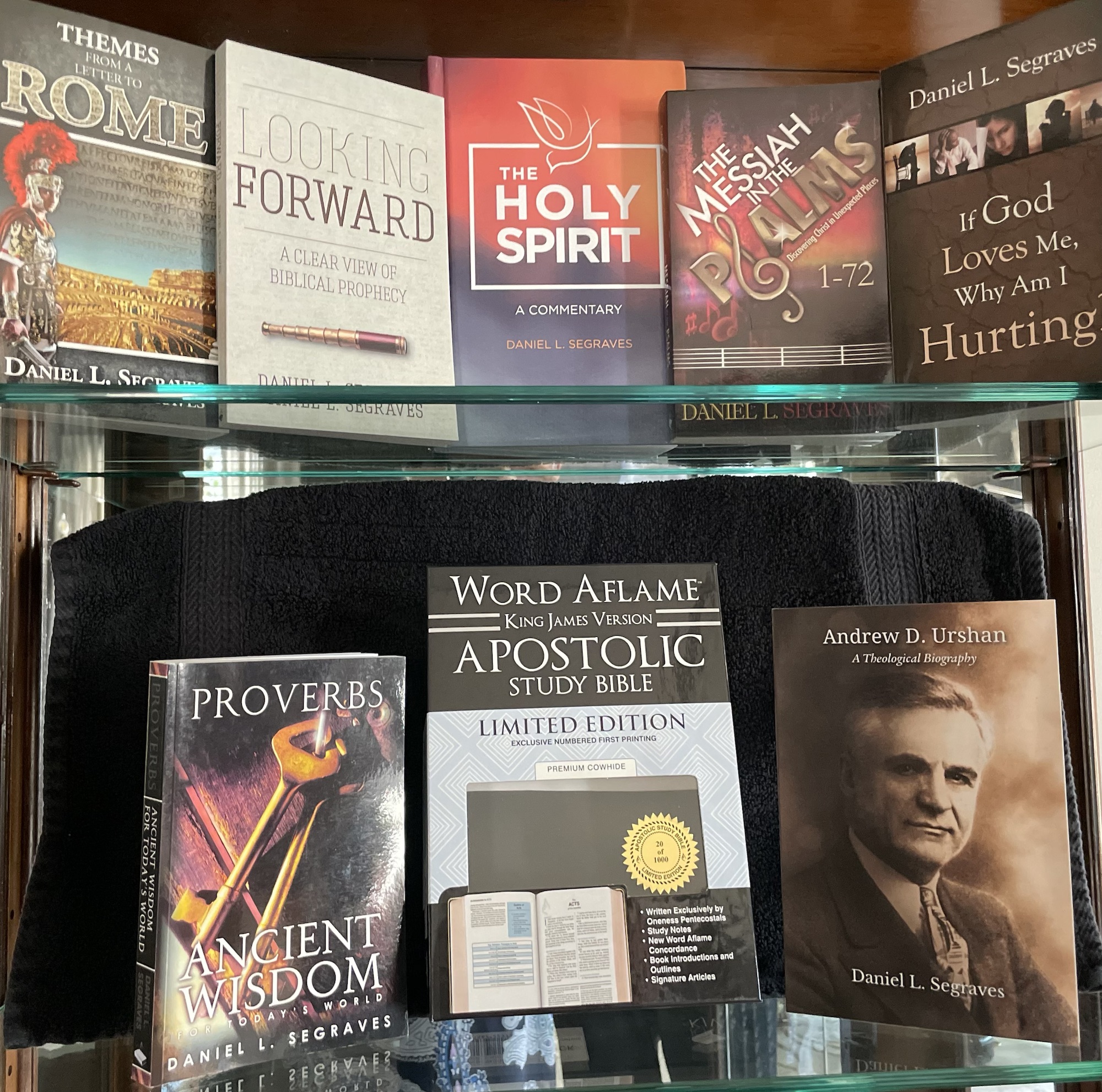
Some years ago, Dr. David K. Bernard, the general superintendent of the United Pentecostal Church International, invited me to submit a document examining the major themes of the Book of Romans. This document, covering these seven themes, was published by Word Aflame Press under the title Themes from a Letter to Rome.

Chapter 6 is titled “Jews: Showing the Favor of God to His National People.” Among other topics, this chapter explores Romans 9 (Israel’s past), Romans 10 (Israel’s present), and Romans 11 (Israel’s future).

Many verses from this section of Romans grip our imagination because of what we have seen in world history and what we continue to observe now. For example:

“I have great sorrow and continual grief in my heart. For I could wish myself accursed from Christ for my brethren, my countrymen according to the flesh. … For they are not all Israel who are of Israel” (Romans 9:2-3).

“My heart’s desire and prayer to God for Israel is that they may be saved” (Romans 10:1).

“God has not cast away His people whom He foreknew. … Blindness in part has happened to Israel until the fullness of the Gentiles has come in. And so all Israel will be saved” (Romans 11:2, 25, 26).

Verses like these are just a few of those demanding careful and prayerful reading in Paul’s letter to the church at Rome. If you are concerned about what you see in today’s world, I encourage you to obtain a copy of this book. It is available at pentecostalpublishing.com in both paperback and eBook formats and from Amazon.com in the Kindle Edition.

[archive]

Goodbye World, Goodbye!

February 19, 2025 | Daniel L. Segraves, Ph.D.

“For the Lord Himself will descend from heaven with a shout, with the voice of an archangel, and with the trumpet of God. And the dead in Christ will rise first. Then we who are alive and remain shall be caught up together with them in the clouds to meet the Lord in the air. And thus we shall always be with the Lord” (I Thessalonians 4:16-17, NKJV).

[archive]

The first purchase for our new home.

February 18, 2025 | Daniel L. Segraves, Ph.D.

Eleven years ago today, Susan and I made the first purchase for our new home.

We married on September 28, 2013 and lived for six months in a two bedroom suite at the Residence Inn by Marriott in Earth City, Missouri while our home was being built. We moved in to our new home on April 23, 2014.

What a day that was! At the beginning of the day we had no grass. Not a blade. But throughout the day thirteen men were on site, laying sod, carrying our furniture in from the Bekins truck parked out front, and two men were hanging wallpaper in different rooms.

As I passed by one of the paperhangers, I heard him say on his cellphone, “This place is a madhouse!”

But by the end of the day we had a full, lush lawn, front and back. All the furniture was in the house. All the paper was hung.

We were home.

About one month after our marriage, Susan and I visited a local Lacefield Music Store. There we viewed the beautiful Kawai pianos on display. On such occasions I always enjoy experimenting with the pianos. We really did not plan to buy one that day, but the store manager assured us we could still purchase a K. Kawai for the Black Friday price even though we were past that day. We took the bait, but we could not take delivery until our house was built.

In the meantime, Lacefield had a top of the line Shigeru Kawai on display. I took advantage of playing this astounding concert grand while we were in the store. If you wish, you can view the video below.

Two days after we moved in, two men arrived with our new K. Kawai, seen below. I have enjoyed playing this piano now for eleven years. It is less than ten feet from the desk where I spend a lot of time doing research and writing my new books.

Susan and I are so grateful to God for His lovingkindness. He brought us together, He has met all our needs, and His presence dwells in the home He has given us.

[archive]

Good News!

February 5, 2025 | Daniel L. Segraves, Ph.D.

I am so happy to report that at 3:43 PM today I received an email from Everett Gossard, Book Editor for the Pentecostal Resources Group informing me that my manuscript for the second volume of The Messiah in the Psalms: Discovering Christ in Unexpected Places has been accepted for publication.

By 4:56 PM I had the contract signed, scanned, and emailed.

I’m thankful for Brother Gossard’s guidance in this project, and I’m already at work on volume 3, which will consist of Book 5 of the Psalter. This consists of Psalms 107-150.

Right away, I have noticed that in this section of the Book of Psalms the Aramaic Targums are replete with the use of Memra, as are Books 3 and 4. The word Memra appears 35 times between Psalm 107 and Psalm 148. My interest is in how Memra is used in the Targums as a kind of interpretative paraphrase for Yahweh, usually rendered LORD in English translations.

I am especially interested to note the use of Memra in Psalm 110:1. This is a significant verse for Christology. It is quoted, paraphrased, or alluded to in the New Testament more than any other Old Testament verse. It is, in fact, the last full verse of the Old Testament quoted by Peter before Acts 2:38, playing a significant role in convicting them and prompting them to ask, “Men and brethren, what shall we do?”

Indeed, the word “Memra” appears in the Targum of Psalm 110:1, giving us guidance to grasp how first century believers may have understood this verse.

When Jesus asked the Pharisees, “What do you think about the Christ? Whose Son is He?” they answered, “The Son of David.” Jesus responded, “How then does David in the Spirit call Him ‘Lord,’ saying, ‘The LORD said to my Lord, “Sit at My right hand, Till I make Your enemies Your footstool” ‘? “If David then calls Him ‘Lord,’ how is He his son?”

The Pharisees were unable to answer a word. From that day, no one dared question Jesus. (See Matthew 22:41-46.)

I will keep you updated on my progress as I work toward Psalm 150.

[archive]