A glance toward the future from a very old psalm: Psalm 90

October 26, 2024 | Daniel L. Segraves, Ph.D.

At about 12:15 this morning, I finished my work on Psalm 90, the first psalm in Book 4 of the Psalter. I had told my wife Susan that I thought I could finish it yesterday, and I almost made it.

The superscription of Psalm 90 informs us it is “A Prayer of Moses the man of God.” It is the only psalm written by Moses, which makes it the oldest in the Book of Psalms. We can’t be sure when it was written, but we can be certain he wrote it before he died! Since I wasn’t able to come up with anything that resembled a close date, I consulted Logos Bible Software’s new AI feature, which assured me that Moses wrote it “by the year 1440 BC.” I’ll go with that.

Since I’m living in 2024, that means Moses wrote the psalm somewhere around 3,464 years ago. That’s why I say it is “a very old psalm.”

When I study the psalms, I always keep in mind that Jesus, just before His ascension, told His disciples, “These are the words which I spoke to you while I was still with you, that all things must be fulfilled which were written in the Law of Moses and the Prophets and the Psalms concerning Me” (Luke 24:44, NKJV). He told the Jewish leaders who did not believe on Him, “There is one who accuses you–Moses, in whom you trust. For if you believed Moses, you would believe Me; for he wrote about Me. But if you do not believe his writings, how will you believe My words?” (John 5:45-47, NKJV).

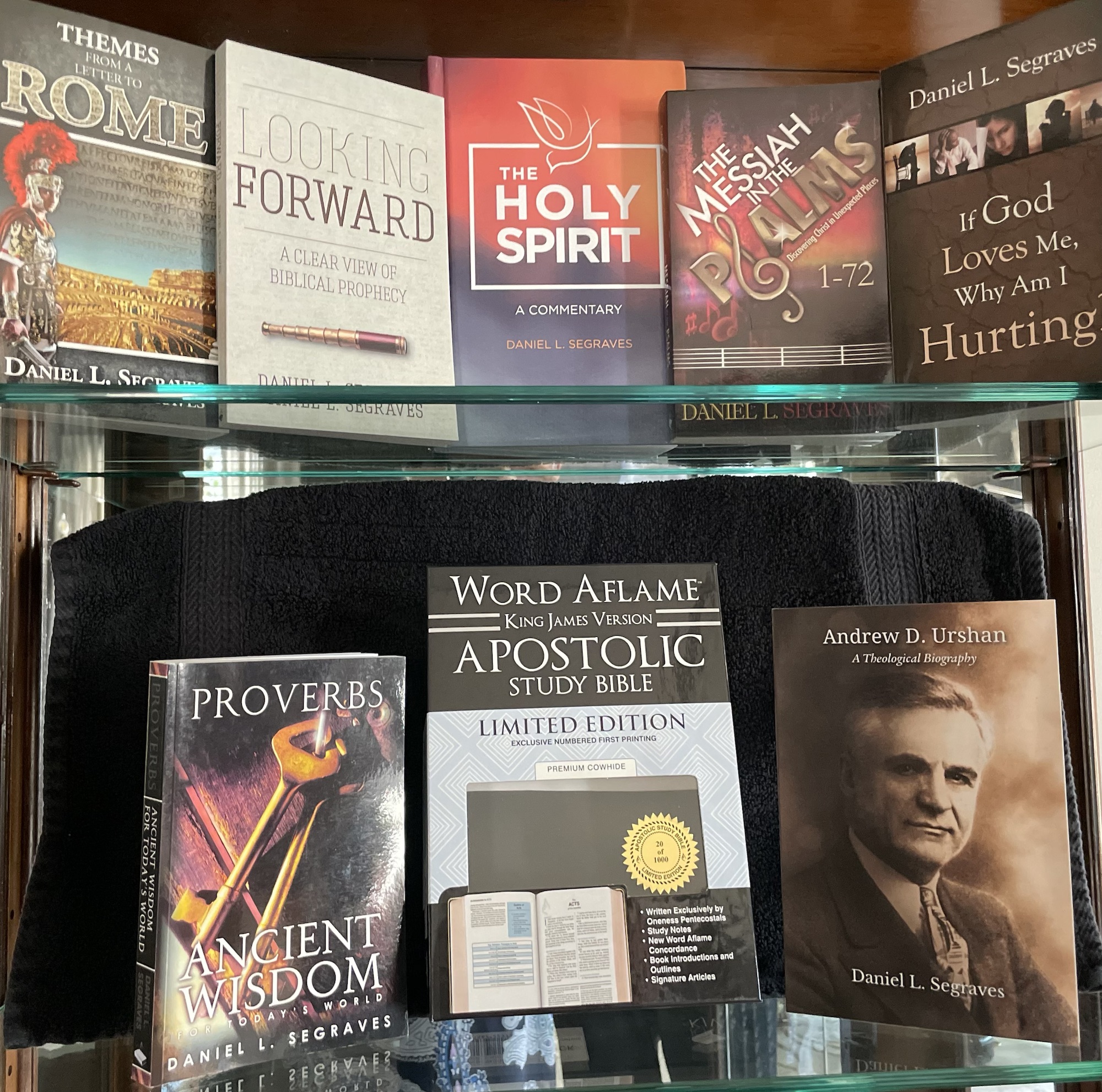
I discovered some interesting things in Psalm 90 that point toward the future. Here’s a hint: They involve servants and children. See if you can figure this out. I’ll tell you what I think in the second volume of my commentary, The Messiah in the Psalms. I hope to finish this up and submit it to the editor by the end of this year. I would be happy to see it published before the 2025 general conference of the United Pentecostal Church International, which will convene in St. Louis, Missouri, my home town!

Now, on to Psalm 91, the psalm from which Satan quoted in his attempt to convince Jesus to throw Himself down from the pinnacle of the temple.

[archive]

Does Psalm 89 include an internal contradiction?

October 22, 2024 | Daniel L. Segraves, Ph.D.

At last, I have finished my work with Psalm 89, the final psalm in Book 3 of the Psalter. Book 3 consists of Psalms 73-89. Early this morning I began work on Psalm 90, “A Prayer of Moses the man of God.” Since this is a prayer of Moses, it is apparently the oldest psalm included in the Psalter. It is, of course, the first psalm in Book 4, which extends through Psalm 106.

As I have mentioned before, my plan is to finish Psalm 106 by the end of this year and to submit it to the editor in hopes of publication before the 2025 general conference of the United Pentecostal Church International.

Now, what’s this about a possible contradiction in Psalm 89? When I post my progress in this project, I often include a snippet of what I have written on each psalm and remind you that my complete work will be included in the published book. I’m not going to do that here. Instead, I will include four verses from Psalm 89 in this post and let you think about their significance as it relates to my question. Here they are:

“I have made a covenant with my chosen, I have sworn unto David my servant, thy seed will I estabish for ever, and build up thy throne to all generations. Selah” (Psalm 89:3-4).

“Thou hast made void the covenant of thy servant: thou hast profaned his crown by casting it to the ground. …Thou hast made his glory to cease, and cast his throne down to the ground” (Psalm 89:39, 44).

Think it over!

[archive]

Psalm 88 … Is There Any Hope?

October 3, 2024 | Daniel L. Segraves, Ph.D.

Tonight, after Susan and I finished viewing the powerful General Conference message delivered by David Bernard, the General Superintendent of the United Pentecostal Church International, I concluded my work on Psalm 88.

This psalm, a personal lament of Heman, a singer and musician appointed by King David, is challenging because of its persistent sense of hopelessness. The themes of the psalm include crying, troubles, thoughts of death, weakness, darkness, wrath, afflictions, isolation, mourning and more.

As I seek to complete my work on Books 3 and 4 of the Psalter, I pray God will help me understand how the Scriptures testify of Jesus, the Messiah. I am thankful to have discovered that there is good news, even in this Psalm of lament.

Tomorrow, I plan to begin my work on Psalm 89.

[archive]